Ridgewood Reservoir: The Engineering Marvel of Brooklyn's Water Supply
In the mid-19th century, the City of Brooklyn faced a critical infrastructure crisis. As the city grew rapidly, its local water supplies could no longer keep pace with the population. By 1851, city officials realized that the lack of a reliable water source was hindering economic growth, making it difficult to attract business firms that were instead drawn to New York City, which benefited from the robust Croton Aqueduct.
To solve this, Brooklyn had to look beyond its immediate borders. The Croton River was already fully utilized by New York City, the Bronx River was inaccessible and inadequate, and local wells and natural lakes on Long Island lacked the necessary quantity and quality. The only viable solution was to harness the numerous small streams across Long Island and transport the water to an elevated reservoir for distribution.
The Design and Construction of the Reservoir
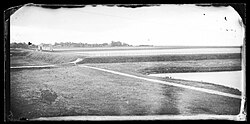
The vision for the Brooklyn Water Works was spearheaded by civil engineer Samuel McElroy. While McElroy's original design proposed three basins, the project was later modified by engineer James P. Kirkwood, who implemented a double basin system. This structure was built on a hilltop in Snediker's Cornfield, located near Evergreen Cemetery in an area of Ridgewood, Queens (now part of Glendale).
Construction began on July 11, 1856. To ensure the reservoir was watertight, engineers used puddling—a process of sealing the basin with compacted clay—while the exterior walls were reinforced with mortar and fieldstone. The system became operational on November 18, 1858.
Expanding the Water Network
By 1862, the reservoir was fed by six dammed streams located in present-day Queens and Nassau Counties: Jamaica Stream (Baisley Pond), Simonson's Stream, Clear Stream, Valley Stream, Pine's Stream, and Hempstead Stream (Hempstead Lake). This water traveled through the Ridgewood Aqueduct, a 12-mile-long masonry conduit, to a pumping station at Atlantic Avenue and Chestnut Street.
At the pumping station, steam-powered pumps—each capable of moving 14 million gallons (53,000 m³) per day—forced the water through a reinforced tube into the high reservoir. By 1868, the Ridgewood Reservoir held an average of 154.4 million gallons (584,000 m³) daily, providing Brooklyn with a ten-day emergency water supply.
Innovation in Driven Wells
One of the most significant technical achievements of the Ridgewood Reservoir was its use of driven wells (wells created by driving a pipe into the ground to reach the water table). This bold approach gained national recognition; a Scientific American article in 1886 praised the originality and success of the plans.
Brooklyn became the largest American city to rely on this technology, setting a precedent for other industrial hubs. By 1900, cities such as Newark, New Jersey, and Lowell, Massachusetts, had adopted similar municipal water systems. At its peak, Brooklyn extracted over 45 million gallons of water per day from these driven wells and other sites.
Growth and Legacy
The Brooklyn Water Works continued to expand throughout the late 19th century. A third basin was completed in 1891, and the conduit was eventually extended 30 miles (48 km) east to a pumping station in Massapequa. However, further expansion was blocked by legislation designed to protect the water resources of Suffolk County.
The infrastructure left a lasting mark on the geography of the region. Early 20th-century roads, including Conduit Boulevard, Force Tube Avenue, and Sunrise Highway, were constructed partially atop or within the right of way of the original water conduit.
Additionally, the land surrounding the reservoir became a public asset. In 1891, the City of Brooklyn purchased the surrounding land, and between 1901 and 1906, Highland Park was developed under the jurisdiction of the Highland Park Society.
Key Facts
- Construction Start: July 11, 1856.
- Operational Date: November 18, 1858.
- Capacity (1868): Average of 154.4 million gallons daily.
- Key Engineers: Samuel McElroy (original design) and James P. Kirkwood (modified design).
- Water Sources: Six dammed streams including Jamaica, Simonson's, Clear, Valley, Pine's, and Hempstead.
- Technological Milestone: Largest U.S. city to utilize a driven well system in the late 19th century.
| Feature | Detail |
|---|---|
| Location | Glendale (formerly Ridgewood), Queens |
| Conduit Length | 12 miles (initial); extended to 30 miles |
| Pumping Capacity | 14 million gallons per day per pump |
| Sealing Method | Clay puddling and fieldstone walls |
| Associated Park | Highland Park (est. 1901–1906) |
Frequently Asked Questions
Why was the Ridgewood Reservoir built?
It was built because the City of Brooklyn was outgrowing its local water supplies and needed a reliable source to attract business firms and support its growing population.
What are driven wells and why were they important here?
Driven wells are wells created by driving pipes into the ground to access water. The Ridgewood Reservoir's successful use of this technology was considered bold and original, leading other major industrial cities like Newark and Lowell to adopt the same system.
How was the water transported to the reservoir?
Water from six dammed streams was carried via the Ridgewood Aqueduct, a 12-mile masonry conduit, to a pumping station where steam pumps forced the water up into the elevated reservoir.
What happened to the land around the reservoir?
The land was purchased by the City of Brooklyn in 1891 and later developed into Highland Park between 1901 and 1906.
Did the reservoir cause any local conflicts?
Yes, farmers in southern Queens County complained that the city's heavy water extraction was lowering the local water table.