Rhineland: History, Geography, and Industrial Evolution
The Rhineland is a historically rich and loosely defined region of Western Germany centered along the middle section of the Rhine river. Extending occasionally into parts of Belgium, it serves as the primary industrial heartland of Germany, characterized by a dense concentration of factories and a complex political legacy. Its identity has been forged through centuries of influence from the Holy Roman Empire, Prussia, and the German Empire.
From its early roots as a settlement for the Ripuarian and Salian Franks to its modern status as a powerhouse of European industry, the Rhineland has transitioned from a fragmented collection of petty principalities into a cornerstone of the modern German state.
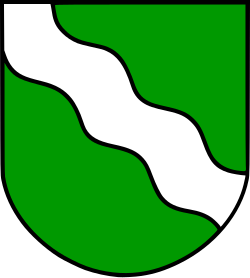
Key Facts
- Economic Role: Germany's main industrial center, particularly in the Ruhr region.
- Historical Roots: Originally settled by Celtic tribes and later conquered by Romans and Franks.
- Political Evolution: Transitioned from Imperial Circles of the Holy Roman Empire to the Prussian Rhine Province.
- Legal Legacy: The Napoleonic Code introduced during French occupation left a lasting impact on the region's legal and social structures.
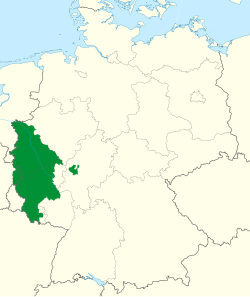
- Modern Division: Now primarily divided among the states of North Rhine-Westphalia, Rhineland-Palatinate, and Hesse.
Defining the Rhineland
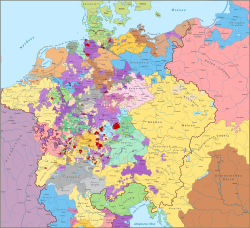
The term "Rhineland" has evolved over centuries. In the High Middle Ages, the area lacked a unified political identity, consisting of various Imperial States emerging from the stem duchy of Lotharingia. A more structured conceptualization appeared between the 16th and 18th centuries under the Holy Roman Empire, where territories were organized into Imperial Circles (regional districts for defense and judicial execution).
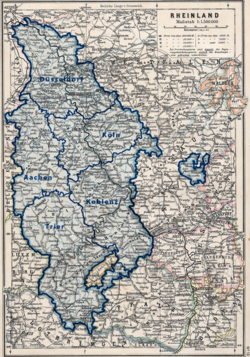
Three specific circles—the Upper Rhenish, Electoral Rhenish, and Lower Rhenish-Westphalian—bore the river's name. Following the French Revolutionary wars, the short-lived Cisrhenian Republic (1797–1802) covered French-annexed territories west of the Rhine. After the fall of Napoleon, Prussia annexed the Lower Rhine and Jülich-Cleves-Berg, formally organizing them into the Rhine Province in 1822.
Global Influence: The Missouri Rhineland
The region's influence extended to the United States in the early 1800s. German settlers established the Missouri Rhineland, a wine-producing area named for its striking topographical and soil similarities to the European Rhineland. By 1860, nearly half of these settlers originated from Koblenz, the capital of the Rhine Province.
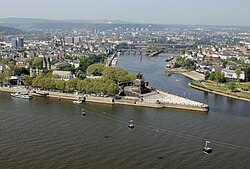
Geography and Urban Centers
The Rhineland's borders stretch from Luxembourg, Belgium, and the Netherlands in the west to the Bergisches Land, Siegerland, and Hessian regions in the east. To the south, it reaches the North Palatine Uplands.
The landscape is diverse, featuring the Rhenish Massif in the south and various hill countries such as the Eifel, Hunsrück, Westerwald, Taunus, and Siebengebirge. These are intersected by the Middle Rhine and its key tributaries: the Moselle, Ahr, and Nahe. The lower Ruhr marks the transition to the North German plain.
The region is home to several major urban and industrial hubs, including:
- Industrial Centers: Duisburg, Düsseldorf, Essen, and Oberhausen.
- Cultural and Political Hubs: Cologne, Bonn, Mainz, and Trier.
- Other Key Cities: Aachen, Koblenz, Krefeld, Leverkusen, Mönchengladbach, Mülheim an der Ruhr, Remscheid, Solingen, and Wuppertal.
Historical Evolution
Pre-Roman and Roman Eras
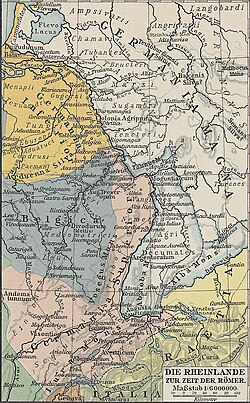
Before Roman arrival, the area between the Ardennes and the Rhine was inhabited by Celtic tribes, including the Treveri and Eburones. On the east bank, Germanic tribes like the Mattiaci, Usipetes, and Tencteri settled. While Julius Caesar conquered the west bank and Augustus established fortified posts, the Romans never fully secured the east bank.
The Frankish and Imperial Periods
As Roman power waned, the Franks conquered the region by the end of the 5th century. Following the Treaty of Verdun, the land was split: the east fell to East Francia and the west to the kingdom of Lotharingia. By the time of Emperor Otto I, both banks were integrated into the Holy Roman Empire.
Over time, the region fragmented into small independent principalities, including the ecclesiastical electorates of Cologne and Trier, the United Duchies of Jülich-Cleves-Berg, and Free Imperial Cities like Aachen and Cologne. Despite this fragmentation, the region remained a center of German culture, with Aachen serving as the coronation site for German emperors.
The French Revolution and Napoleonic Impact
In 1795, France annexed the left bank of the Rhine. Under Napoleon, the region was radically transformed. The French abolished feudal privileges and historic taxes, introduced the Napoleonic Code (a rationalized legal system), and centralized administration. These reforms liberalized the economy and society, liberating Jews from ghettos and increasing industrial prosperity. These changes were so deeply embraced that the Napoleonic Code remained in effect for a century.
Prussian Rule and the World Wars
Prussia's influence grew gradually, starting with the occupation of the Duchy of Cleves in 1609. After the Congress of Vienna, Prussia took control of the lower Rhenish districts, maintaining the liberal institutions established by the French. This remained the status quo until the end of World War I.
Following the 1918 Armistice, the Rhineland was occupied by Allied forces. The Treaty of Versailles banned German military presence in the region. Tensions peaked in 1923 when French and Belgian troops occupied the Ruhr district due to reparations failures, leading to passive resistance and hyperinflation. Although the occupation ended in 1930, Nazi Germany remilitarized the territory in 1936, a move that went largely unchallenged by international powers and emboldened the regime toward war.
Modern Rhineland
In 1946, the region was reorganized into the states of Hesse, North Rhine-Westphalia, and Rhineland-Palatinate. Today, North Rhine-Westphalia remains an industrial titan, rich in minerals such as coal, lignite, and uranium. In contrast, Rhineland-Palatinate focuses more on agriculture, particularly the renowned vineyards of the Mosel, Ahr, and Mittelrhein regions.
| Aspect | Details |
|---|---|
| Primary Industries | Manufacturing, Mining (Coal, Lignite), Viticulture |
| Key Modern States | North Rhine-Westphalia, Rhineland-Palatinate, Hesse |
| Major Rivers | Rhine, Moselle, Ahr, Nahe |
| Historical Influences | Celtic, Roman, Frankish, French, Prussian |
| Religious Character | Strongly Catholic in core territories |
Frequently Asked Questions
What is the significance of the Napoleonic Code in the Rhineland?
The Napoleonic Code replaced outdated feudal laws with a rational, centralized legal system. It abolished feudal privileges and taxes, liberalized the economy, and provided a legal framework that persisted in the region for a century after the French departed.
How did the Ruhr occupation of 1923 affect Germany?
The occupation by French and Belgian troops in response to unpaid reparations led to widespread passive resistance by German workers. This economic disruption contributed significantly to the period of hyperinflation in the Weimar Republic.
Which modern German states encompass the historical Rhineland?
Since 1946, the region has been divided primarily between North Rhine-Westphalia, Rhineland-Palatinate, and parts of Hesse.
Why is the Rhineland considered Germany's industrial heartland?
The region, particularly the Ruhr area, possesses significant mineral deposits—including coal and lignite—and benefits from excellent water transport via the Rhine, which facilitated the growth of massive factory complexes.
What was the "Rhine Province"?
The Rhine Province (or Rhenish Prussia) was an administrative reorganization created by the Prussian government in 1822 to manage the territories annexed after the defeat of the French Empire.