Religious Symbols and Their Global Meanings
A religious symbol is an iconic representation designed to embody a specific faith or a core concept within a religious tradition. These symbols serve as visual shorthand, allowing practitioners to identify their beliefs and communicate complex theological ideas through a single image.
In societies characterized by religious pluralism—such as the Roman Empire in antiquity or modern multicultural nations—these symbols are essential for identification and recognition. Their utility extends into official capacities; for example, the United States military uses specific chaplain symbols, and the U.S. Department of Veterans Affairs recognizes 57 different emblems for headstones and markers, including symbols for non-religiosity.
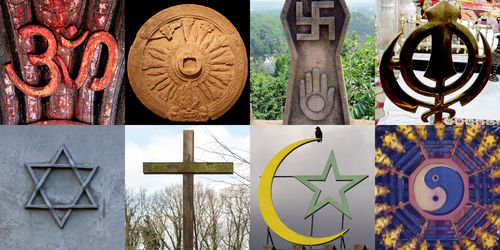
Key Facts

- Universal Utility: Symbols allow for inconspicuous identification of faith, which was historically vital during periods of persecution.
- Evolution: Many symbols, such as the Star and Crescent or the Star of David, evolved over centuries from cultural or political markers into religious icons.
- Aniconism: Some traditions, like Islam, have a strong history of aniconism (the prohibition of depicting sentient beings), leading to the use of calligraphy over figurative imagery.
- Cross-Cultural Use: Certain symbols, like the Swastika, hold positive meanings of prosperity and auspiciousness across Hinduism, Buddhism, and Jainism.
Major World Religions and Their Symbols

Christianity
The Cross and Cruciform is the most recognized symbol of Christianity. While used since early Christianity, it became the dominant symbol during the medieval Crusades. Prior to this, early Christians used more discreet symbols like the Ichthys (fish), Staurogram, and Christogram to identify one another during Roman persecution.
Islam
The Star and Crescent became associated with Islam gradually, largely due to its use as the flag of the Ottoman Empire from 1844 and its presence in Ottoman mosque decorations. Because of aniconism, Islamic calligraphy is frequently used to express core concepts, such as the shahada (declaration of faith) on the Saudi Arabian flag or the takbir on the flags of Iraq and Iran.
Buddhism
The Wheel of Dharma (Dharmachakra) has represented the path to Nirvana since at least the 3rd century BC. While it is the primary symbol in India, Sri Lanka, and Mongolia, the Swastika is more traditionally used in Mahayana Buddhist regions like China, Japan, Korea, and Taiwan.

Hinduism and Jainism
In Hinduism, the Om is a primary sacred sound and symbol. The Swastika is also used, with the clockwise version representing the sun and prosperity, while the counterclockwise version (sauvastika) relates to night or the tantric aspects of Kali. Jainism uses a specific emblem introduced in 1974, featuring a hand with a wheel on the palm to symbolize Ahimsa (non-violence).
Judaism
The Star of David (hexagram) became a recognized symbol of the Jewish community in 17th-century Vienna. An older symbol, the Menorah (seven-branched lampstand), dates back to the Temple in Jerusalem and remains in use today, though it was eventually overtaken in popularity by the Star of David.

Diverse and Indigenous Faith Traditions

African Indigenous Religions
Many African traditions utilize graphical, pictorial, or numerological symbols. The Akan religion uses the Gye Nyame symbol to represent the omnipotence and immortality of the sky god, Nyame. The Serer religion employs the Yoonir, a star representing the universe and destiny, and the Mbot, which symbolizes the Ndut rite of passage for males.
The Ìṣẹ̀ṣe religion of the Yoruba people uses symbols to explain the philosophical concept of the four cardinal points of the earth (Igun Mẹ́rin Ayé), representing the centrality of humanity, divinity, and the cosmos.

Other Notable Traditions
- Sikhism: The Khanda, adopted in 1920, represents the slogan Deg Tegh Fateh.
- Taoism: The Taijitu (Yin and Yang) developed into its modern form in the 17th century to represent dualism.
- Zoroastrianism: The Faravahar symbolizes good thoughts, words, and deeds.
- Shinto: The Torii gate marks the transition from the profane to the sacred, though many Japanese practitioners view it as a gate rather than a religious symbol.
- Wicca: The Pentacle was adopted in the 1960s and is now recognized on U.S. veteran headstones.
Summary of Key Religious Symbols

| Religion | Primary Symbol | Core Meaning/Significance |
|---|---|---|
| Christianity | Cross | Central symbol of the faith and Christendom |
| Islam | Star and Crescent | Historically linked to the Ottoman Empire |
| Buddhism | Wheel of Dharma | The path to Nirvana and Buddha's teachings |
| Hinduism | Om | Sacred sound and spiritual unity |
| Judaism | Star of David | Community identity (prominent since 17th century) |
| Sikhism | Khanda | Representation of Sikh slogans and identity |
| Taoism | Taijitu | Balance of opposing forces (Yin and Yang) |
Frequently Asked Questions





Why did early Christians use symbols like the fish instead of the cross?
Early Christians faced persecution within the Roman Empire. Symbols like the Ichthys (fish) allowed them to identify one another inconspicuously without alerting authorities to their faith.
Is the Swastika only associated with one religion?
No. The Swastika is a sacred symbol in several Eastern traditions. In Hinduism, it represents the sun and prosperity; in Buddhism, it symbolizes the Buddha's auspicious footprints; and in Jainism, it is associated with the 7th Tirthankara, Suparshvanatha.
What is the difference between a Torii gate and a religious symbol?
While Westerners often view the Torii as the symbol of Shinto, many Japanese people perceive it as a functional gate that marks the boundary between the profane world and a sacred realm, rather than a symbolic icon of the religion itself.
How does aniconism affect Islamic symbols?
Aniconism is the prohibition of depicting sentient beings in religious art. This prevented the development of figurative symbols in Islam, leading the faith to rely on calligraphy (written text) and colors to express its core concepts.
What does the Faravahar represent in Zoroastrianism?
The Faravahar is thought to represent a Fravashi (guardian angel) and symbolizes the fundamental Zoroastrian principles of good thoughts, good words, and good deeds.