Red Supergiants: Properties of the Universe's Largest Stars
Red supergiants are among the most imposing objects in the cosmos. Characterized by their immense size and relatively cool surface temperatures, these stars represent a late stage in the evolution of massive stars. While they are not the hottest stars in the universe, their sheer scale allows them to radiate an incredible amount of energy, making them some of the most luminous objects in the night sky.
Key Facts
- Surface Temperatures: Generally below 4,100 K.
- Size: Often hundreds to over a thousand times the radius of the Sun.
- Mass: Typically range between 10 and 40 solar masses (M ☉).
- Luminosity: Frequently tens or hundreds of thousands of times that of the Sun (L ☉).
- Stability Limit: The Hayashi limit suggests a theoretical maximum radius of approximately 1,500 R ☉.
Physical Characteristics and Classification
Red supergiants are identified by their spectral types, primarily falling within the K and M classes. This classification is directly tied to their surface temperatures, which range from 4,100 K down to 3,450 K. Interestingly, size alone does not determine if a star is a supergiant; for instance, the giant star Alpha Herculis is larger (264–303 R ☉) than the K2 supergiant Epsilon Pegasi (185 R ☉).
Despite their cool surfaces, their massive surface area results in extreme luminosity. However, there is a physical boundary known as the Hayashi limit. If a star were to exceed a radius of roughly 1,500 R ☉, it would become too unstable to exist, which is why we do not observe stars beyond this size.
| Spectral Type | Temperature (K) |
|---|---|
| K1–1.5 | 4,100 |
| K2–3 | 4,015 |
| K5–M0 | 3,840 |
| M0 | 3,790 |
| M1 | 3,745 |
| M2 | 3,660 |
| M3 | 3,605 |
| M5 | 3,450 |
Mass Loss and Stellar Evolution
These stars typically originate from main-sequence stars with masses between 10 M ☉ and 40 M ☉. Stars exceeding 40 M ☉ generally do not evolve into red supergiants. Because of their high luminosity and low surface gravity, red supergiants experience extreme mass loss—millions of times greater than that of the Sun. This process creates vast, observable nebulae of gas and dust surrounding the star.
As they age, more massive supergiants lose material more rapidly. Evidence suggests that most red supergiants converge toward a similar mass of approximately 10 M ☉ by the time their cores collapse, though this final value is influenced by the star's initial rotation and chemical composition.
Variability and Surface Dynamics
Most red supergiants exhibit visual variability, meaning their brightness fluctuates over time. They are usually categorized as irregular or semiregular variables, with specific sub-classes: SRC (slow semi-regular) and LC (slow irregular). While most variations are small, some can reach amplitudes of up to four magnitudes.
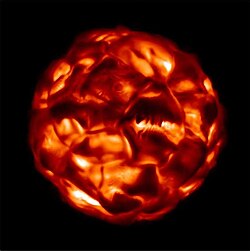
This variability is driven by several factors. Some stars show powerful stellar winds near the end of their lives, while others experience radial and non-radial mode variations. A significant cause of brightness change is photospheric granulation. Unlike the Sun, red supergiants have a small number of very large convection cells on their surface. As the star rotates, these giant cells cause visible shifts in surface brightness.
Chemical Composition and Spectral Analysis
The spectra of these stars are characterized by a dense array of metal absorption lines and molecular bands. Astronomers use specific markers, such as the Ca II triplet and near-infrared cyanogen band strengths, to determine the star's luminosity class.
While hydrogen dominates the surface, the core's hydrogen is completely consumed. Through a process called dredge-up, material processed by the CNO cycle (carbon-nitrogen-oxygen cycle) is brought to the surface, enhancing nitrogen levels while depleting carbon and oxygen. In extreme cases of mass loss, helium may eventually become the most abundant element on the surface.
Maser Emissions
The circumstellar material surrounding red supergiants often produces maser emission (microwave amplification by stimulated emission of radiation), typically from water (H 2 O), silicon monoxide (SiO), and hydroxyl (OH). Using Very Long Baseline Interferometry (VLBI), scientists can use these masers to calculate precise distances to the stars, aiding in the mapping of galactic structures.
Rotation and Angular Momentum
Red supergiants generally rotate very slowly. Even stars that rotated rapidly during their main-sequence phase are slowed down (braked) by the massive amount of material they shed. While most are nearly stationary, some stars like Betelgeuse show modest rotation, which may be the result of interactions with a binary companion. Despite the slow surface rotation, the internal cores continue to rotate, creating a significant differential rotation rate between the core and the surface.
Frequently Asked Questions
Why are red supergiants so luminous if they are cool?
Luminosity depends on both temperature and surface area. Although their surface temperature is low, red supergiants are so physically massive that their total surface area is enormous, allowing them to emit vast amounts of energy.
What is the Hayashi limit?
The Hayashi limit is a theoretical boundary that defines the maximum radius a star can reach while remaining stable. For red supergiants, this limit is approximately 1,500 solar radii.
How do red supergiants lose so much mass?
The combination of extremely high luminosity and very low surface gravity allows stellar winds to push massive amounts of gas away from the star, often creating surrounding nebulae.
What causes the brightness of a red supergiant to change?
Variability is caused by several factors, including powerful stellar winds, radial and non-radial pulsations, and the rotation of giant convection cells on the star's surface.
What is the role of masers in studying these stars?
Masers are naturally occurring microwave lasers in the star's surrounding gas. By observing these emissions with VLBI, astronomers can derive highly accurate distances and parallaxes to the stars.