Realm of New Zealand: Governance and Associated States
The Realm of New Zealand is a unique geopolitical arrangement comprising a sovereign state and several associated territories in the Pacific. While New Zealand is a fully independent nation, it maintains complex legal and diplomatic relationships with the Cook Islands, Niue, and Tokelau, ranging from full free association to varying degrees of self-government.
Key Facts
- New Zealand is a sovereign state and the primary entity within the Realm.
- The Cook Islands and Niue are self-governing states in free association with New Zealand.
- Tokelau is a territory moving toward free association but currently possesses a lower degree of self-government.
- Foreign Affairs and Defence for the associated states are handled by New Zealand, provided they give advice and consent.
- The Ross Dependency is constitutionally part of New Zealand, though its status is subject to the Antarctic Treaty.
New Zealand: The Sovereign Core
New Zealand is recognized as a sovereign state, identified simply as "New Zealand" within the United Nations General Assembly. Its geography extends beyond the mainland to include several distinct island groups and territories.
The core of the nation consists of the North Island, South Island, Stewart Island, and coastal islands like the Solander Islands, all organized into 16 regions. Additionally, the Chatham Islands Territory lies to the east. To the north are the Kermadec and Three Kings Islands, while the New Zealand Subantarctic Islands lie to the south; these remote areas are primarily inhabited by conservation and research staff.
New Zealand also claims the Ross Dependency in Antarctica as a constitutional part of its territory. However, this claim is recognized by only four other countries and is governed by the terms of the Antarctic Treaty signed in 1959.
The Associated States: Cook Islands and Niue
The Cook Islands and Niue operate under a status of free association, meaning they are self-governing states that have chosen to maintain a formal link with New Zealand. This relationship is defined by their respective constitutions, the 2001 Joint Centenary Declaration, and a 1983 Exchange of Letters. Under this arrangement, the New Zealand Parliament cannot unilaterally pass laws for these states.
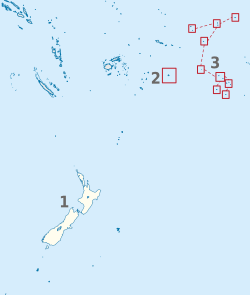
While these states manage their own internal affairs, New Zealand represents them in defence and foreign affairs, acting only with their consent. Diplomatically, they use High Commissioners—representatives who, in Commonwealth practice, represent their governments rather than the head of state. Currently, Catherine Graham serves as the New Zealand High Commissioner to the Cook Islands, and Helen Tunnah serves as the High Commissioner to Niue.
Representation of the Crown
Because the Governor-General resides in New Zealand, the two states handle royal representation differently:
- Cook Islands: The government appoints a King's Representative who is not subordinate to the Governor-General. Sir Tom Marsters has held this position since 2013.
- Niue: According to the 1974 Constitution, the Governor-General of New Zealand serves as the King's Representative and exercises the executive authority of the Crown.
Tokelau: The Path to Self-Government
Tokelau possesses a lower level of autonomy than Niue or the Cook Islands. It is currently represented by an Administrator—a role held by Don Higgins since 2022—who has the authority to overturn rules passed by the General Fono (the Tokelauan parliament).
Tokelau has attempted to move toward a status of free association. However, in referendums held in 2006 and 2007 at the request of the United Nations, the population did not reach the required two-thirds majority to adopt a governance system with powers equal to those of the Cook Islands and Niue.
Summary of Entities within the Realm
| Entity | Status | Legislative Authority | Crown Representative |
|---|---|---|---|
| New Zealand | Sovereign State | Independent Parliament | Governor-General |
| Cook Islands | Free Association | Self-governing | King's Representative |
| Niue | Free Association | Self-governing | Governor-General |
| Tokelau | Non-self-governing | General Fono (subject to Administrator) | Administrator |
Frequently Asked Questions
Can the New Zealand Parliament pass laws for the Cook Islands or Niue?
No, the New Zealand Parliament is not empowered to unilaterally pass legislation for these two states due to their status as self-governing states in free association.
What is the role of a High Commissioner in this context?
In Commonwealth practice, High Commissioners act as diplomatic representatives of their respective governments rather than representatives of the head of state.
Why is the Ross Dependency's status contested?
While New Zealand considers the Ross Dependency part of its territory, only four other countries recognize this claim, and the area is subject to the international regulations of the Antarctic Treaty.
Why hasn't Tokelau achieved free association status?
Tokelau failed to reach the necessary two-thirds majority in referendums conducted in 2006 and 2007 to transition to a governance system equal to that of Niue and the Cook Islands.
Who represents the King in the Cook Islands?
The King is represented by the King's Representative, a position appointed by the Cook Islands Government. Sir Tom Marsters has served in this role since 2013.