Rayonier: A Century of Evolution in Forestry and Timberland Management
From its origins as a regional pulp producer in the Pacific Northwest to its current status as a global timberland powerhouse, Rayonier has spent nearly a century adapting to the shifting demands of the industrial forestry market. Founded in 1926, the company has transitioned through various corporate structures, including a period under ITT and its eventual conversion into a Real Estate Investment Trust (REIT)—a company that owns, operates, or finances income-producing real estate.
Key Facts
- Founded: 1926 as Rainier Pulp and Paper Company in Shelton, Washington.
- Global Reach: Significant historical operations in the United States and New Zealand.
- Major Transition: Converted to a REIT on January 1, 2004.
- Strategic Merger: Announced a combination with PotlatchDeltic in October 2025 to create a $7.1 billion forestry company.
- Land Assets: The combined PotlatchDeltic and Rayonier entity will own approximately 4.2 million acres of US timberland.
The Early Years: Pulp and Paper Foundations
The company began as the Rainier Pulp and Paper Company, taking its name from Mount Rainier. Its first mill, opened in 1927 in Shelton, Washington, utilized Tsuga heterophylla (western hemlock) to produce premium bleached paper pulp.
By 1930, the company partnered with DuPont to produce hemlock pulp specifically for the manufacture of rayon, a semi-synthetic fiber. This strategic shift led to the construction of two more mills in Hoquiam and Port Angeles, Washington. In 1937, the company became publicly traded and rebranded as Rayonier—a portmanteau of "rayon" and "Rainier."
Expansion continued into the southeastern United States with the 1939 opening of a pulp mill in Fernandina Beach, Florida.
Mid-Century Growth and Corporate Shifts
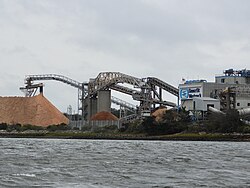
Following World War II, Rayonier aggressively expanded its land holdings in the Pacific Northwest and established the Rayonier Foundation in 1952 to support local charitable and educational organizations. The 1950s marked the company's entry into international markets with sales offices in Asia and Europe, and the opening of a Georgia pulp mill in Jesup in 1954. By 1974, the Jesup facility was expanded to become the largest pulp mill on earth.
The corporate landscape shifted in 1968 when ITT purchased the company, renaming it ITT Rayonier. During this era, the company expanded its global footprint, establishing a presence in China by 1985 and entering the New Zealand market with a log-trading office in 1988 and the purchase of 250,000 acres of timberland in 1992.
Modern Era: REIT Conversion and Strategic Divestment
In 1994, Rayonier was spun off from ITT and returned to the New York Stock Exchange. To align its corporate structure with its land-heavy assets, the company converted to a REIT on January 1, 2004. This was followed by the creation of TerraPointe LLC in 2005 to manage properties with development potential.
The 21st century saw a series of strategic acquisitions and divestments to optimize the portfolio:
- 2013: Sold its wood products division (mills in Baxley, Swainsboro, and Eatonton, Georgia) to Interfor for $80 million.
- 2014: Spun off its performance fibers business into an independent company, Rayonier Advanced Materials Inc. (RYAM).
- 2016: Acquired 61,000 acres in Oregon for $263 million while selling 55,000 acres in Washington for $130 million.
- 2020: Acquired Pope Resources in the Pacific Northwest.
Corporate Infrastructure and Development
In 2017, Rayonier consolidated its headquarters and forest resources offices in Wildlight, Florida. The company is currently developing a 23,600-acre project in Wildlight, with phase two (15,000 acres) beginning in 2022.
Future Outlook: The PotlatchDeltic Merger
Recent years have seen Rayonier streamline its international holdings, including the intended 2025 sale of its New Zealand joint venture interest to the Rohatyn Group for $710 million. The most significant shift occurred in October 2025, when Rayonier and PotlatchDeltic announced an all-stock merger. This deal creates a forestry giant valued at $7.1 billion, managing roughly 4.2 million acres of US timberland. As part of this transition, the headquarters will move to Atlanta, Georgia, in early 2027.
| Year | Event | Significance |
|---|---|---|
| 1926 | Founded | Started as Rainier Pulp and Paper Company. |
| 1937 | Rebranded as Rayonier | Became a publicly traded company. |
| 1968 | ITT Acquisition | Renamed ITT Rayonier. |
| 2004 | REIT Conversion | Shifted to a Real Estate Investment Trust model. |
| 2014 | RYAM Spin-off | Separated performance fibers business. |
| 2025 | PotlatchDeltic Merger | Creation of a $7.1 billion forestry company. |
Frequently Asked Questions
What is the origin of the name Rayonier?
The name is a portmanteau of "rayon," the fiber the company produced for DuPont, and "Rainier," referring to Mount Rainier in Washington state.
When did Rayonier become a REIT?
Rayonier officially converted to a Real Estate Investment Trust (REIT) on January 1, 2004.
What happened to Rayonier's performance fibers business?
In June 2014, the performance fibers business was spun off into an independent, publicly traded company called Rayonier Advanced Materials Inc. (NYSE: RYAM).
Where will Rayonier's headquarters be located after the PotlatchDeltic merger?
The company plans to relocate its headquarters to Atlanta, Georgia, in the first quarter of 2027, while maintaining regional offices in Wildwood, Florida, and Spokane, Washington.
How much land will the combined Rayonier and PotlatchDeltic company own?
The combined entity will own approximately 4.2 million acres of timberland within the United States.