RAF Sutton on Hull: A History of Balloon Command and Fighter Control
Established on the eve of World War II, the base at Sutton on Hull served as a critical node in Britain's aerial defense strategy. From its origins as a hub for barrage balloons to its later role in fighter control and specialized rescue training, the site reflects the evolving nature of military aviation and defense during the mid-20th century.
The Era of No. 17 Balloon Centre
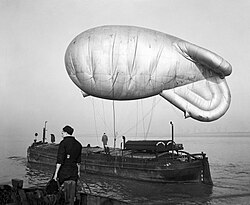
Construction of the base began in late 1938, reaching completion by early 1939. The facility officially opened on June 28, 1939, initially operating as No. 17 Balloon Centre. Its primary purpose was to manage barrage balloons—large tethered balloons designed to obstruct enemy aircraft and force them to fly at higher altitudes, making them more vulnerable to anti-aircraft fire.
The operational structure of the centre relied on three Royal Auxiliary Air Force (RAuxAF) Squadrons: No. 942, 943, and 944 (East Riding). Together, these squadrons were allotted 72 balloons. Each squadron was divided into five flights, with each flight managing nine balloons. The manpower for a single balloon was substantial, consisting of one regular Royal Air Force balloon operator, one Corporal, and ten RAuxAF Airmen.
Command of the base fell under No. 33 Group of the Balloon Command, which was headquartered in Sheffield.
War-Time Transitions and the Anti-Diver Barrage
As the war progressed, the staffing of the squadrons evolved, with members of the Women's Auxiliary Air Force joining the ranks. In 1944, the organizational structure shifted when No. 942 and 943 Squadrons amalgamated into the 942/3 Squadron. Later that year, No. 944 Squadron was disbanded.
The 942/3 Squadron was subsequently redeployed to London to participate in the Anti-Diver Barrage, a defensive line of balloons intended to intercept V1 Flying Bombs. By the end of 1944, the need for such barrages ceased, rendering Balloon Command redundant. The command was officially disbanded in February 1945, and the base was renamed RAF Sutton on Hull in October 1942.
Specialized Training and Fighter Control
Beyond its balloon operations, the base became a center for excellence in emergency services. In August 1943, the Royal Air Force School of Fire Fighting and Rescue began training at RAF Sutton on Hull. This school operated throughout the war and beyond, receiving its own official badge in December 1953. In 1955, the trade was integrated into the RAF Regiment (Trade Group 22), leading to the school's relocation to RAF Catterick in 1959.
From 1947 to 1961, the base also hosted the No. 3505 Fighter Control Unit (FCU). The FCU worked in tandem with RAuxAF Fighter Squadrons to coordinate aerial intercepts. The unit adopted the motto Intercipere et delere ("Intercept and Destroy") and was awarded a badge in 1951 featuring the White Rose of York with four lightning sparks. Following the disbandment of the RAuxAF Fighter Squadrons in 1957, the FCUs were eventually wound up.
Key Facts
- Official Opening: June 28, 1939.
- Balloon Capacity: 72 balloons shared across three RAuxAF squadrons.
- Balloon Crew: 12 personnel per balloon (1 regular RAF operator, 1 Corporal, 10 RAuxAF Airmen).
- Strategic Role: Participated in the Anti-Diver Barrage against V1 Flying Bombs in 1944.
- Training Legacy: Home to the RAF School of Fire Fighting and Rescue from 1943 to 1959.
- Fighter Control: Hosted No. 3505 FCU from 1947 to 1961.
| Unit/School | Period of Activity | Primary Function |
|---|---|---|
| No. 17 Balloon Centre | 1939 – 1945 | Aerial defense via barrage balloons |
| RAF School of Fire Fighting and Rescue | 1943 – 1959 | Specialized emergency and rescue training |
| No. 3505 Fighter Control Unit | 1947 – 1961 | Coordination with RAuxAF Fighter Squadrons |
Frequently Asked Questions
When was the base officially opened?
The base was officially opened on June 28, 1939, after construction began in late 1938.
What was the purpose of the Anti-Diver Barrage?
The Anti-Diver Barrage was a defensive deployment of balloons designed to intercept and obstruct V1 Flying Bombs targeting London in 1944.
Who manned the balloons at No. 17 Balloon Centre?
Each balloon was operated by a team of 12, consisting of one regular RAF balloon operator, one Corporal, and ten Airmen from the Royal Auxiliary Air Force (RAuxAF).
What happened to the RAF School of Fire Fighting and Rescue?
After training at Sutton on Hull for over 15 years, the school was moved to RAF Catterick in 1959 following the integration of the trade into the RAF Regiment (Trade Group 22).
What was the motto of the No. 3505 Fighter Control Unit?
The unit's motto was "Intercipere et delere," which translates to "Intercept and Destroy."