Radnorshire Governance and Administrative History
The administrative evolution of Radnorshire reflects a complex transition from medieval structures to modern local government. Over the centuries, the region shifted from a system of hundreds and ecclesiastical parishes to a structured network of urban and rural districts, mirroring the broader legislative changes across England and Wales.
Key Facts
- Parliamentary Shift: The standalone Radnorshire constituency existed from 1542 until 1918.
- Administrative Hubs: Governance shifted from Presteigne to Llandrindod Wells in 1889.
- District Evolution: Sanitary districts established in 1875 became Urban and Rural Districts in 1894.
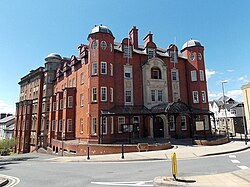
- Council Headquarters: The former Gwalia Hotel served as the county council headquarters from 1950 to 1974.
Parliamentary Constituencies
Beginning in 1542, Radnorshire maintained its own constituency for electing members to the English, and later the United Kingdom, parliament. This arrangement lasted until 1918, when it merged with the neighboring Breconshire to form the Brecon and Radnorshire constituency. This name also identifies the current Senedd (Welsh Parliament) constituency for the area. As of 2024, the region is part of the Brecon, Radnor and Cwm Tawe constituency in the UK parliament.
Local Government Subdivisions
The Hundred System
Upon the county's creation, it was divided into six hundreds—ancient administrative divisions of a shire. These were Colwyn, Cefnllys (also spelled Kevenlleece or Cevnllŷs), Knighton, Painscastle, Radnor, and Rhaiadr (or Rhayader).
Poor Law Unions and Health Boards
The 19th century brought significant administrative reform. The Poor Law Amendment Act 1834 established poor law unions (PLUs), which were catchment areas for workhouses. While not local authorities themselves, their boundaries influenced future government districts. Most of Radnorshire fell under the Knighton, Presteigne, and Rhayader unions, though peripheral parishes were linked to unions in Brecknockshire (Builth and Hay on Wye) and Herefordshire (Kington).
Town councils were absent until 1850, when a local board was formed in Knighton. Similar boards were later established in Llandrindod Wells (then called Trefonen) and Presteigne in 1891.
Sanitary Districts
The Public Health Act 1875 introduced sanitary districts to manage public health. Local board districts became urban sanitary districts (USDs), while the remaining poor law union areas became rural sanitary districts (RSDs). By 1891, the county was divided into several districts, including Knighton (both USD and RSD), Llandrindod Wells USD, and Rhayader RSD. The Presteigne RSD was dissolved in 1877, with its parishes redistributed.
Urban and Rural Districts (1894–1974)
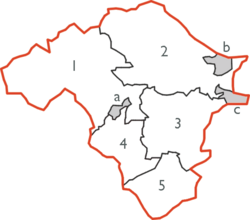
The Local Government Act 1894 replaced sanitary districts with directly elected urban districts (UDs) and rural districts (RDs). These remained unchanged until 1974. The eight districts were:
- Colwyn RD
- Knighton RD
- Knighton UD
- Llandrindod Wells UD
- New Radnor RD
- Painscastle RD
- Presteigne UD
- Rhayader RD
Civil Parishes
From the medieval era until 1974, Radnorshire was divided into civil parishes, which largely mirrored ecclesiastical parishes. These served as the primary unit of local government.
| Hundred | Parishes |
|---|---|
| Cefnllys | Bleddfa, Cefnllys, Llanbadarn Fawr, Llandeglau, Llandrindod, Llanfihangel Rhydithon, Llangunllo, Pwll-y-Llethr, Whitton |
| Colwyn | Aberedw, Betws Diserth, Craig Furuna, Diserth, Glascwm, Llanbadarn y Garreg, Llanelwedd, Llanfaredd, Llansanffraid-yn-Elfael, Rhiwlen |
| Knighton | Abaty Cwm Hir, Bugeildy, Heyop, Knighton, Llananno, Llanbadarn Fynydd, Llanbister, Llanddewi Ystradennau |
| Painscastle | Bochrwd, Bryngwyn, Cleirwy, Llanbedr Castell-paen, Llanddewi Fach, Llandeilo Graban, Llanfihangel Dyffryn Arwy, Llannewydd, Llansteffan, Llowes, Y Clas-ar-Wy |
| Radnor | Casgob, Colfa, Llanandras, Llanfair Llythynwg, Llanfihangel Nant Melan, New Radnor, Norton, Old Radnor |
| Rhayader | Llanarmon, Llanfihangel Helygen, Llanllŷr, Llansanffraid Cwmddeudwr, Nantmael, Rhaeadr |
Administrative Premises
Before the Radnorshire County Council was formed in 1889, the county was managed by the court of quarter sessions. This body eventually settled in Presteigne, utilizing the Shire Hall, which was originally built in 1542 and rebuilt in 1829.
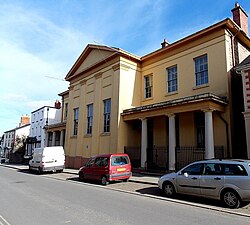
When the county council was established on April 1, 1889, a narrow vote (12 to 11) moved the council's meetings to Llandrindod Wells, although the Shire Hall in Presteigne remained a courthouse until the 1990s.
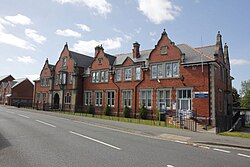
The council initially met at the Pump House Hotel before constructing the "County Buildings" on High Street in 1909.
In 1950, the council moved its staff to the former Gwalia Hotel on Ithon Road, which served as the headquarters until the council's abolition in 1974.
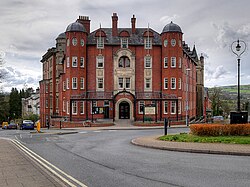
Following the 1974 reorganization, The Gwalia became an area office for the Powys County Council.
Frequently Asked Questions
When did Radnorshire stop having its own parliamentary constituency?
The standalone Radnorshire constituency was abolished in 1918 and merged with Breconshire to become the Brecon and Radnorshire constituency.
What were the "hundreds" in Radnorshire?
Hundreds were ancient administrative divisions. Radnorshire had six: Colwyn, Cefnllys, Knighton, Painscastle, Radnor, and Rhaiadr.
Why did the county council move from Presteigne to Llandrindod Wells?
The move occurred in 1889 following a vote of 12 to 11 by the newly established county council members.
What happened to the local government districts in 1974?
The urban and rural districts were abolished in 1974 as part of a wider reorganization of local government.
What was the role of the Gwalia Hotel in local governance?
The former Gwalia Hotel served as the headquarters for the Radnorshire County Council from 1950 until 1974, and later became an area office for Powys County Council.