Radio Relay Systems: Bridging Communication Gaps
In the world of wireless communication, distance and physical obstacles often stand in the way of a clear signal. When two radio stations are unable to communicate directly—whether due to the curvature of the Earth, rugged terrain, or extreme distance—they rely on a radio relay. This system acts as a vital bridge, ensuring that information reaches its destination without degradation.
How Radio Relays Work
A radio relay station serves as an intermediate point between a transmitter and a receiver. Its primary function is to intercept a weak signal, amplify it, and retransmit it. This process often involves changing the direction of the signal to navigate around obstacles or to extend the reach of the transmission over vast distances.
By receiving a fading signal and broadcasting it as a stronger, refreshed version, these stations prevent the loss of data and maintain the integrity of the communication link.
Types of Radio Relay Technologies
Depending on the environment and the required range, different relay methods are employed. These range from ground-based towers to assets orbiting the Earth.
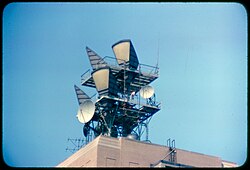
Microwave Radio Relay
Microwave relays use high-frequency radio waves to transmit data between fixed stations. These are typically line-of-sight systems, meaning the antennas must be visible to one another, often requiring tall towers to clear the horizon.
Airborne Radio Relay
Airborne relays utilize aircraft or high-altitude platforms to bounce signals over obstacles or into remote areas where ground infrastructure is unavailable.
Communications Satellites
Satellites act as the ultimate high-altitude relay stations. They receive signals from one point on Earth and retransmit them to another, allowing for global communication that transcends terrestrial boundaries.
Key Facts
- Purpose: Overcomes distance, terrain, and other physical barriers to communication.
- Mechanism: Receives weak signals and retransmits them as stronger signals.
- Versatility: Can retransmit signals in different directions to bypass obstacles.
- Examples: Includes microwave towers, airborne platforms, and satellites.
- Historical Context: The American Radio Relay League was originally established to facilitate this specific function.
Comparison of Relay Methods
| Relay Type | Medium/Platform | Primary Use Case |
|---|---|---|
| Microwave | Terrestrial Towers | Fixed point-to-point communication |
| Airborne | Aircraft/Drones | Temporary or remote coverage |
| Satellite | Space-based Orbiters | Long-distance and global connectivity |
Frequently Asked Questions
Why is a radio relay necessary?
Radio relays are necessary when direct communication is impossible due to distance, terrain (such as mountains), or other physical difficulties that block or weaken the signal.
What does a relay station do to the signal?
A relay station receives a weak signal and retransmits it as a stronger signal, often directing it toward the final destination.
What is the role of the American Radio Relay League?
The American Radio Relay League was founded specifically to support the purpose of radio relaying, although this has become a less central part of its work over time.
Are satellites considered radio relays?
Yes, communications satellites are a primary example of radio relay technology, as they receive and retransmit signals across vast distances.