PubMed: The Essential Gateway to Biomedical Literature
In the world of medical research, access to peer-reviewed evidence is the cornerstone of clinical practice and scientific discovery. PubMed serves as the primary global portal for this information, providing a free, comprehensive search interface for millions of citations and abstracts. Managed by the United States National Library of Medicine (NLM), it has evolved from a restricted institutional tool into a ubiquitous resource for researchers, healthcare providers, and the general public.
Originally, access to the MEDLINE database—the core of PubMed—was limited. From 1971 to 1997, users typically accessed MEDLINE via phone lines through university libraries or other institutional facilities. The launch of PubMed in January 1996 changed this landscape, enabling free, home- and office-based searching. By June 1997, the system was fully offered to the public, eventually replacing earlier web versions like "Internet Grateful Med" by 2001.
Key Facts
- Management: Operated by the United States National Library of Medicine (NLM).
- Scale: Over 40 million citations and abstracts as of March 15, 2025.
- Historical Reach: Records date back to 1966, with selective entries reaching as far back as 1809.
- Accessibility: Free to the public via the web; 26.8 million records link to full-text versions.
- Growth: Approximately one million new records were added annually between 2010 and 2019.
Core Content and Database Integration
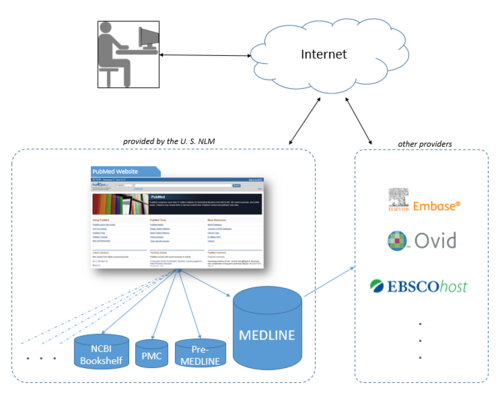
While PubMed is most famous for its connection to MEDLINE, it is actually a multifaceted aggregator. It provides access to several distinct data streams to ensure a comprehensive search experience.
Integrated Resources
- Index Medicus: Older references from the print version, dating back to 1951 and earlier.
- PMC Citations: Links to PubMed Central, a free archive of biomedical and life sciences journal literature.
- NCBI Bookshelf: A collection of full-text books and other NLM records.
- NLM Catalog: Detailed information regarding the journals indexed within MEDLINE.
To maintain data integrity, the NLM updated its indexing system in 2016, allowing publishers to directly correct typos and errors in indexed articles.
Technical Features and User Tools
PubMed is designed to handle complex scientific queries through a variety of specialized tools and identifiers.
Search and Interface Evolution
The interface has undergone significant changes to improve usability. A 2009 update introduced "telegram" searches—quick, Google-like formulations. A more comprehensive redesign followed in January 2020, which became the default on May 15, 2020, though it received mixed reactions from power users.
The PubMed Identifier (PMID)
Every record in PubMed is assigned a PMID (PubMed Identifier), which is a unique integer starting at 1. It is important to distinguish the PMID from the PMCID (PubMed Central Identifier), which specifically identifies works published in the free-to-access PubMed Central repository.
Advanced Functionalities
- Secondary Identifiers (SI): Since 2005, PubMed has extracted accession numbers for molecular sequence data, gene expression, chemical compounds, and clinical trial IDs (such as NCT identifiers from ClinicalTrials.gov).
- My NCBI: A free registration service that allows users to save searches, set up email updates, and configure display formats.
- LinkOut: A facility that connects users to their local institutional journal holdings, allowing them to access full-text articles via their own library's subscriptions.
The Ecosystem of PubMed Derivatives
Because the NLM leases MEDLINE data to private vendors and provides an API (the eutils-application program interface), a vast ecosystem of "PubMed derivatives" has emerged. These include commercial platforms like Embase, Ovid, and EBSCO, as well as free web-based tools that offer specialized ranking (e.g., MedlineRanker) or clustering of results (e.g., ClusterMed).
Looking toward the future, the ZBMed (German National Library of Medicine) announced plans in 2025 to develop an internationally supported open-source version of PubMed to further diversify access to scientific data.
| Feature | Details |
|---|---|
| Total Citations | 40+ Million (as of March 2025) |
| Earliest Records | Highly selective to 1809 |
| Full-Text Links | 26.8 Million records |
| Free Full-Text | 10.9 Million articles |
| Primary Identifier | PMID (Unique Integer) |
Reliability and Infrastructure
Despite its robustness, the system is not immune to failure. On March 4, 2025, a temporary global outage lasted approximately one day. While services were quickly restored and the disruption was found to be non-deliberate, the event sparked significant concern among the global research community regarding the reliability of essential research infrastructure.
Frequently Asked Questions
What is the difference between PubMed and MEDLINE?
MEDLINE is the primary database of biomedical citations, while PubMed is the free search engine and interface used to access MEDLINE, along with other NLM resources like the NCBI Bookshelf and PMC citations.
What is a PMID?
A PMID (PubMed Identifier) is a unique integer assigned to every single record in the PubMed database, used to uniquely identify and cite a specific article.
Can I access full-text articles for free on PubMed?
PubMed itself primarily provides citations and abstracts. However, it provides links to full-text versions for 26.8 million records, and approximately 10.9 million of those are available for free.
What is the purpose of the Secondary Identifier (SI) field?
The SI field stores accession numbers for external databases, such as molecular sequence data, chemical compounds, and clinical trial registries like ClinicalTrials.gov.
What happened to PubMed Commons?
PubMed Commons was a feature that allowed authors to comment on indexed articles. It was piloted in 2013 and made permanent in 2016, but was discontinued in February 2018 due to minimal usage.