Protein Oligomer Nomenclature and Structural Organization
In the study of protein quaternary structure, many proteins do not function as single isolated chains but instead assemble into larger complexes. These complexes are known as oligomers. To describe the number and arrangement of the individual protein chains that make up these complexes, scientists use a specific system of nomenclature based on Greek and Latin roots.
Key Facts
- The suffix -mer (from the Greek for "part" or "subunit") is used to denote the number of subunits in a complex.
- Homomeric proteins consist of identical subunits, while heteromeric proteins consist of different subunits.
- The smallest functional unit of an oligomer is called a monomer, subunit, or protomer.
- While most proteins form complexes of eight subunits or fewer, massive molecular machines like ribosomes and viral capsids can contain significantly more.
- Terms like "dimer of dimers" describe the specific symmetry and arrangement of the subunits rather than just the total count.
The Naming System for Oligomeric Complexes
The formal naming of oligomers typically follows Greco-Latinate prefixes for the first ten to twenty subunits. For complexes exceeding twenty subunits, the standard convention is to use the number followed by the suffix "-meric" (e.g., 21-mer).
| Number of Subunits | Formal Name |
|---|---|
| 1 | Monomer |
| 2 | Dimer |
| 3 | Trimer |
| 4 | Tetramer |
| 5 | Pentamer |
| 6 | Hexamer |
| 7 | Heptamer |
| 8 | Octamer |
| 9 | Nonamer |
| 10 | Decamer |
It is worth noting that while the system extends up to eicosamers (20 subunits), certain configurations, such as pentadecamers (15), heptadecamers (17), and 23-mers, have no known biological examples.
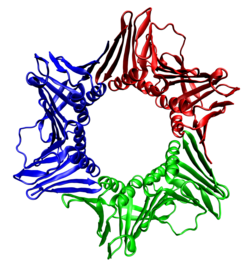
Homomers vs. Heteromers
A critical distinction in protein architecture is whether the subunits are identical. A homo-oligomer (or homomer) is formed when identical protein monomers come together. For example, two identical monomers form a homo-dimer.
Conversely, a hetero-oligomer (or heteromer) is composed of different protein subunits. A hetero-dimer, for instance, consists of two different protein monomers. The term protomer was originally created to describe the smallest unit of these hetero-oligomeric proteins, though it is now commonly used for both types in scientific literature.
Complex Symmetry and Higher-Order Assemblies
Subunits typically arrange themselves in cyclic symmetry to create closed point group symmetries. In some instances, proteins form smaller complexes that then assemble into even larger structures. This leads to descriptive nomenclature such as "dimer of dimers" or "trimer of dimers."
This terminology is used to specify the arrangement and symmetry of the oligomer, regardless of how the protein dissociates. For example, a tetramer with a four-fold rotation axis (point group symmetry 4 or C4) has four identical interfaces. However, a tetramer with point group symmetry 222 or D2 has different interfaces and is described as a "dimer of dimers" because it can dissociate into two identical homodimers. Similarly, hexamers with 32 point group symmetry may be called "trimer of dimers" or "dimer of trimers."
Large-Scale Molecular Machines
While complexes larger than octamers are rare for most proteins, there are significant exceptions in cellular biology. Viral capsids often consist of multiples of 60 proteins. Other complex molecular machines include the spliceosome, the transcription complex, and the proteasome, the latter of which contains 28 subunits organized as four heptameric rings. The ribosome stands as perhaps the largest molecular machine, comprising numerous protein and RNA molecules.
Frequently Asked Questions
What is the difference between a monomer and a protomer?
A monomer is a single protein chain. A protomer is a term originally used to describe the smallest unit of a hetero-oligomeric protein, but it is now used interchangeably with monomer and subunit for both homo- and hetero-oligomers.
What does "dimer of dimers" actually mean?
This term describes the point group symmetry and arrangement of a tetramer. It indicates that the complex is organized as two identical dimers joined together, implying different types of interfaces between the subunits compared to a simple tetramer with a single four-fold rotation axis.
Are there proteins with more than 20 subunits?
Yes. While most proteins are small oligomers, large molecular machines like the proteasome (28 subunits), viral capsids (often multiples of 60), and the ribosome contain many more subunits.
What is the difference between a homomer and a heteromer?
A homomer is a protein complex made of identical subunits, whereas a heteromer is made of two or more different types of protein subunits.