Progressive Pop: The Evolution of Experimental Pop Music
Progressive pop is a stylistic approach to popular music that seeks to break away from standard genre formulas. Whether viewed as a deliberate departure from the "three-minute single" or as a commercially accessible offshoot of progressive rock (prog), this movement transformed pop from simple dance music into a sophisticated art form intended for active listening.
Emerging from the economic boom of the mid-1960s, the genre flourished as record labels granted artists more creative control over their content and marketing. By blending rock and roll with diverse influences—ranging from Indian ragas to Asian melodies—musicians began to push the boundaries of what was considered "radio-friendly."
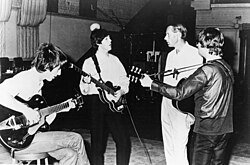
Key Facts
- Core Goal: To move beyond standard pop formulas through experimentation.
- Defining Features: Use of hooks and earworms combined with unorthodox instrumentation, key changes, and complex rhythms.
- Pioneers: The Beatles and The Beach Boys are credited as the primary architects of the movement.
- Relationship to Prog: It often serves as a "leaner" or more accessible version of progressive rock.
- Era of Peak Influence: Mid-1960s through the 1980s.
Characteristics of the Genre
Progressive pop is defined by a tension between accessibility and experimentation. While it retains the hooks (catchy musical phrases) and earworms typical of pop, it introduces elements usually reserved for classical or avant-garde music.
Common stylistic markers include:
- Unorthodox Instrumentation: The use of colorful or non-traditional instruments.
- Structural Complexity: Experiments with larger musical forms and disruptive treatments of past conventions.
- Harmonic Shifts: Frequent changes in key and rhythm that deviate from the standard 12-bar blues or simple pop progressions.
The 1960s: The Birth of a Movement
In the mid-1960s, the term "progressive" became a buzzword in the music press, suggesting that every new release should be a progression from the last. Two pivotal albums defined this era: The Beach Boys' Pet Sounds and The Beatles' Sgt. Pepper's Lonely Hearts Club Band.
Brian Wilson of The Beach Boys set a critical precedent by acting as his own producer in the studio. His work on Pet Sounds—described by the press as "The Most Progressive Pop Album Ever!"—and the psychedelic single "Good Vibrations" provided a blueprint for the genre. Similarly, The Beatles shifted the focus of rock from the dance floor to the living room. Musicologist Walter Everett notes that the 1965 album Rubber Soul began a trend of slowing down tempos, making the music something to be "thought about" rather than danced to.
By 1967, the divide between "pop" and "rock" became sharper. While the general public enjoyed the melodic side of progressive pop, the "vanguard" of compositional forms—groups like King Crimson and Pink Floyd—were increasingly labeled as "progressive rock."

The 1970s: Symphonic Grandeur and AM Radio
As the 1970s progressed, the heavy complexity of progressive rock began to see a decline in sales. This created a vacuum for a "leaner breed of pomp rock"—bands that maintained a sophisticated, orchestral sound but remained accessible enough for AM radio.
Groups such as Electric Light Orchestra (ELO), Queen, and Supertramp bridged this gap. ELO's Jeff Lynne, in particular, is noted for blending the kaleidoscopic style of the post-Sgt. Pepper Beatles with symphonic grandeur, exemplified in the track "Mr. Blue Sky." Other artists, like the Alan Parsons Project, utilized epic orchestration to create a sound that was progressive in scale yet pop in appeal.
![ELO performing in 1986. Frontman Jeff Lynne was one of prog-pop's "signature architects".[4]](/images/32/63/3263e3dfdff606a01b4d3ee0b4e3d5b8c98ecc90a769532a188f750baff923f5.jpg)
Decline and Modern Legacy (1980s–2010s)
The rise of punk rock and new wave in the late 1970s rendered the ornate style of prog-pop unfashionable. Simultaneously, record labels reclaimed creative control, exerting more influence over the production process and steering artists toward more commercial, less experimental sounds.
Despite this, the spirit of progressive pop persisted. In the 1980s, acts like Tears for Fears continued the tradition of thoughtful, layered production. By the 21st century, the influence evolved into a new trend characterized by large collectives with fluid hierarchies, such as Arcade Fire, Animal Collective, and Broken Social Scene.
Summary of Progressive Pop Evolution
| Era | Key Focus | Defining Artists | Primary Characteristics |
|---|---|---|---|
| Mid-1960s | Foundational Experimentation | The Beatles, The Beach Boys | Studio production, slower tempos, psychedelic arrangements |
| 1970s | Symphonic Accessibility | ELO, Queen, Supertramp | Orchestral fullness, AM radio appeal, "pomp rock" |
| 1980s | Commercial Transition | Tears for Fears, The Buggles | Integration with New Wave, synth-driven experimentation |
| 2000s+ | Modern Collectives | Arcade Fire, Animal Collective | Non-hierarchical bands, indie-experimental fusion |
Frequently Asked Questions
What is the difference between progressive pop and progressive rock?
While both emphasize experimentation and complex compositions, progressive pop remains more accessible and "radio-friendly," often retaining the melodic hooks and shorter structures of pop music, whereas progressive rock often features longer, more esoteric forms.
Which albums are considered the starting points of progressive pop?
The Beach Boys' Pet Sounds and The Beatles' Sgt. Pepper's Lonely Hearts Club Band are widely cited as the most significant early contributors to the genre.
How did the role of the producer change during this movement?
Brian Wilson of The Beach Boys is credited with setting a precedent that allowed artists to enter the studio and act as their own producers, giving them direct control over the artistic content of their music.
Why did progressive pop decline in the late 1970s?
The genre fell out of favor due to the emergence of punk and new wave, which favored raw energy over complexity, and a shift in the music industry where record labels exerted more control over creative processes.
Who are some modern examples of progressive pop?
Modern iterations can be found in the work of large musical collectives like Arcade Fire, Broken Social Scene, and Animal Collective, who often eschew traditional band hierarchies.