Professional Wrestling History: A Global Evolution
Professional wrestling has evolved from raw athletic exhibitions in traveling carnivals to a multi-billion dollar global entertainment industry. While often viewed as a monolith today, the sport developed distinct identities across different continents, blending legitimate athletic competition with staged drama to captivate audiences.
Key Facts
- The NWA (National Wrestling Alliance) established the territory system in North America starting in 1948.
- Lucha Libre became a national phenomenon in Mexico following the founding of EMLL in 1933.
- The Monday Night War was a fierce ratings battle between WCW and WWF from 1995 to 2001.
- The Attitude Era shifted the WWF's content toward a teen-oriented, edgy style in the late 1990s.
- WWE became the dominant global force after acquiring its primary competitors, WCW and ECW, in 2001.
The United States: From Carnivals to Global Dominance
Origins and the Early Superstars (1860s–1948)
Modern professional wrestling emerged after the American Civil War. Initially, athletes with amateur experience performed at traveling carnivals, where promoters added colorful costumes and fictional biographies to increase entertainment value. These "athletic shows" often featured open challenges to the crowd and were heavily tied to high-stakes gambling.
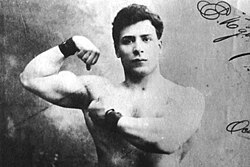
The early 20th century was dominated by Martin "Farmer" Burns and his student, Frank Gotch. Gotch became one of America's first true sports superstars, claiming the undisputed heavyweight championship after defeating Georg Hackenschmidt in 1908 and 1911. However, by 1915, public trust waned as doubts about the sport's legitimacy grew, and interest dipped following Gotch's retirement.
The Territory Era and the Golden Age (1948–1984)
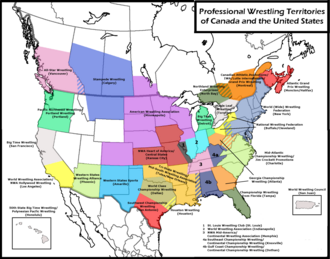
In 1948, the National Wrestling Alliance (NWA) was formed as a loose confederation of independent companies. To unify the sport, the NWA tapped Lou Thesz to consolidate various titles into one World Heavyweight Championship.
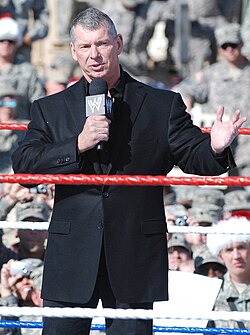
The 1950s marked a "Golden Age" driven by the advent of television. Wrestling's blend of drama and colorful characters made it an inexpensive and popular product for networks like DuMont. However, overexposure led to a decline in network ratings, pushing promoters toward local syndicated shows. This era also saw the rise of breakaway organizations, such as Verne Gagne's American Wrestling Association (AWA) and Vincent J. McMahon's Capitol Wrestling Corporation (which later became the WWF).
The Boom Periods and the Monday Night War (1984–2001)
The 1980s saw the rise of the World Wrestling Federation (WWF) and the creation of WrestleMania. This period reached a peak with WrestleMania III, which drew a record 93,173 attendees. Simultaneously, Jim Crockett Promotions (later World Championship Wrestling or WCW) challenged the WWF's dominance using the NWA's infrastructure and talent like Ric Flair.
By the mid-1990s, the industry entered the Monday Night War. WCW's Monday Nitro competed directly against WWF's Monday Night Raw. WCW initially gained the upper hand with the formation of the New World Order (nWo) and more realistic storylines. The WWF responded with the Attitude Era, introducing more violence and provocative characters to target a teenage demographic.
The Modern Era (2001–Present)
The landscape shifted dramatically in 2001 when the WWF (renamed WWE in 2002) purchased both WCW and the hardcore-style Extreme Championship Wrestling (ECW). While WWE became the global leader, niche markets led to the creation of Ring of Honor (ROH) and Impact Wrestling. More recently, All Elite Wrestling (AEW) launched in 2019, introducing new competition to the televised market.
International Developments
Mexico and the Art of Lucha Libre
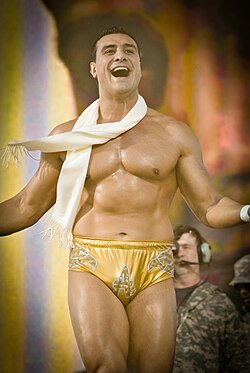
Professional wrestling in Mexico was regional until 1933, when Salvador Lutteroth founded the Empresa Mexicana de Lucha Libre (EMLL). The sport exploded in popularity during the 1950s via television, giving rise to the Tres Grandes: El Santo, Blue Demon, and Mil Máscaras.
In 1992, Antonio Peña founded Lucha Libre AAA Worldwide (AAA) as an alternative to CMLL (the successor to EMLL). AAA expanded its reach through collaborations with WCW and the WWF in the 1990s and has since transitioned to streaming platforms like Twitch and YouTube.
The United Kingdom and the "World of Sport"
British wrestling was long controlled by Joint Promotions. In the late 1970s, Max Crabtree revitalized the industry by promoting the character "Big Daddy." However, the reliance on a single star failed to sustain live attendance. The iconic World of Sport program was cancelled in 1985, and the market eventually shifted toward a rotation system involving All Star Promotions and the WWF.

Australia, Japan, and Russia
Australia saw a surge in popularity during the 1930s and 1950s, importing stars like Lou Thesz and Gorgeous George. The 1960s and 70s were dominated by WCW Australia, which held a landmark deal with the Nine Network until it closed in 1978. Since 1985, the Australian market has largely relied on North American products.
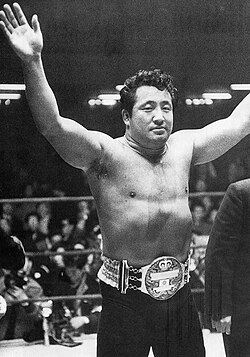
In Russia, interest in wrestling returned in the 1980s through international performances. The early 2000s saw the birth of domestic federations, such as the Independent Federation of Wrestling (IWF), which launched shows like "Danger Zone" and "Wrestleada."

Summary of Global Wrestling Evolution
| Region/Era | Key Organization | Defining Characteristic | Peak Period |
|---|---|---|---|
| USA (Territory) | NWA | Regional monopolies & unified title | 1948–1984 |
| USA (Boom) | WWF / WCW | National TV & Monday Night War | 1984–2001 |
| Mexico | EMLL / AAA | Lucha Libre & Masked Icons | 1933–Present |
| United Kingdom | Joint Promotions | World of Sport TV era | Pre-1985 |
| Australia | WCW Australia | Imported stars & Nine Network deal | 1960s–1978 |
Frequently Asked Questions
What was the NWA territory system?
The National Wrestling Alliance (NWA) was a confederation of independent promoters who agreed to recognize a single World Heavyweight Champion while maintaining control over their own local geographic regions (territories).
How did the "Attitude Era" change professional wrestling?
The Attitude Era, led by the WWF in the late 1990s, shifted the product away from cartoonish characters toward more adult-oriented content, featuring increased violence, profanity, and edgy storylines to attract teenagers.
Who are the "Tres Grandes" of Mexican wrestling?
The Tres Grandes refers to El Santo, Blue Demon, and Mil Máscaras, the three most influential superstars of the Mexican Lucha Libre tradition.
What caused the end of the Monday Night War?
The war ended in 2001 when the WWF (now WWE) purchased its primary competitor, WCW, and subsequently acquired ECW, effectively eliminating its major competition in the North American market.
Why did professional wrestling decline in the UK in the 1980s?
The decline was driven by the cancellation of the World of Sport program in 1985 and a failure to maintain live event attendance despite the popularity of stars like Big Daddy.