Proctodeum: Development and Anatomy of the Lower Anal Canal
The human alimentary canal is a complex system developed from multiple embryonic origins. One of the most specialized regions is the proctodeum, the ectodermal component that forms the terminal end of the digestive tract. Understanding the proctodeum is essential for grasping the histological transitions and anatomical boundaries of the lower anal canal.
Embryological Origins
The proctodeum originates from the surface ectoderm, the outermost layer of the early embryo. During embryogenesis, it is created through a specific folding of the outer body wall, which invaginates to meet the endodermal portion of the developing gut. This process ensures that the exit of the alimentary canal is properly integrated with the external skin of the body.
Anatomical Structure and the Pectinate Line
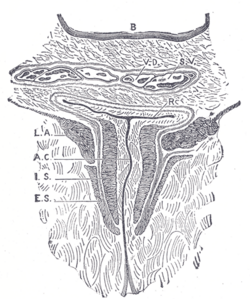
The proctodeum gives rise to the lower part of the anal canal. The critical landmark in this region is the pectinate line, which serves as the junction between the endodermal upper canal and the ectodermal lower canal.
Below the pectinate line, the lining of the anal canal consists of two distinct types of stratified squamous epithelium:
- Zona hemorrhagica: A region lined by non-keratinized stratified squamous epithelium.
- Zona cutanea: A region lined by keratinized stratified squamous epithelium, similar to the skin.
The transition point where these two epithelial zones meet is known as Hilton's white line.
Key Facts
- Precursor: Surface ectoderm.
- Primary Function: Forms the lower portion of the anal canal.
- Key Boundary: Located below the pectinate line.
- Epithelial Types: Includes both keratinized (zona cutanea) and non-keratinized (zona hemorrhagica) stratified squamous epithelium.
- Clinical Landmark: Hilton's white line marks the junction between the two epithelial zones.
Summary of Proctodeum Characteristics
| Feature | Detail |
|---|---|
| Embryonic Origin | Surface ectoderm |
| Anatomical Result | Lower anal canal |
| Upper Boundary | Pectinate line |
| Non-keratinized Zone | Zona hemorrhagica |
| Keratinized Zone | Zona cutanea |
| Transition Line | Hilton's white line |
Frequently Asked Questions
What is the proctodeum?
The proctodeum is the ectodermal part of the alimentary canal that forms the lower section of the anal canal during embryonic development.
How is the proctodeum formed?
It is created during embryogenesis by the folding of the outer body wall, utilizing surface ectoderm as its precursor.
What is the significance of the pectinate line?
The pectinate line marks the anatomical and embryological boundary between the upper anal canal (derived from endoderm) and the lower anal canal (derived from the proctodeum/ectoderm).
What is Hilton's white line?
Hilton's white line is the specific junction where the non-keratinized stratified squamous epithelium (zona hemorrhagica) meets the keratinized stratified squamous epithelium (zona cutanea).
What are the two epithelial zones of the lower anal canal?
The two zones are the zona hemorrhagica, which is non-keratinized, and the zona cutanea, which is keratinized.