Process Gain in Spread-Spectrum Systems
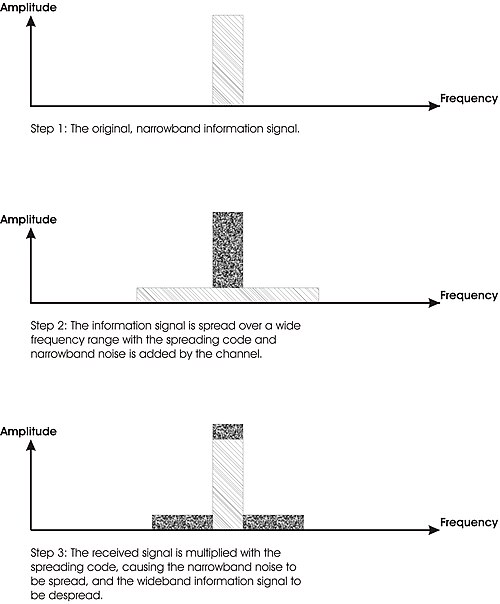
In the realm of wireless communications, process gain (also known as processing gain) serves as a critical metric for evaluating how a system handles signals across a wide frequency range. At its core, process gain represents the ratio between the spread radio frequency (RF) bandwidth and the original unspread baseband bandwidth. This mechanism is a cornerstone for determining how a system performs when operating in challenging jamming environments.
Key Facts
- Process gain is the ratio of spread bandwidth to unspread bandwidth.
- It is typically measured and expressed in decibels (dB).
- It provides resistance against narrowband interference but does not reduce wideband thermal noise.
- In an AWGN channel, a spread-spectrum system requires the same power as a non-spread system.
- It is a decisive factor in assessing system performance under jamming conditions.
Calculating Process Gain
To determine the process gain, engineers compare the bandwidth of the signal after it has been spread to the bandwidth of the signal before spreading. This is often expressed as a numerical ratio or converted into decibels for easier analysis.
For example, if a signal with a baseband bandwidth of 1 kHz is spread to an RF bandwidth of 100 kHz, the numerical ratio is calculated as 100,000 / 1,000 = 100. To convert this to decibels, the formula 10 log10(100) is used, resulting in a process gain of 20 dB.
Impact on Noise and Interference
It is important to distinguish between different types of noise when discussing process gain. Process gain does not mitigate the effects of wideband thermal noise. In a scenario involving an Additive White Gaussian Noise (AWGN) channel—where noise is spread uniformly across the frequency spectrum—a Direct-Sequence Spread-Spectrum (DSSS) system exhibits the same bit error behavior as a non-spread system using the same modulation format.
Consequently, if all other variables remain equal, a spread system requires the same amount of transmitter power as an unspread system to maintain performance on an AWGN channel.
However, DSSS systems offer a significant advantage over conventional communication systems regarding narrowband interference. Because the interference does not benefit from the process gain applied to the DSSS signal, the signal-to-interference ratio is effectively improved, making the system more resilient to targeted jamming.
Process Gain in Frequency Modulation
In the context of Frequency Modulation (FM), the calculation for processing gain is more complex and is defined by the following formula:
Gp = (1.5 * Bn * (Δf)2) / W3
In this equation:
- Gp represents the processing gain.
- Bn is the noise bandwidth.
- Δf is the peak frequency deviation.
- W is the sinusoidal modulating frequency.
| Feature | Effect/Value |
|---|---|
| Primary Definition | Ratio of RF bandwidth to baseband bandwidth |
| Common Unit | Decibels (dB) |
| Narrowband Interference | Increased resistance / Improved signal-to-interference ratio |
| Wideband Thermal Noise | No reduction in effect |
| AWGN Power Requirement | Equivalent to non-spread systems |
Frequently Asked Questions
What is the primary purpose of process gain?
The primary purpose of process gain is to improve a system's resilience against narrowband interference and jamming by spreading the signal over a wider bandwidth than is strictly necessary for the data rate.
Does process gain help with thermal noise?
No, process gain does not reduce the effects of wideband thermal noise. In an AWGN channel, a spread-spectrum system performs similarly to a non-spread system in terms of bit error behavior.
How is process gain calculated for a simple signal?
It is calculated by dividing the spread (RF) bandwidth by the unspread (baseband) bandwidth. This ratio can then be converted to decibels using the formula 10 log10(ratio).
Why is DSSS better than conventional systems for interference?
DSSS is superior because narrowband interference is not subject to the process gain of the DSSS signal, which results in an improved signal-to-interference ratio compared to conventional systems.
What variables affect process gain in Frequency Modulation?
In FM, process gain is determined by the noise bandwidth, the peak frequency deviation, and the sinusoidal modulating frequency.