Prince George: The Operational History of a Royal Navy Battleship
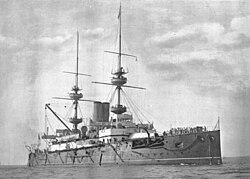
The Prince George was a formidable presence in the British Royal Navy, spanning a career that stretched from the height of the Victorian era through the turmoil of the First World War. From her beginnings as a symbol of imperial prestige to her final role as a depot ship, her journey was marked by diplomatic reviews, accidental collisions, and intense combat operations.
Early Construction and Pre-War Service
Laid down at the Portsmouth Dockyard on September 10, 1894, the Prince George was launched on August 22, 1895. The launch ceremony was a royal affair, performed by the Duchess of York (later Queen Mary) in the presence of her husband, Prince George, Duke of York (later King George V), for whom the vessel was named. After fitting-out, she was commissioned into the Royal Navy on November 26, 1896, to serve with the Channel Fleet.
During her early years, the ship participated in several high-profile events, including the Fleet Review at Spithead for Queen Victoria's Diamond Jubilee in 1897 and the Coronation Fleet Review for King Edward VII in 1902. Beyond ceremonial duties, she conducted combined manoeuvres in the Aegean Sea and visited Gibraltar and Tetuan.
Naval Accidents and Refits
The ship's early career was not without peril. On October 17, 1903, the Prince George suffered severe damage when her sister ship, Hannibal, rammed her at 9 knots off the coast of Spain. The collision punched a large hole below the waterline on the starboard quarter, leaving the ship in danger of sinking for several hours. She managed to reach Ferrol by steering with her engines while her sternwalk was awash.
Following temporary repairs in Ferrol, she returned to Portsmouth for full restoration. In July 1904, she ended her initial service with the Channel Fleet and underwent a significant refit.
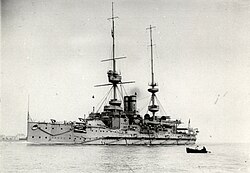
Between 1905 and 1912, the Prince George transitioned through various roles, including service with the Atlantic Fleet and serving as the flagship for the Commander-in-Chief of the Portsmouth Division of the Home Fleet. This period was marked by further mishaps, including a collision with the German cruiser SMS Friedrich Carl in 1905 and a collision with the cruiser Shannon in 1907. By December 1910, she was placed in the commissioned reserve with a nucleus crew (a reduced complement of personnel) before joining the 7th Battle Squadron in 1912.
World War I and the Dardanelles Campaign
With the outbreak of the First World War in August 1914, the Prince George returned to full commission. Her initial contributions involved securing the passage of the Plymouth Marine Division to Ostend, Belgium, and covering the movement of the British Expeditionary Force to France.
In February 1915, she was transferred to the Dardanelles to serve as a mine-bumper—a ship positioned to absorb the impact of floating mines to protect other vessels. Based at Tenedos, she attacked Ottoman forts in March 1915. On May 3, she sustained a 6-inch (152-mm) hit below the waterline while firing on Turkish batteries, necessitating repairs in Malta.
Returning to action in July, she provided gunfire support for French troops near Krithia and Achi Baba. In late 1915 and early 1916, she covered the evacuation of Allied troops from Suvla Bay and West Beach. During the latter operation, she survived a torpedo strike off Cape Helles that failed to explode.
Final Years and Conversion
After serving at Salonika, the ship returned to Chatham Dockyard in March 1916. For two years, she served in subsidiary roles, including as an auxiliary sickbay and an accommodation ship. In May 1918, she underwent a conversion to become a destroyer depot ship (a support vessel providing supplies and maintenance to smaller destroyers). During this process, she was briefly renamed Victorious II.
Attached to the repair ship Victorious at Scapa Flow, she supported the Grand Fleet before reverting to her original name, Prince George, in February 1919. She spent her final active months as a depot ship for destroyers based on the Medway.
Key Facts
- Commissioned: November 26, 1896.
- Major Conflict: World War I, specifically the Dardanelles campaign.
- Specialized Role: Served as a "mine-bumper" and later a destroyer depot ship.
- Notable Incidents: Rammed by HMS Hannibal (1903) and hit by a 6-inch shell (1915).
- Final Fate: Wrecked off Camperduin, Netherlands, on December 30, 1921.
| Period | Primary Role/Assignment | Key Location |
|---|---|---|
| 1896–1904 | Channel Fleet Service | English Channel / Aegean Sea |
| 1905–1912 | Atlantic & Home Fleet | Portsmouth / Gibraltar |
| 1914–1915 | Expeditionary Support | France / Belgium |
| 1915–1916 | Mine-bumper / Combat Support | Dardanelles / Tenedos |
| 1918–1920 | Destroyer Depot Ship | Scapa Flow / Medway |
Frequently Asked Questions
Who was the ship named after?
The ship was named after Prince George, Duke of York, who later became King George V.
What happened during the collision with HMS Hannibal?
In October 1903, HMS Hannibal rammed the Prince George at 9 knots, creating a large hole below the waterline. The ship nearly sank but managed to reach Ferrol for repairs.
What is a "mine-bumper"?
A mine-bumper is a ship used to lead a formation or occupy a position where it can absorb the impact of naval mines, thereby protecting more valuable ships in the fleet.
How did the ship eventually sink?
After being sold for scrap in 1921 and resold to a German firm, the ship was wrecked off Camperduin, Netherlands, on December 30, 1921, during its final voyage.
Where is the wreck of the Prince George today?
The wreck remains off the coast of Camperduin. In 2014, it was buried in sand as part of a beach expansion program, and a marker now identifies the location.