President of the Republic of Poland
The President of the Republic of Poland (Polish: Prezydent Rzeczypospolitej Polskiej) serves as the head of state and the supreme representative of the nation. Operating under the framework of the 1997 Constitution of Poland, the president shares executive power with the Council of Ministers, which is led by the prime minister. Beyond ceremonial duties, the president holds significant authority as the commander-in-chief of the Armed Forces and acts as a critical arbiter within the Polish political system.
Key Facts
- Incumbent: Karol Nawrocki (since August 6, 2025).
- Term Length: Five years, renewable once.
- Election Method: Direct popular vote by absolute majority.
- Primary Residences: Presidential Palace (official seat) and Belweder (ceremonial).
- Annual Salary: 294,000 zł.
- Key Roles: Head of State and Commander-in-Chief.
Historical Evolution of the Presidency
The office of the presidency has undergone several transformations since the early 20th century. The first president, Gabriel Narutowicz, was sworn in on December 11, 1922, following a period where Józef Piłsudski served as the "Chief of State" (Naczelnik Państwa). The early years were marked by political volatility, including the 1926 May Coup by Piłsudski, which led to the establishment of the Sanation regime under President Ignacy Mościcki.
During World War II, following the German invasion of 1939, the presidency moved into exile. Władysław Raczkiewicz assumed the role in France before the government-in-exile relocated to London. This line of succession continued until Ryszard Kaczorowski served as the final president-in-exile.
Between 1945 and 1954, Poland fell under Soviet influence. Bolesław Bierut served as head of state until the 1952 Constitution of the Polish People's Republic abolished the presidency in favor of a collective leadership known as the Council of State (Rada Państwa). The presidency was restored in 1989 as part of a political compromise between the government and the opposition to ensure a stable transition of power. General Wojciech Jaruzelski first held the restored office, followed by Lech Wałęsa, who won the first direct presidential election in 1990.
Election Process and Eligibility
To ensure democratic legitimacy, the president is elected directly by the Polish people. A candidate must be a Polish citizen, at least 35 years old on the day of the first round, and must collect at least 100,000 signatures from registered voters to be registered.
The election requires an absolute majority to win. If no candidate achieves this in the first round, a second round is held between the two candidates who received the highest number of votes.
Powers and Responsibilities
While the president represents the state rather than the people (a role reserved for members of the Sejm and Senate), the office wields substantial influence over the legislative and executive branches.
Executive and Legislative Influence
The president has the authority to initiate the legislative process and can exercise a veto to stop a bill. However, the Sejm can overrule this veto with a three-fifths majority vote (at least 230 members). Additionally, the president may refer a bill to the Constitutional Tribunal to verify its legality before signing it into law.
In terms of government formation, the president selects the prime minister. While this is a free choice, the president typically appoints a politician supported by the majority party in the Sejm.
International and Military Authority
As the supreme representative of Poland, the president ratifies and revokes international agreements, appoints ambassadors, and accepts foreign diplomatic accreditations. Domestically, the president grants state distinctions and holds the right of clemency to dismiss final court verdicts, usually in consultation with the minister of justice.
As commander-in-chief, the president appoints the chief of the general staff and service branch commanders. In times of war, the president nominates the supreme commander of the Armed Forces and may order general mobilization.
Presidential Residences and Properties
The Office of the President maintains several properties for official, ceremonial, and recreational use.
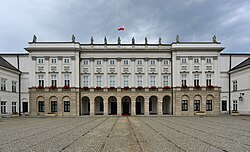
The Presidential Palace in Warsaw has served as the official seat of the presidency since 1993. It became the primary residence when Lech Wałęsa moved there in 1994.
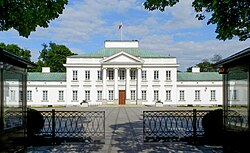
The Belweder Palace, while previously the official seat until 1993, remains an official residence used for ceremonial purposes and hosting foreign heads of state.
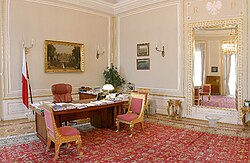
Other notable properties include the Presidential Castle in Wisła—a former Habsburg hunting cottage used as a conference center and hotel—as well as retreats in Lucień, Ciechocinek, Hel (Jurata-Hel), Promnik, and Klarysew.
Succession and Continuity
The Polish Constitution does not provide for a directly elected line of succession. If the president is unable to perform their duties, the Marshal of the Sejm assumes presidential powers for a maximum of 60 days until new elections are held.
This protocol was notably utilized following the April 10, 2010, Smolensk air disaster, which claimed the lives of President Lech Kaczyński and 94 others. Bronisław Komorowski, then Marshal of the Sejm, served as acting president until he won the subsequent election.
| Feature | Details |
|---|---|
| Constitutional Basis | Constitution of Poland (1997) |
| Term Limit | 5 years (max 2 terms) |
| Military Rank | Commander-in-Chief |
| Legislative Power | Veto power, right to initiate legislation |
| Succession | Marshal of the Sejm (Acting) |
Frequently Asked Questions
How is the President of Poland elected?
The president is elected through a direct popular vote. A candidate must win an absolute majority; if no one does in the first round, a runoff election is held between the top two candidates.
What happens if the president cannot fulfill their duties?
The Marshal of the Sejm takes over as acting president for a period of up to 60 days, during which time elections must be organized.
Can the president's veto be overturned?
Yes, the Sejm can overrule a presidential veto with a three-fifths majority vote, provided at least half of the statutory members (230) are present.
What are the requirements to run for president?
A candidate must be a Polish citizen, at least 35 years old, and must gather at least 100,000 signatures from registered voters.
What is the difference between the Presidential Palace and Belweder?
The Presidential Palace is the current official seat and primary office of the president, while the Belweder Palace is used primarily for ceremonial functions and hosting visiting dignitaries.