Preschool Education: Global Variations and National Approaches
Preschool education serves as a primary vehicle for societies to transmit essential cultural values to the next generation. While the specific goals and methods vary significantly across borders, a universal thread remains: the expectation that preschool will enhance a young child's ability to perform basic self-care tasks, including dressing, feeding, and toileting.
Key Facts
- Cultural Transmission: Preschool systems are designed to reflect and instill the specific values of the society that controls them.
- Diverse Models: Approaches range from the individuality-focused learning centers of the US to the group-harmony emphasis in Japan.
- Policy Shifts: Many nations, such as India and Ireland, are moving toward more formalized or government-funded early childhood systems.
- Inclusion: The integration of children with disabilities varies, with some regions utilizing Individualized Education Plans (IEPs) and others struggling with teacher training.
Early Childhood Education in Asia
China
Early childhood education (ECE) in China has evolved rapidly since the 1980s, shaped by a blend of traditional, communist, and Western cultural influences. The government has implemented strategic policies, such as the 2001 Guidance for Kindergarten Education and the 2010–2020 National Education Reform and Development programs.
Recent years have seen the introduction of Western pedagogical models, including Montessori, Reggio Emilia, the Project Approach, and Developmentally Appropriate Practice (DAP). However, adapting these to the Chinese context has sparked debate among practitioners. Current goals focus on improving teacher professional knowledge regarding play and inclusion, as well as strengthening the collaborative partnership between kindergartens and families.
Japan
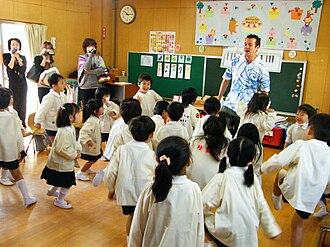
In Japan, the primary objective is the development of social skills and a sense of group belonging. To foster peer interaction and reduce reliance on the teacher, classes often consist of up to 40 students. Cooperativeness, kindness, and social consciousness are prioritized over individual achievement.
Unstructured play is highly valued as a means to provide a rich social environment that may be missing in increasingly isolated nuclear families.
India
Historically, preschool in India has been largely privately run and not officially recognized by the government. However, the National Education Policy (NEP) 2020 marks a significant shift. The NEP 2020 recognizes the foundational stage (ages 3 to 8) as critical and proposes replacing the traditional 10+2 schooling system with a new 5+3+3+4 structure to formalize early intervention.
Philippines
Children typically enter kindergarten at age 5. The curriculum emphasizes learning the alphabet, numbers, shapes, and colors through songs, games, and dance. A key feature is the use of native languages; as of the 2013–2014 school year, the curriculum incorporates 19 different mother tongue languages to ensure students can read in their native tongue by the end of grade 1.
European Perspectives on Preschool
Ireland and Lithuania
Ireland significantly increased its preschool enrollment to approximately 93% after passing a law in 2010 providing free preschool for children between 3 years 2 months and 4 years 7 months. This addressed previous barriers where high private fees left many children without early education.
In Lithuania, preschool is classified as non-formal education under the Law on Education. Its purpose is to satisfy the cognitive, social, ethnic, and cultural needs of the child. Facilities can be public (state or municipality) or private, but all must follow criteria approved by the Minister of Education, Science and Sport.
Sweden, Turkey, and Armenia
Sweden offers preschool from age 1 to 6, governed by local municipalities and following a national curriculum. In Turkey, preschool begins at age 5, while primary education starts at 6. In Armenia, the timeline is shifted earlier, with preschool starting at age 3 and primary education at age 5.
Preschool Systems in the United Kingdom
The UK offers a variety of settings, including childcare centers, playgroups, and nursery classes within primary schools. Funding and structure vary by region:
- England: Children are entitled to 15 hours of free childcare funding after their third birthday. The curriculum focuses on three prime areas (communication, physical, and personal/social development) and four specific areas (literacy, math, understanding the world, and expressive arts).
- Wales: Following devolution, Wales introduced a "Foundation Phase" for 3- to 7-year-olds, emphasizing learning through play across seven developmental areas.
- Northern Ireland: Funded nursery and preschool places are available from age 3. Regulations strictly limit class sizes to 26 children and mandate specific qualifications for supervisors.
- Scotland: The curriculum covers a broad range of subjects, including Expressive Arts, Health & Wellbeing, Sciences, and Religious & Moral Education.
The United States Approach
Preschool in the US emphasizes individuality and the belief that "children's play is their work." Using a learning center approach, children choose their own activities, allowing teachers to address specific strengths and weaknesses.
Socially, US preschools encourage independent conflict resolution. Rather than immediate punishment, teachers guide children to use verbal strategies to resolve disputes and encourage sincere apologies based on understanding.
Special Education and Inclusion
Under the Individuals with Disabilities Education Act (IDEA), the US has moved toward inclusion, integrating children with special needs into general classrooms. This is managed through Individualized Education Plans (IEP) or Individual Family Service Plans (IFSP), which create a partnership between parents and educators.
Specialized US Programs
The US also features Cooperative Preschools, which prioritize parent involvement and education. Additionally, the federal Head Start program (established in 1964) provides comprehensive education, health, and disability services to low-income families to ensure school readiness for children from birth to age five.
Summary of Global Preschool Characteristics
| Country/Region | Primary Focus | Key Feature | Typical Start Age |
|---|---|---|---|
| Japan | Social Harmony | Large group sizes (up to 40) | Varies |
| United States | Individuality | Learning centers & choice | Varies |
| China | Reform & Integration | Blending Western & Traditional models | Varies |
| Philippines | Literacy | Mother-tongue based instruction | 5 |
| Ireland | Accessibility | Government-funded free preschool | 3+ |
| Sweden | National Standards | Municipal governance | 1 |
Frequently Asked Questions
What is the main goal of preschool in Japan?
The primary goals in Japan are the development of social skills and a sense of group belonging, emphasizing cooperativeness and kindness through a rich social environment.
How does the US approach conflict resolution in preschool?
US teachers encourage children to resolve disputes independently using verbal strategies ("use your words") and focus on understanding the behavior before deciding on a punishment.
What is the purpose of the Head Start program in the US?
Head Start is a federal program designed to increase school preparedness for children from low-income families, providing education and disability services from birth to age five.
How has the Philippines integrated language into its preschool curriculum?
The Philippines mandates that children learn basic concepts in their native language, utilizing 19 different mother tongue languages to ensure literacy by the end of grade 1.
What changed in Ireland's preschool system in 2010?
Ireland passed a law making preschool free for children between 3 years 2 months and 4 years 7 months, which significantly increased enrollment to about 93%.