Power Chords: The Foundation of Rock and Metal Guitar
In the world of electric guitar, few sounds are as iconic or as impactful as the power chord. Also known as a fifth chord, this musical structure is a staple of rock, punk, and heavy metal. Unlike traditional chords that define a mood as happy or sad, the power chord provides a raw, driving energy that cuts through the noise of a loud amplifier.
At its most basic level, a power chord consists of the root note and the perfect fifth. While it may not be a full triad in the classical sense, its simplicity is exactly what makes it so effective, especially when paired with distortion.

Key Facts
- Composition: Consists of a root note and a perfect fifth, often with added octaves.
- Tonal Quality: Neither major nor minor, making it "indeterminate."
- Sonic Effect: Works optimally with distortion to create a rich, bassy, and powerful sound.
- Common Genres: Essential to heavy metal, punk rock, and hard rock.
- Notation: Typically written as a root letter followed by a 5 (e.g., C5).
The Science of the Sound
To understand why power chords are used in rock, one must look at intermodulation distortion. This occurs when two or more notes are played through a distortion process that non-linearly transforms the audio signal, generating additional frequencies (partials) based on the sums and differences of the original harmonics.
When a standard major or minor chord is played with heavy distortion, the complex ratios between the third and the other notes can result in a "messy" or indistinct sound. This is further complicated by equal temperament—the standard tuning system for guitars—where thirds are slightly wider or narrower than they would be in just intonation.
In contrast, the ratio between the root and the fifth in a power chord is very close to the just interval of 3:2. This creates a coherent sound when distorted. The resulting intermodulation expands the sound spectrum, often creating a new fundamental frequency an octave lower than the root, which gives the chord its characteristic "power." Even without distortion, the simple ratios create a stark, powerful effect known as a combination tone.
![In a triadic context, chords with omitted thirds may be considered "indeterminate" triads.[5] Playⓘ](/images/85/6e/856ec8aa9b2ec8c798639b4a9e1a7d8ad93e5e6d6b816e8f1451efc202b0de4e.png)
Terminology and Notation
Power chords are most commonly notated with a "5" (e.g., C5) or as "no 3" (e.g., C(no 3)), indicating that the third of the chord is omitted. Because the third is the note that determines whether a chord is major or minor, the power chord is considered indeterminate (sometimes noted as ind).
This gives the power chord a chameleon-like quality: it can sound major or minor depending on the musical context in which it is played. Additionally, power chords can be inverted (playing the fifth below the root) or doubled in octaves to change the perceived pitch and low-end power.
A Brief History
While modern audiences associate power chords with electric guitars, their written history in the 20th century includes the "Preludes" of Brazilian composer Heitor Villa-Lobos, and earlier work by Francisco Tárrega. However, the transition to rock music began in the 1950s.
Early electric blues guitarists like Willie Johnson and Pat Hare are cited as true originators, with Johnson's work on Howlin' Wolf's "How Many More Years" (1951) serving as a key example. Scotty Moore later used them in Elvis Presley's "Jailhouse Rock" (1957). The modern distorted power chord sound was popularized by Link Wray, who famously tore the speaker cone in his 1958 track "Rumble."
By the 1960s, the Kinks used fast power chord changes in "You Really Got Me," and Pete Townshend of The Who incorporated them into his theatrical "windmill" strumming. Later, Robert Fripp of King Crimson and Johnny Ramone of the Ramones further cemented the power chord's role in progressive and punk rock, respectively.
Playing Techniques and Fingering
Power chords are typically played in the middle register to ensure the closest matching of overtones. The most common fingering is the 1-5-1' structure: the root, the fifth, and the octave of the root.
Standard Fingering
On a guitar with strings tuned in fourths (like the lower four strings of a standard guitar), the root is played on one fret, and the fifth and octave are played two frets higher on the next two strings. If playing on the first or second strings, the fingering must be adjusted one fret higher.
Alternative Voicings
- Barre Fourth: An inverted fifth where the fifth is played below the root, often played with one finger (e.g., the riff in Deep Purple's "Smoke on the Water").
- Fourth Chord: A 5-1'-5' structure where the root is the second note played, though the fifth is the lowest.
- Dropped Tuning: In Drop D tuning, power chords on the sixth string can be played with a single finger, and D power chords can be played using three open strings.
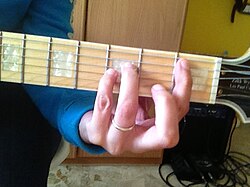
The Spider Chord
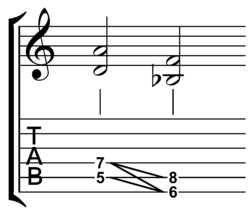
Popularized by Dave Mustaine of Megadeth in the 1980s thrash metal scene, the spider chord is a technique used to reduce string noise during fast, chromatic riffs. It requires the use of all four fingers of the fretting hand, allowing the player to move between chords (such as a tonic and a minor submediant) without shifting the entire hand position.
Summary Table
| Feature | Standard Power Chord | Spider Chord | Drop D Power Chord |
|---|---|---|---|
| Intervals | Root + Perfect Fifth | Root + Perfect Fifth | Root + Perfect Fifth |
| Tonal Quality | Indeterminate | Indeterminate | Indeterminate |
| Primary Use | General Rock/Metal | Fast Chromatic Riffs | Heavy Low-end/Easy Fingering |
| Fingering | Typically 2-3 fingers | All 4 fingers | Can be 1 finger |
Frequently Asked Questions
Why is a power chord called "indeterminate"?
It is called indeterminate because it lacks a third. In music theory, the third is the note that defines whether a chord is major or minor. Without it, the power chord can fit into either harmonic context.
Why do power chords sound better with distortion than major chords?
Because the ratio between the root and fifth is simple (nearly 3:2), the intermodulation distortion produces harmonics that are coherent. Major or minor chords have more complex ratios that can sound muddy or indistinct when distorted.
What is the difference between a power chord and a full chord?
A full chord (like a major triad) includes a root, a third, and a fifth. A power chord omits the third, consisting only of the root and the fifth (and sometimes octaves).
Who popularized the power chord in modern rock?
While early blues guitarists like Willie Johnson and Pat Hare used them, Link Wray is credited with popularizing the distorted power chord sound in 1958 with the song "Rumble."
What is a spider chord?
A spider chord is a specialized fingering technique used primarily in thrash metal to play chords across several strings quickly and with minimal noise by utilizing all four fingers of the fretting hand.