Positive Feedback: Mechanisms and Applications Across Science and Society
In the broadest sense, positive feedback is a process where the output of a system is routed back as an input in a way that enhances or amplifies the original stimulus. Unlike negative feedback, which seeks stability and equilibrium, positive feedback drives a system away from its starting state, often leading to exponential growth, rapid transitions, or instability.
From the circuitry of a vintage radio to the complex dynamics of global economics and human physiology, positive feedback serves as a powerful engine for change and amplification. While often associated with instability—such as the screech of a microphone—it is also fundamental to essential life processes and the functioning of modern digital technology.
Key Facts
- Amplification: Positive feedback increases the magnitude of a response, often leading to exponential growth.
- Electronics: It is used in oscillators and memory latches (flip-flops) to maintain stable digital states.
- Physiology: Essential for processes like childbirth and blood clotting, though usually terminated by a counter-signal.
- Sociology: Drives the "network effect," where a service becomes more valuable as more people use it.
- Risk: In economics and chemistry, uncontrolled positive feedback can lead to systemic collapse or thermal runaway.
Positive Feedback in Electronics
In electronic engineering, positive feedback occurs when a signal is fed back into an amplifier in phase with the original signal. This can dramatically multiply the gain of a circuit. For example, regenerative circuits, patented in 1914, allowed a single vacuum tube to amplify weak radio signals by 20,000 to 100,000 times, far exceeding the standard gain of 20 to 50.
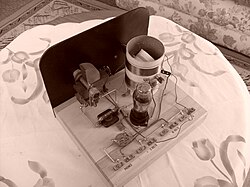
However, high gain often leads to instability and oscillation. This characteristic is intentionally harnessed in electronic oscillators—such as the Hartley, Colpitts, and Wien bridge designs—which use tuned circuits or quartz crystals to create linear, sinusoidal signals.
Digital Logic and Memory
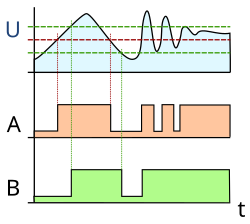
Positive feedback is critical for digital stability. A Schmitt trigger uses positive feedback to create sharp thresholds for analog inputs, preventing erratic switching through a phenomenon called hysteresis (where the input must drop below a different, lower threshold to reset the output).
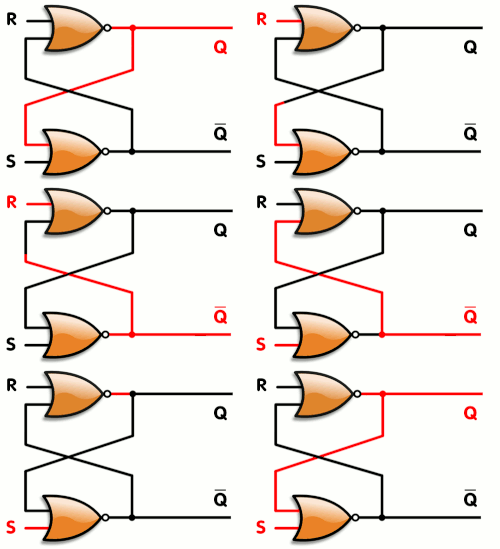
Similarly, an electronic flip-flop (or latch) uses high positive feedback to remain in one of two stable states even after the input signal is removed. This mechanism forms the basis of one bit of electronic memory used in Random Access Memory (RAM).
Audio, Video, and Visual Feedback
One of the most common experiences of positive feedback is acoustic feedback (the Larsen effect). This occurs when a microphone picks up the amplified sound from a loudspeaker, re-amplifies it, and creates a loop that results in a loud squeal or screech.

While audio engineers use equalizers to prevent this, some musicians, such as Jimi Hendrix and Brian May, have intentionally used guitar feedback as a creative musical tool. The Beatles' "I Feel Fine" is one of the earliest popular recordings to utilize this effect.
A similar principle applies to video. When a camera is pointed at a monitor displaying its own live feed, video feedback creates repeating, recursive patterns on the screen.

Biological and Physiological Systems
In living organisms, positive feedback amplifies a body's response to a stimulus to achieve a specific outcome. These loops are typically temporary and are broken by a counter-signal once the goal is reached.
Physiological Examples
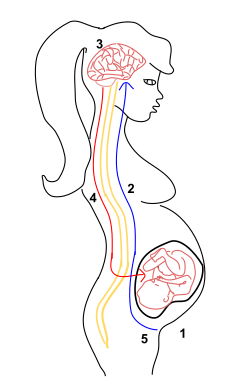
- Childbirth: The fetus pushing against the cervix triggers the release of oxytocin, which causes uterine contractions, further pushing the fetus against the cervix.
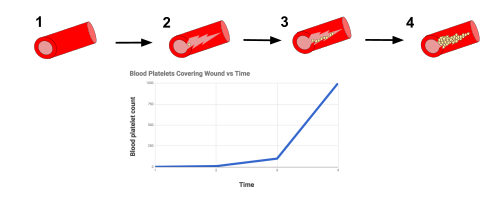
- Blood Clotting: Damaged vessel walls release chemicals that attract platelets; as more platelets gather, they release more chemicals, accelerating the seal.
- Lactation: Suckling triggers the hypothalamus to signal the pituitary gland to produce prolactin, increasing milk production.
Cellular and Genetic Regulation
At the microscopic level, positive feedback regulates protein levels and immune responses. In the immune system, B lymphocytes use a loop involving antibodies and the complement protein C3 to speed up the secretion of more antibodies when a pathogen is detected.
![Positive feedback is a mechanism by which an output, such as protein levels, is enhanced. However, in order to avoid any fluctuation in the protein level, the mechanism is inhibited stochastically (I); therefore, when the concentration of the activated protein (A) is past the threshold ([I]), the loop mechanism is activated and the concentration of A increases exponentially if d[A]=k [A].](/images/3d/37/3d3746dbb245d0bb029019c1b47b7bb9746a8d31a77a1d69633391b561a78be8.webp)
However, this can become dangerous. A cytokine storm is a potentially fatal hyper-immune reaction where a positive feedback loop between cytokines and immune cells leads to dangerously elevated cytokine levels.
Social, Economic, and Environmental Dynamics
Positive feedback also governs large-scale human and environmental systems, often creating "winner-take-all" scenarios or systemic instabilities.
Economics and Social Media
George Soros's theory of reflexivity suggests that investor expectations are influenced by price movements, which in turn reinforce those movements until they become unsustainable. Similarly, systemic risk can be seen in Ponzi schemes, where returns to old investors attract new ones, driving growth toward an inevitable collapse.

In sociology, the network effect describes how a service (like Facebook or Twitter) becomes more attractive as its user base grows. This is often amplified by bots and the psychological drive for virtual validation (likes and shares).
Environmental and Evolutionary Trends
In climatology, positive feedback can accelerate warming. For instance, warming oceans may release methane hydrates—a potent greenhouse gas—which further increases the temperature. In evolution, "arms races" and the relationship between technological innovation and human population growth are viewed as second-order positive feedback loops that increase carrying capacity and population simultaneously.
Chemistry and Conservation
In chemistry, if a reaction releases heat and that heat increases the reaction rate, thermal runaway can occur, potentially leading to a chemical explosion if the heat is not removed quickly.
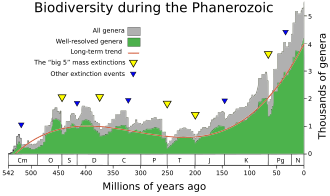
A tragic example of positive feedback in conservation is the "extinction loop": as a species becomes rarer, its parts often become more valuable, which in turn increases the incentive for hunters to kill the remaining individuals.
| Field | Mechanism/Example | Typical Outcome |
|---|---|---|
| Electronics | Regenerative Circuits / Flip-Flops | High Gain / Stable Memory States |
| Physiology | Oxytocin in Childbirth | Completion of a Biological Event |
| Sociology | Network Effect / Bank Runs | Rapid Expansion or Systemic Collapse |
| Climatology | Methane Release | Accelerated Global Warming |
| Chemistry | Exothermic Reactions | Thermal Runaway / Explosion |
Frequently Asked Questions
What is the main difference between positive and negative feedback?
Negative feedback promotes stability by counteracting a change to maintain a set point (homeostasis). Positive feedback promotes instability or change by amplifying a stimulus, driving the system further away from its original state.
Why is audio feedback considered a positive feedback loop?
It is a loop because the output (sound from the speaker) becomes the input (sound picked up by the microphone). Because the signal is amplified and fed back in phase, it grows exponentially, resulting in the characteristic screech.
How does a Schmitt trigger use positive feedback?
It uses positive feedback to create hysteresis, meaning it has different thresholds for switching "on" and "off." This prevents the output from flickering rapidly when the input signal is noisy or changes slowly.
Can positive feedback be dangerous in the human body?
Yes. While many loops are healthy (like clotting), others can be lethal. A cytokine storm is an example where an uncontrolled positive feedback loop in the immune system causes excessive inflammation and organ failure.
What is the "network effect" in social media?
The network effect is a social positive feedback loop where the value of a network increases as more people join. This attracts even more users, causing the network to grow at an accelerating rate.