Portuguese People: History, Genetics, and Global Diaspora

Portuguese People: A Journey Through History, Genetics, and Global Influence

The Portuguese (Portuguese: Portugueses) are an ethnic group primarily native to Portugal, characterized by a rich tapestry of ancestral migrations, a dominant Latin Catholic faith, and a language that has spread to every corner of the globe. With a domestic population of approximately 9.2 million, the Portuguese identity extends far beyond the borders of the Iberian Peninsula, forming a vast global network known as the Lusophone world.

From the ancient tribes of the Atlantic coast to the modern digital influencers of the 21st century, the story of the Portuguese is one of resilience, exploration, and cultural synthesis.

Aroeira 3 skull of 400,000-year-old Homo heidelbergensis found in 2014. The oldest trace of human history in Portugal

Key Facts

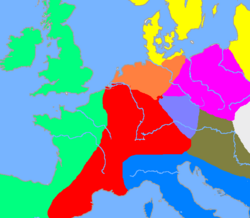
A simplified map of archaeological cultures of the late Bronze Age (c. 1200 BC): northern Urnfield culture
  • Primary Language: Portuguese and Portuguese Sign Language (LGP).
  • Dominant Religion: Latin Catholicism.
  • Global Presence: A diaspora estimated at approximately 70 million people.
  • Genetic Marker: High prevalence of Haplogroup R1b (56%).
  • Most Common Surname: Silva, followed by Santos and Ferreira.

Ancestry and Early Inhabitants

Ethnographic and Linguistic Map of the Iberian Peninsula at about 200 BC.[152]

The genetic and cultural foundation of the Portuguese people was laid over millennia. Early traces of human history in Portugal date back 400,000 years, as evidenced by the Aroeira 3 skull of Homo heidelbergensis. Following the Neolithic period, the region saw the arrival of Indo-Europeans and Celts, who blended with existing populations to form a diverse pre-Roman landscape.
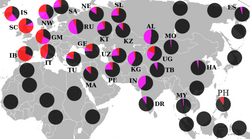
Distribution of R1a (purple) and R1b (red). See also this map for distribution in Europe.

Pre-Roman Tribes

Before the Roman conquest, the territory was divided among various tribes, many of whom were loosely affiliated or dependent on the Lusitanians. Key groups included:

  • Lusitanians: The dominant group in the interior and north.
  • Celtici: Celts located in the Alentejo and northern mountainous regions.
  • Turduli: Found in the Guadiana Valley and the Estremadura region.
  • Cynetes (Conii): Inhabitants of the Algarve and southern Alentejo.
  • Oestriminis: A tribe dependent on the Lusitanians, located between the Douro and Vouga rivers.
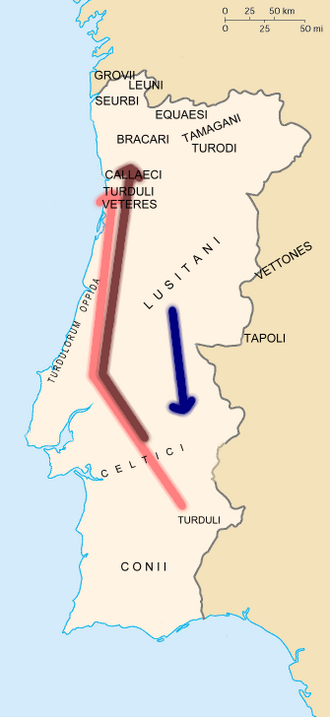
Map showing the main pre-Roman tribes in Portugal and their main migrations. Turduli movement in red, Celtici in brown and Lusitanian in a blue colour. Most tribes neighbouring the Lusitanians were dependent on them. Names are in Latin.

Resistance to Roman expansion was epitomized by Viriato (179–139 BC), who led a successful eight-year guerrilla war before being betrayed by his own ranks.

Viriato (179 – 139 BC), led a guerilla war against the Romans for eight years. He was beheaded by traitors from his ranks, who killed him in his sleep for a bribe.[162] The statue depicted is in Viseu.

Genetics and Population Structure

The Reconquista Timetable and expulsion of the Moors.

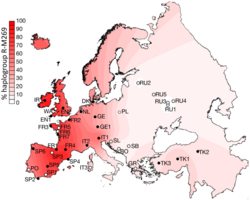
Modern genetic studies highlight the Portuguese as part of the broader Romance-speaking family, sharing close ties with Galicians, Spaniards, and other Southern Europeans. A defining characteristic of the Portuguese male lineage is the high frequency of Haplogroup R1b, which is present in 56% of the population.

Comparison of Y-DNA Haplogroups (%)
Country/Group R1b I1 J2 E1b1b
Portugal 56 2 6.5 14
Spain 69 1.5 3 7
France 58.5 8.5 5.5 7.5
Ireland 81 6 1 0
Sephardi Jews 25 1 22 6

The Global Diaspora

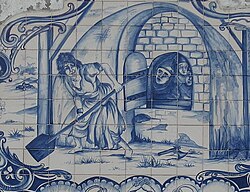
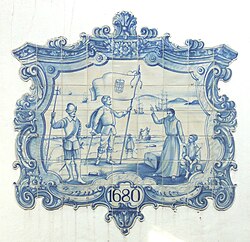
Azulejo tile image of Brites de Almeida killing Castilian soldiers

The Portuguese diaspora is one of the most widespread in the world, driven by the Age of Discovery, colonial expansion, and economic migration. The largest concentration of people with Portuguese ancestry is found in Brazil, where approximately 180 million people share this heritage.
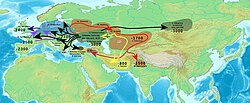
Indo-European migrations

The Americas and Oceania

Beyond Brazil, significant populations exist in Venezuela (1.3 million) and Peru (1.15 million). In North America, the United States hosts roughly 1.4 million people of Portuguese ancestry, while Canada has between 400,000 and 550,000.
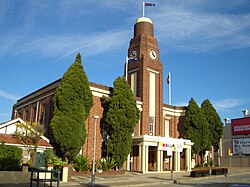
Petersham (Sydney) is a neighbourhood known for its extensive Portuguese commercial offerings

Europe and Africa

In Europe, France is a primary destination with up to 2 million people of Portuguese birth or ancestry. Other notable communities are found in Switzerland, Luxembourg, and Belgium. In Africa, significant populations remain in Angola, Mozambique, and Cape Verde.
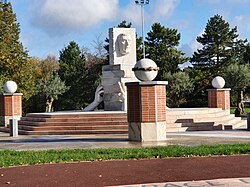
Champigny-sur-Marne Portuguese monument (Monument des Portugais)

The Sephardi Legacy

A poignant chapter of the diaspora involves the Sephardi Jews. Following their expulsion from Portugal, many established influential communities worldwide. Notable figures of Portuguese-Jewish descent include the philosopher Baruch Spinoza and the economist David Ricardo.
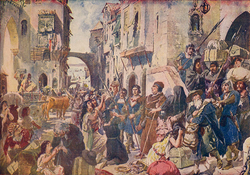
"The Banishment of the Jews", by Alfredo Roque Gameiro, in Quadros da História de Portugal ("Pictures of the History of Portugal", 1917)

Culture and Contributions

Geographical distribution of Haplogroup R1b (Y-DNA), R1b1a1a2 (R-M269)

Portuguese influence is visible globally through architecture, cuisine, and the arts. The Azulejo (decorative ceramic tile) is a hallmark of Portuguese architecture, while Fado music captures the essence of the national soul.

Azulejos are a distinctive feature of Portuguese architecture as it is the case with Capela das Almas [pt], in Porto

Culinary Influence

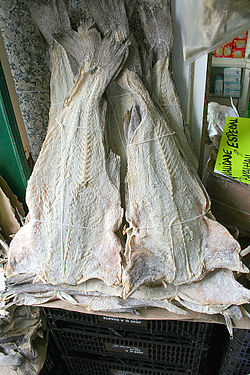
Portuguese cuisine is world-renowned, with Bacalhau (salted cod) serving as a national staple. Interestingly, the Japanese tempura is believed to have derived from the Portuguese dish Peixinhos da horta.
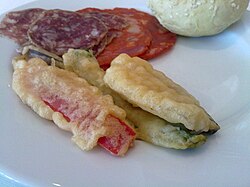
Peixinhos da horta, a typical dish from Lisbon from which Japanese tempura derives

Science and Intellectualism

Portugal has contributed significantly to global knowledge. From the epic poetry of Luís de Camões to modern scientific breakthroughs—such as Odette Ferreira identifying HIV-2—the Portuguese intellectual tradition remains vibrant.
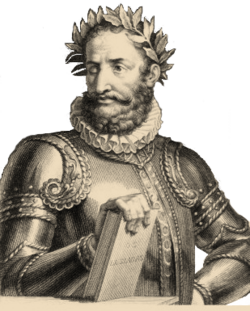
Luís de Camões, one of the greatest poets of the European literary tradition. His epic poem Os Lusíadas ranks among the finest works of world literature

Modern Influence and Public Figures

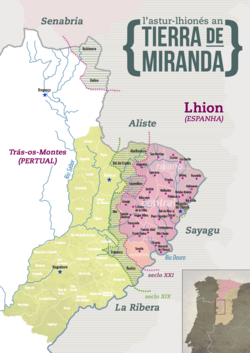
Areas in Northern Portugal where Mirandese is spoken

In the digital age, the Portuguese identity is championed by global icons. Cristiano Ronaldo stands as the most followed person on Instagram, symbolizing the global reach of Portuguese talent. The modern Luso-Brazilian identity is also prominent in entertainment and sports, blending the cultures of the mainland and the Americas.
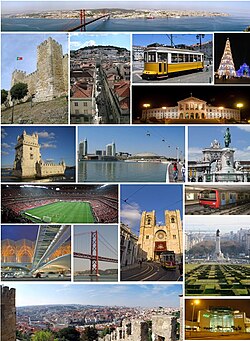
Lisbon, with 545,143 inhabitants in the city proper, is the capital and the largest city in Portugal.

Frequently Asked Questions
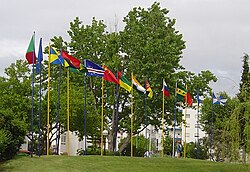
Flags of the countries of origin of the main immigrant communities in the municipality of Seixal
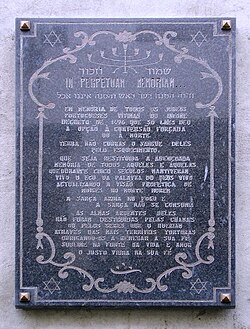
In memoriam of the expulsion of the Jews from Porto.
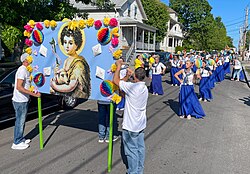
Bodo de Leite parade in East Providence, Rhode Island
Azulejo depicting the foundation of Colonia del Sacramento, now a Unesco World Heritage Site, Portuguese Museum
Portuguese community in Oberá, Misiones, Argentina
Former Cape Verdian President Jorge Carlos Fonseca
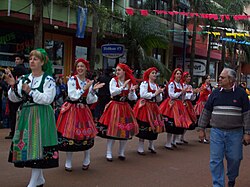
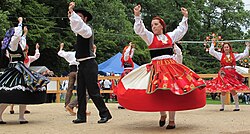
Portuguese folk dancing in Kockelscheuer.
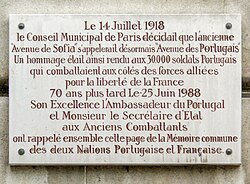
Commemorative plaque on the Portuguese.avenue (Avenue des Portugais) in Paris
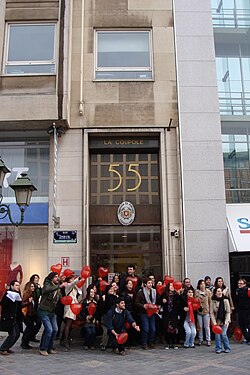
Portuguese in front of their embassy in Brussels, Belgium
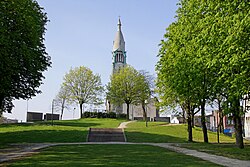
Portuguese catholic church in Gentilly, seen from the Cité Internationale Universitaire de Paris
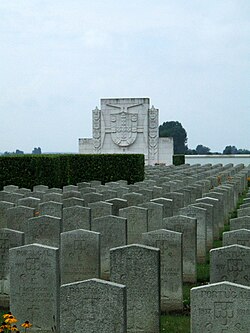
Portuguese Military Cemetery in Richebourg, France
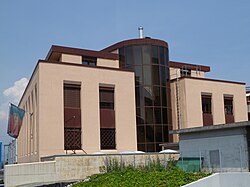
Portuguese consulate in Geneva
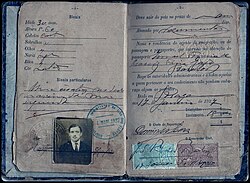
Passport of an immigrant from the Braga District to Brazil
Khanom farang kudi chin, Thai-style cake influenced by Portuguese desserts
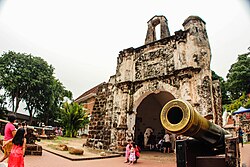
A Famosa, as well as the Historical centre of Malacca, is a remnant of the Portuguese presence now part of the Unesco World Heritage Sites.
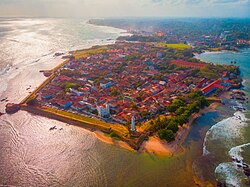
Aerial view of Galle Fort, built by the Portuguese in 1588 and now a Unesco World Heritage Site
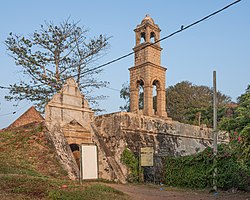
Negombo fort, that was built by the Portuguese to defend Colombo as a part of a defensive system all over the island.
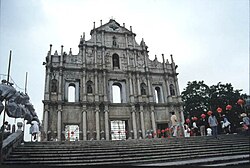
The Historic Centre of Macao, epitome of the Sino-Portuguese culture, is a Unesco World Heritage Site
Bacalhau codfish is one of the epitomes of Portuguese cuisine
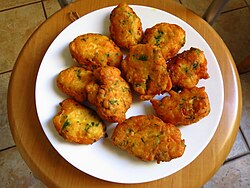
Pastéis de bacalhau, a typical petisco found everywhere in Portugal
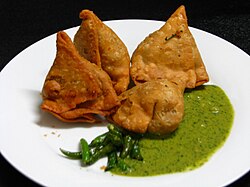
Chamuças (samosas) are an example of dish of foreign origin today widely popular in Portugal. They were first brought to the country during the Age of Discovery in the 15th century.
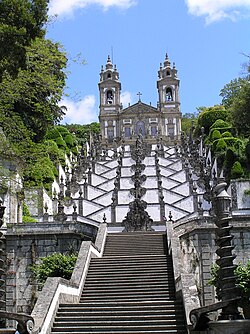
Santuário do Bom Jesus do Monte, in Braga, with its famous Baroque stairway
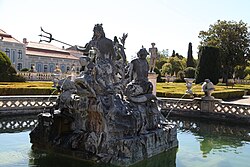
Fountain in the Palácio Nacional de Queluz, Queluz
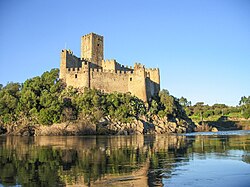
Portugal is famous for its Medieval and Templar castles. A fine example is the Castle of Almourol, in Vila Nova da Barquinha.
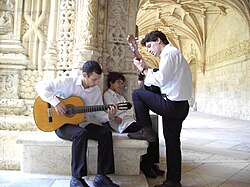
Portuguese fadistas performing in the Mosteiro dos Jerónimos, Lisbon
Carmen Miranda GCIH, OMC who reached stardom in Brazil as the foremost interpreter of samba

What is the most common surname in Portugal?

The most common surname is Silva, held by approximately 9.44% of the population, followed by Santos and Ferreira.

How many people are part of the Portuguese diaspora?

The total diaspora is estimated at approximately 70 million people, with the largest population residing in Brazil.

What is the significance of Haplogroup R1b in Portugal?

Haplogroup R1b is the most prevalent Y-DNA lineage in Portugal, found in 56% of the population, which aligns them closely with other Western European populations.

Which Portuguese dish influenced Japanese tempura?

The dish Peixinhos da horta (fried green beans) is the precursor to what is now known as Japanese tempura.

Who was Viriato?

Viriato was a leader of the Lusitanians who led a guerrilla war against the Roman Empire for eight years before his death in 139 BC.

References

  1. Only people legally registered as living in Portugal and not holding Portuguese nationality (thus excluding naturalised citizens and descendants of immigrants) are taken into account.
  2. "População residente aumenta, mas envelhecimento continua a agravar-se - 2024". INE. 18 June 2025. Retrieved 18 June 2025.
  3. AIMA I.P. - DPEE – Direção de Planeamento, Estudos e Estatística (October 2025). Relatório de Migrações e Asilo 2024 [Report on Migrations and Asylum 2024] (PDF) (Report) (in European Portuguese) (Digital ed.). p. 2. ISBN 978-989-35625-8-1. Retrieved 28 March 2026.
  4. "Estudo descobre 31,19 milhões de portugueses pelo mundo". Dn.pt. Archived from the original on 28 October 2014. Retrieved 24 August 2014.
  5. "A Lisbonne, une visite d'Elisabeth Borne dédiée à la culture et aux dossiers énergétiques". lefigaro.fr. 29 October 2022. Archived from the original on 28 November 2024. Retrieved 29 October 2022.