Port Costa: The Rise and Fall of a West Coast Shipping Hub
Nestled along the Carquinez Strait, Port Costa stands as a quiet reminder of California's industrial ambition. Founded in 1879, this town was once a critical link in the transcontinental railroad system, serving as a landing for the Solano, a railroad ferry operated by the Central Pacific Railroad. By transporting entire trains from Benicia to Port Costa, the ferry enabled rail traffic to continue toward the Oakland Pier, placing the town at the heart of American westward expansion.
The Era of Industrial Growth
The town's rapid development was driven largely by businessman George W. McNear. In 1880, McNear established the Port Costa Warehouses and Dock Company. The area, previously known as Bull Valley and owned by William Piper, was purchased by McNear in 1883 for $100,000. Under his leadership, Port Costa evolved into the busiest port on the West Coast, specializing primarily in the shipment of wheat.
Beyond shipping, the town diversified its economy through manufacturing. The Port Costa Brick Works became a staple of local industry, operating for nearly a century from 1905 until 1991.
Community and Architecture
As the economy boomed, the town established essential civic institutions. The first post office opened in 1881 under postmaster Kate Hurley, eventually relocating to one of McNear's warehouses. Spiritual life centered around St. Patrick Church, founded in 1884, which underwent rebuilding in 1898 and restoration in 1980.
Education was anchored by the Port Costa School. Designed by architect William Wilde in the classical revival style (an architectural movement inspired by the symmetry and columns of ancient Greece and Rome), the school opened in 1912 and served the community until 1966. Its historical significance was formally recognized in 1988 when it was added to the National Register of Historic Places.
The Decline of the Waterfront
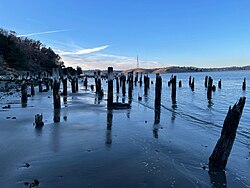
For decades, the town's commercial life revolved around its wharves and docks. However, this waterfront infrastructure was plagued by instability. Between 1883 and 1941, numerous fires devastated the docks. Furthermore, a severe infestation of shipworms led to the demolition of a large portion of the "Waterfront Port Costa" area in 1921.
Today, no wharves or docks remain standing, though the skeletal remains of the past are still visible.
Economic Shift and Modern Transition
The decline of Port Costa was precipitated by two major factors: a drop in California's wheat production in the early 20th century and a shift in transportation technology. In 1930, the Southern Pacific—which had taken over Central Pacific operations—completed a railroad bridge at Martinez, rendering the ferry crossing obsolete.
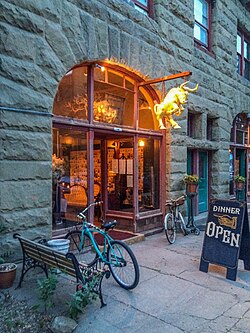
Efforts to revitalize the town began in 1963 when Bill Rich renovated the Burlington Hotel (built circa 1883) and McNear's 1886 warehouse to attract tourists. This era saw the warehouse host antique stores and, briefly, Clayton Bailey's Wonders of the World Museum. However, a 1983 fire in the hills between Port Costa and Crockett triggered a period of decline.
In recent decades, Port Costa has found a new identity as a niche destination. The Warehouse Cafe, a biker bar purchased in 1999, has developed a cult following. Additionally, the Bull Valley Roadhouse and the Burlington Hotel underwent renovations in 2012 and 2013, respectively, ensuring the town remains a popular spot for weekend visitors.
Key Facts
- Founded: 1879 as a railroad ferry landing.
- Peak Industry: Once the busiest port on the West Coast, primarily shipping wheat.
- Key Figure: George W. McNear, who bought the land for $100,000 in 1883.
- Infrastructure: The 1930 Martinez railroad bridge replaced the ferry system, leading to the town's decline.
- Historic Site: The Port Costa School is listed on the National Register of Historic Places.
| Year | Event |
|---|---|
| 1879 | Port Costa founded as a ferry landing for the Solano. |
| 1883 | George W. McNear purchases Bull Valley land for $100,000. |
| 1905 | Port Costa Brick Works begins operations. |
| 1912 | Port Costa School opens. |
| 1930 | Southern Pacific bridge at Martinez opens, replacing ferries. |
| 1991 | Port Costa Brick Works ceases operations. |
Frequently Asked Questions
Why was Port Costa founded?
It was established in 1879 to serve as a landing for the Solano railroad ferry, which transported trains across the Carquinez Strait as part of the transcontinental railroad route.
What was the primary export of Port Costa during its peak?
Port Costa became the busiest port on the West Coast primarily through the shipping of wheat.
What caused the decline of the town's population?
The decline was caused by a decrease in wheat output and the 1930 construction of a railroad bridge at Martinez, which eliminated the need for the ferry crossing.
What happened to the town's docks and wharves?
The waterfront suffered from multiple fires between 1883 and 1941, and shipworms caused significant damage leading to demolitions in 1921. Only pilings remain today.
Which buildings in Port Costa are historically significant?
Notable buildings include the Port Costa School (on the National Register of Historic Places), the Burlington Hotel, and the warehouses built by George W. McNear.