Population Growth: Global Trends, History, and Future Projections
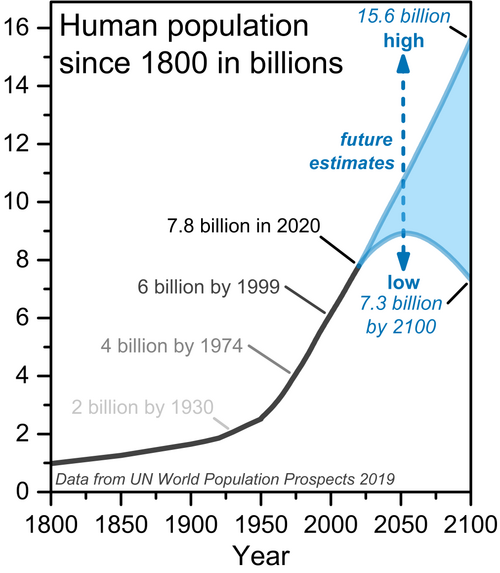
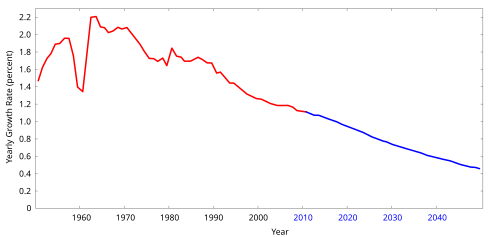
Population growth refers to the increase in the number of individuals within a specific population or dispersed group. Over the last two centuries, the human race has experienced an unprecedented expansion, growing from approximately 1 billion people in 1800 to 8.2 billion by 2025. Currently, the global population increases by roughly 70 million people annually, representing a growth rate of 0.85% per year.
While the total number of people continues to rise, the pace of this growth is shifting. As of 2024, the United Nations projects that the global population will peak in the mid-2080s at approximately 10.3 billion. These estimates have been revised downward in recent years, reflecting a sharp decline in global birth rates, although some analysts argue that these projections may still underestimate future growth.
![Population growth rate (2023, Our World in Data)[1]](/images/8e/bb/8ebb86a9e6008833c64b6d153d57978fe247f39fd0d4b633cf499c20f46aa231.png)
Key Facts
- Current Population: 8.2 billion (2025).
- Annual Increase: Approximately 70 million people per year.
- Projected Peak: 10.3 billion by the mid-2080s (UN projection).
- Historical Peak Rate: The global growth rate peaked at 2.2% in 1963.
- Primary Drivers: Technological advances in agriculture, sanitation, and medicine.
The History of Human Population Expansion
Significant global growth began following the end of the Black Death around 1350. This acceleration was driven by a combination of technological and medical breakthroughs. Improvements in agricultural productivity and sanitation, alongside medical advancements that reduced mortality rates, allowed populations to expand more rapidly than in previous eras.
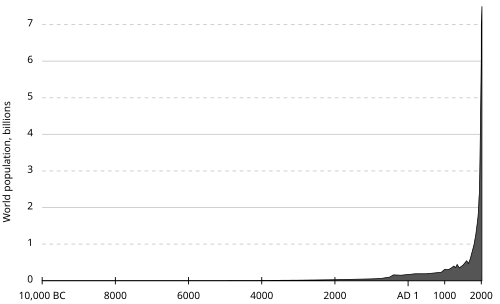
Historically, the timeline of growth shows a dramatic acceleration in the 20th century. For instance, the world reached 2 billion people by 1927 and surged to 8 billion by 2022.
Demographic Transitions and Growth Models
The Demographic Transition
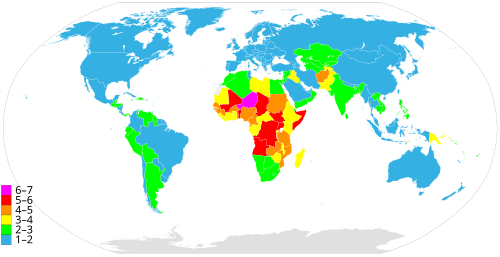
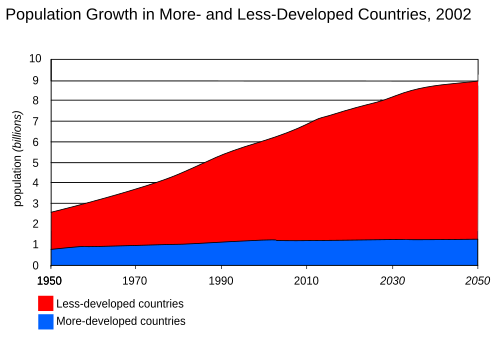
The demographic transition is a process where nations with higher standards of living experience a significant slowing of population growth. This creates a stark contrast between developed nations and less developed contexts, where population growth remains more robust.
Mathematical Modeling: The Logistic Equation
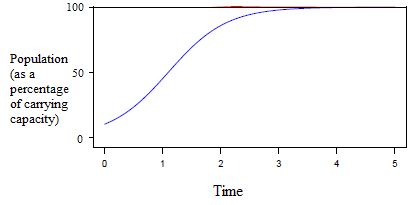
To understand how populations grow, scientists often use the logistic equation. Unlike exponential growth, which assumes infinite resources, the logistic model accounts for density dependence—the idea that growth slows as a population reaches the carrying capacity of its environment.
Global Distribution and Regional Trends
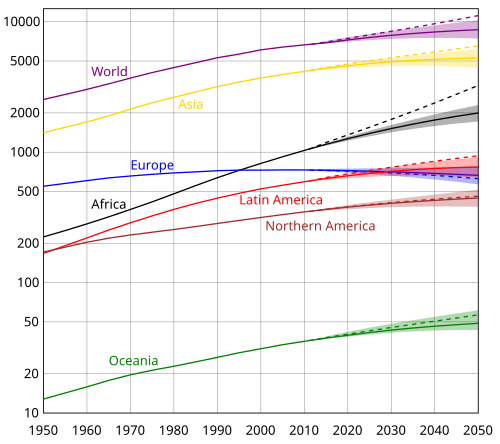
Population growth is not uniform across the globe. Much of today's growth is concentrated in less developed countries. For example, between 1990 and 2012, Africa saw a population increase of 73.3%, while OECD Europe grew by only 11.5%.
Some nations have even experienced negative growth. Russia and Japan, for instance, have seen declines in their population growth rates, with Russia recording a -0.1% growth rate between 2010 and 2020.
Comparative Population Growth (1990–2020)
| Country | 1990 Population | 2020 Est. Population | Growth (2010–2020) |
|---|---|---|---|
| World | 5,306,425,000 | 7,503,828,180 | 0.8% |
| China | 1,139,060,000 | 1,384,688,986 | 0.3% |
| India | 873,785,000 | 1,333,000,000 | 0.9% |
| United States | 253,339,000 | 329,256,465 | 0.6% |
| Nigeria | 97,552,000 | 203,452,505 | 2.5% |
| Japan | 122,251,000 | 126,168,156 | -0.1% |
Environmental Impact and Sustainability
The combination of population growth and increased consumption is a primary driver of environmental concerns, including climate change and biodiversity loss. This is largely due to the overexploitation of natural resources to support human development.
To address these challenges, international policy is centered on the Sustainable Development Goals. These goals aim to improve global standards of living and human well-being while simultaneously reducing the environmental footprint of human society.
![Absolute increase in global human population per year[2]](/images/c8/47/c8474428df273d1b2db888d00f4ea666c47c1ffee15817175a149178a1683c24.webp)
Frequently Asked Questions
When will the global population stop growing?
According to 2024 United Nations projections, the global population is expected to peak in the mid-2080s at approximately 10.3 billion people.
What is the demographic transition?
The demographic transition is a phenomenon where countries with higher standards of living experience a significant decline in population growth rates.
Why did the human population grow so rapidly after 1800?
The rapid growth was caused by a mix of technological advancements that increased agricultural productivity, better sanitation, and medical breakthroughs that lowered mortality rates.
Which regions are currently experiencing the most growth?
The majority of world population growth is currently occurring in less developed countries, with Africa and the Middle East showing some of the highest growth percentages.
How does population growth affect the environment?
Population growth, coupled with rising consumption, leads to the overexploitation of natural resources, which contributes to biodiversity loss and climate change.