Popular Science: A History of Scientific Communication
For over 150 years, Popular Science has served as a bridge between the complex world of scientific discovery and the curious public. From its origins as a scholarly journal for the educated elite to its evolution into a digital-first media brand, the publication has mirrored the changing ways humanity consumes technical knowledge.
The Scholarly Beginnings (1872–1915)
Founded in May 1872 by Edward L. Youmans and published by D. Appleton & Company, the publication was originally titled The Popular Science Monthly. Its primary mission was to disseminate scientific knowledge to the educated layman. In its early years, the journal relied heavily on reprints from English periodicals and became a prestigious outlet for some of the most influential minds in history.
The magazine featured contributions from legendary figures including Charles Darwin, Louis Pasteur, Thomas Edison, and William James. Following the death of Edward Youmans in 1887, his brother William Jay Youmans took over as editor-in-chief.
By 1900, economic pressures forced D. Appleton & Company to sell the journal to James McKeen Cattell. Under Cattell's leadership, the publication maintained its academic rigor, continuing to target a highly educated readership.
The Pivot to Popularity and the Modern Publishing Company
By 1915, the academic model was struggling financially. James McKeen Cattell announced that the Popular Science Monthly name would be transferred to the Modern Publishing Company to launch a new publication aimed at general audiences. The original scholarly journal was renamed The Scientific Monthly, which continued until 1958 when it was absorbed into the journal Science.
The Modern Publishing Company had previously merged several titles, including Electrician and Mechanic and Modern Electrics. To resolve naming confusion and clearly signal its focus, the company adopted the Popular Science Monthly brand starting with the November 1915 issue.
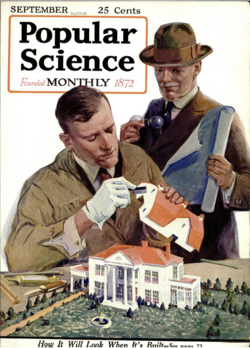
Under the leadership of new editor Waldemar Kaempffert, a former Scientific American editor, the magazine underwent a dramatic transformation. It shifted from a scholarly format—typically featuring eight to ten long articles per 100-page issue—to a high-energy format with hundreds of short, accessible articles and illustrations. Kaempffert targeted the "home craftsman and hobbyist," a strategy that doubled circulation within the first year.
Iconic Features and Growth
Over the following decades, the magazine introduced beloved recurring segments. From the 1920s to 1970, readers followed the fictional stories of Gus Wilson's Model Garage. From 1952 to 1989, the publication featured Roy Doty's Wordless Workshop. The magazine also became a staple for automotive enthusiasts, running annual new model reviews from 1940 to 1941, and again from 1954 through the mid-1970s.
Corporate Transitions and the Digital Age
In 1967, the Popular Science Publishing Company was acquired by the Times Mirror Company. During this era, the magazine adopted the subtitle "The What's New Magazine" (1969–1989) and experienced massive growth. By its 100th anniversary in 1972, circulation reached 1,625,000, with a readership that was 98% male.
The turn of the millennium brought rapid ownership changes. In 2000, Times Mirror merged with the Tribune Company, and the magazine was subsequently sold to Time Inc. By 2003, it was the top-selling science magazine in the U.S., boasting nearly 1.5 million monthly readers. In 2007, it was acquired by the Bonnier Magazine Group.
Bonnier pushed the brand into the digital frontier. Innovations included the Popular Science Predictions Exchange (PPX) in 2007—a virtual betting market for tech innovations—and the launch of Popular Science+ in 2010, the first title on the Mag+ tablet platform.
Modern Evolution and Digital Transformation
The 2010s were marked by a drive for inclusivity and modernization. Under editor-in-chief Joe Brown (appointed in 2016), the magazine worked to diversify its audience; by June 2018, women represented 52% of its online readership. The publication frequency also shifted from monthly to bi-monthly in 2016, and finally to quarterly in 2018.
In October 2020, the Bonnier Group sold the brand to North Equity LLC, which later formed Recurrent Ventures. This era saw the end of the print edition in 2021, transitioning the brand to a digital-only format. Despite these challenges, the brand continued to win accolades, including a 2022 National Magazine Award for its "Heat" issue.
Following a period of downsizing in late 2023, which saw the discontinuation of the digital edition and PopSci+, the brand was acquired by Ziff Davis in May 2026.
Key Facts
- Founded: May 1872 by Edward L. Youmans.
- Original Focus: Scholarly scientific knowledge for the educated layman.
- Major Pivot: Shifted to a "hobbyist" and general audience format in 1915.
- Peak Print Reach: 1,625,000 circulation by 1972.
- Digital Transition: Eliminated print editions in 2021 to become digital-only.
- Current Owner: Ziff Davis (acquired May 2026).
| Era/Year | Owner/Publisher | Primary Format/Focus |
|---|---|---|
| 1872–1900 | D. Appleton & Company | Scholarly Journal |
| 1900–1915 | James McKeen Cattell | Academic Science |
| 1915–1967 | Modern Publishing Company | Popular Science/Hobbyist |
| 1967–2000 | Times Mirror Company | Mass Market Monthly |
| 2000–2007 | Time Inc. | Top-selling US Science Mag |
| 2007–2020 | Bonnier Magazine Group | Multi-platform/Digital Pivot |
| 2020–2026 | Recurrent Ventures | Digital-only |
| 2026–Present | Ziff Davis | Digital Media Portfolio |
Frequently Asked Questions
Who founded Popular Science?
The magazine was founded in May 1872 by Edward L. Youmans and was initially published by D. Appleton & Company.
When did the magazine stop printing physical copies?
Popular Science eliminated its print edition in 2021, transitioning fully into a digital-only publication.
What was the "PPX"?
The Popular Science Predictions Exchange (PPX) was a prediction market launched in 2007 where users placed virtual bets on future technological and scientific innovations.
How did the magazine change in 1915?
It transitioned from a scholarly, academic journal with a few long articles to a popular science magazine featuring hundreds of short, easy-to-read articles and numerous illustrations for hobbyists.
Who currently owns Popular Science?
As of May 2026, the brand is owned by Ziff Davis.