Pope Gregory III: The Syrian Pontiff and the Struggle Against Iconoclasm
Pope Gregory III served as the Bishop of Rome from February 11, 731, until his death on November 28, 741. His papacy was defined by a volatile geopolitical landscape, marked by theological clashes with the Byzantine Empire and the relentless territorial expansion of the Lombards in Italy. A figure of significant historical transition, Gregory III was the last pope of Syrian origin and the last pope born outside of Europe for over a millennium, until the election of Pope Francis in 2013.
Key Facts
- Pontificate: February 11, 731 – November 28, 741.
- Origin: Born in Bilad al-Sham (Umayyad Caliphate), making him the last non-European pope until 2013.
- Major Conflict: Opposed iconoclasm (the destruction of religious images) promoted by Emperor Leo III.
- Military Threats: Faced constant pressure from the Lombards and sought aid from the Frankish leader Charles Martel.
- Legacy: Promoted the mission of Saint Boniface in Germany and restored the Aurelian Walls of Rome.
Election and Early Papacy
The son of a Syrian Christian named Ioannes (or John), Gregory was elected pope by popular acclamation on February 11, 731. However, his formal consecration as bishop did not occur until March 18. This delay was due to the requirement of approval from the Byzantine exarch of Ravenna, the imperial governor of the region. Gregory III holds the distinction of being the final pope to seek the exarch's ratification for his election.
The Battle Against Iconoclasm
Upon taking office, Gregory III immediately clashed with Emperor Leo III over iconoclasm—the imperial policy of banning and destroying religious icons. When the Emperor arrested Gregory's representative, the Pope convened a synod in November 731 that explicitly condemned the destruction of images.
The imperial response was severe. Emperor Leo III attempted to seize papal territories in Calabria and Sicily and transferred ecclesiastical jurisdictions in Illyricum to the patriarch of Constantinople. Despite these pressures, Gregory III doubled down on his veneration of icons and relics. He beautified numerous churches with images of Jesus Christ, the Virgin Mary, and the saints. Notably, he installed an iconostasis (a wall of icons and religious paintings) in St. Peter's Basilica, supported by six onyx and marble columns gifted by the exarch Eutychius.
Beyond art, Gregory was a champion of monasticism. He established the monastery of St. Chrysogonus and rebuilt the hospice of Saints Sergius and Bacchus to provide support for the poor.
Ecclesiastical Policy and European Missions
Gregory III utilized periods of relative peace to resolve internal church disputes and expand the faith into Northern Europe. He mediated a jurisdictional conflict between the patriarchs of Grado and Aquileia and approved the elevation of key figures in the English church, including Tatwine and Nothhelm as archbishops of Canterbury, and Egbert as archbishop of York.
His most significant impact on Northern Europe was his support for Saint Boniface. In 732, Gregory elevated Boniface to archbishop of Germany. By 737, he appointed Boniface as a papal legate and vicar, granting him the authority to reorganize episcopal sees and convene councils in Augsburg.
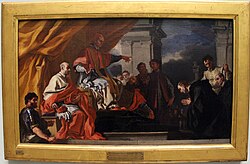
In a move to distance the church from pagan influences, Gregory III banned the consumption of horse meat in 732, labeling it an "abomination" due to its association with pagan ritual feasts.
The Lombard Threat and the Frankish Appeal
The security of Rome was constantly threatened by the Lombards. To defend the city, Gregory III completed the restoration of the Aurelian Walls and refortified Centumcellae. He also purchased the fortress of Gallese to secure communications with Ravenna.
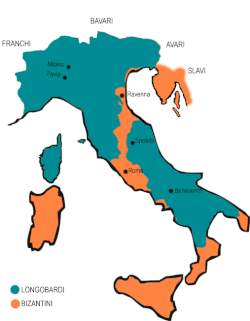
As the Lombard king Liutprand intensified his attacks, Gregory found himself in a desperate position. Despite his theological disputes with the Byzantines, he supported the Empire in recapturing Ravenna around 738. However, as the Lombards continued to seize towns like Ameria and Blera, Gregory turned to the Franks.
He sent urgent pleas to Charles Martel, the Frankish mayor of the Palace, offering to shift his allegiance from the Eastern Empire to the Franks in exchange for protection. While Charles Martel was largely occupied by the Umayyad invasion of Gaul—whom Gregory described as gens ferocissima ("that most fierce nation")—he eventually sent an embassy to Rome. This implicit support, combined with an outbreak of fever among the Lombard troops, forced Liutprand to retreat in 739.
Death and Legacy
Despite his efforts, Gregory III was unable to permanently halt the Lombard advance. He died on November 28, 741, and was succeeded by Pope Zachary. He was buried in the oratory he had constructed within St. Peter's Basilica. He is venerated in both the Roman Catholic and Eastern Orthodox Churches, with his feast day observed on December 10.
| Category | Details |
|---|---|
| Term | 731 – 741 AD |
| Origin | Syrian (Bilad al-Sham) |
| Key Opponent | Emperor Leo III (Byzantine Empire) |
| Key Ally (Sought) | Charles Martel (Franks) |
| Major Achievement | Restoration of Aurelian Walls; support of St. Boniface |
| Theological Stance | Anti-iconoclasm |
Frequently Asked Questions
Why was Pope Gregory III's origin significant?
Gregory III was the last pope of Syrian origin and the last pope born outside of Europe for 1,272 years, until the election of Pope Francis in 2013.
What was the conflict regarding iconoclasm?
Byzantine Emperor Leo III promoted iconoclasm, the destruction of religious images. Pope Gregory III strongly opposed this, condemning the practice in a 731 synod and decorating churches with icons of Christ, Mary, and the saints.
How did Gregory III attempt to defend Rome from the Lombards?
He restored the Aurelian Walls, refortified Centumcellae, and purchased the fortress of Gallese. He also appealed to Charles Martel of the Franks for military intervention.
What role did Saint Boniface play during this papacy?
Saint Boniface was elevated to archbishop of Germany in 732 and later appointed as a papal legate and vicar by Gregory III to reorganize the church hierarchy in Germany.
Why did Pope Gregory III ban horse meat?
He banned the consumption of horse meat in 732 because it was associated with pagan ritual feasting, which he considered an abomination.