Pole of Inaccessibility: The History of Antarctica's Most Remote Outpost
Deep within the frozen expanse of the Antarctic plateau lies the Pole of Inaccessibility, the point on the continent furthest from any ocean. Reaching this desolate location requires immense logistical effort, and the history of the site is marked by a series of daring expeditions from the Soviet Union, the United States, and independent explorers.
The First Soviet Outpost (1958)
The site first saw human habitation during the 3rd Soviet Antarctic Expedition. Personnel and equipment were delivered via a tractor convoy, which served a dual purpose: transporting the team and providing the foundation for the station's infrastructure. The outpost consisted of a radio shack, an electrical hut, and a hut designed to accommodate four people, all constructed atop the tractors used during the traverse.
To facilitate transport, an airstrip was cleared, allowing a Li-2 aircraft to land on December 18, 1958. The station was powered by a diesel generator and equipped with a transmitter for communication. However, the extreme isolation proved impractical for long-term habitation. On December 26, 1958, the outpost was vacated indefinitely. Four researchers were airlifted out, while the remaining 14 members returned via tractor. The site was deemed too remote for safe permanent operation and was reserved for short-term visits.
Subsequent Expeditions and Visits
Following the initial establishment, several expeditions returned to the Pole of Inaccessibility to conduct research or test endurance.
- 1964: The 8th Soviet Antarctic Expedition visited the site from February 1 to February 6.
- 1965-1966: The American Queen Maud Land Traverse reached the pole on January 27, 1965, departing via C-130 aircraft the following day. A second American crew arrived on December 15, 1965, to perform observations and refurbish their snowcats before continuing to the Plateau Station, arriving there on January 29, 1966.
- 1967: The 12th Soviet Antarctic Expedition conducted a visit to the site.
Modern Explorations
In more recent years, the site has attracted adventurers using innovative transport methods. On January 19, 2007, the British Team N2i reached the pole using specially designed foil kites. Later, on December 27, 2011, Sebastian Copeland and Eric McNair-Landry reached the location by foot and kite ski. Their journey began at the Novolazarevskaya station as part of the Antarctica Legacy Crossing, a partial east–west transcontinental trek covering over 4,100 km (2,500 mi).
Key Facts
- Established: 1958 by the 3rd Soviet Antarctic Expedition.
- Infrastructure: Included a diesel generator, transmitter, and huts built on tractors.
- Designation: Officially recognized as Historic Site or Monument 4 (HSM 4).
- Notable Landmark: A bust of Vladimir Lenin facing Moscow.
- Accessibility: Reached by tractor, C-130 aircraft, and kite skiing.
The Historic Site and the Lenin Bust
The original station building is topped by a bust of Vladimir Lenin, positioned to face Moscow. Over time, the harsh Antarctic environment has reclaimed the structure; as of 2007, the building is almost entirely buried by snow, leaving only the bust visible above the surface.
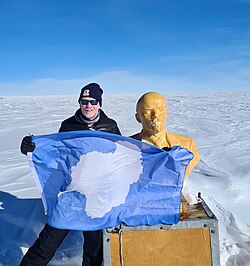
Due to its historical significance, Russia proposed that the site be protected. The buried building, the emergent bust, and a plaque commemorating the 1958 Soviet conquest of the Pole of Inaccessibility have been designated as Historic Site or Monument (HSM 4) under the Antarctic Treaty Consultative Meeting.
| Year | Expedition/Team | Method of Transport | Purpose/Outcome |
|---|---|---|---|
| 1958 | 3rd Soviet Antarctic Expedition | Tractor Convoy / Li-2 Aircraft | Established first temporary outpost |
| 1964 | 8th Soviet Antarctic Expedition | Not Specified | Short-term visit |
| 1965 | American Queen Maud Land Traverse | C-130 Aircraft / Snowcats | Observations and traverse continuation |
| 1967 | 12th Soviet Antarctic Expedition | Not Specified | Short-term visit |
| 2007 | British Team N2i | Foil Kites | Exploration |
| 2011 | Copeland & McNair-Landry | Foot and Kite Ski | Part of 4,100 km transcontinental crossing |
Frequently Asked Questions
Why was the original Soviet station abandoned?
The station was vacated in December 1958 because it was located too far from other research stations to allow for safe, permanent operation.
What is HSM 4?
HSM 4 refers to Historic Site or Monument 4, a designation given to the buried Soviet station, the bust of Vladimir Lenin, and the commemorative plaque under the Antarctic Treaty Consultative Meeting.
How is the station building currently preserved?
The building is not actively maintained but is preserved by the environment, as it is almost entirely buried under snow, with only the bust of Lenin remaining visible.
Who were the first people to reach the pole using kites?
The British Team N2i reached the Pole of Inaccessibility using specially designed foil kites on January 19, 2007.
What was the purpose of the American Queen Maud Land Traverse?
The American crews visited the pole to make observations, refurbish their snowcats, and continue their traverse toward the Plateau Station.