Plaza Santiago Montenegro: A Historic Urban Space in Rosario
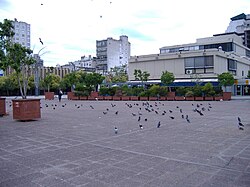
Located in the heart of Rosario, Santa Fe, Plaza Santiago Montenegro is a compact hardscape plaza—a public space primarily paved with hard materials rather than grass—that serves as a testament to the city's evolving urban landscape. Named in honor of Captain Santiago Montenegro, one of the earliest Spanish-descended settlers in the region, the plaza is a focal point of the downtown area.
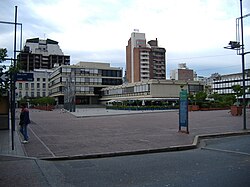
The plaza is strategically positioned within a city block bounded by San Luis Street, a pedestrian section of San Martín Street, and the narrow passage known as Barón de Mauá. A significant portion of this block is occupied by the Bernardino Rivadavia Culture Center, making the area a hub for both leisure and the arts.
Key Facts
- Location: Downtown Rosario, Santa Fe, Argentina.
- Former Name: Known as Plaza Pinasco until 1993.
- Primary Feature: A hardscape public space adjacent to the Bernardino Rivadavia Culture Center.
- Historical Use: Served as a marketplace from 1857 until 1962.
- World Cup Connection: Site of a former press center for the 1978 FIFA World Cup.
A History of Transformation
The land where Plaza Santiago Montenegro now stands has undergone several dramatic transformations over the last century and a half. From 1857 to 1903, the site functioned as a marketplace. This was replaced around 1905 by a more organized fruit and vegetable market, which remained in operation until 1962.
In 1962, Mayor Cándido Carballo ordered the removal of the market for sanitary reasons, leading to the demolition of the existing buildings. This left an empty lot that was eventually repurposed through a partnership between the Municipality and the Automóvil Club Argentino. The agreement allowed for the construction of an underground car park, while the surface was converted into a hardscape public space originally named Plaza Emidgio Pinasco.
The 1978 FIFA World Cup Influence
The plaza's layout changed again when Rosario served as a sub-seat for the 1978 FIFA World Cup. To meet FIFA's requirements, a sector of the plaza was used to construct a press center. Although initially intended to be a provisional structure, the building was made permanent and donated to the Municipality, eventually becoming the Bernardino Rivadavia Culture Center.
Modern Era and Community Use
The plaza underwent a significant rebuilding process in 1993 under the administration of Mayor Héctor Cavallero, at which time it was renamed Plaza Santiago Montenegro. Following this renovation, the space became a popular spot for a flea market, where artisans sold small goods and vendors offered used textbooks via makeshift kiosks.
By 2005, the municipal government intervened following complaints regarding the plaza's maintenance. As part of a broader city policy to organize street fairs, the government surveyed the vendors and implemented a permit system to regulate who could operate within the plaza, ensuring a more orderly environment for visitors and sellers alike.
| Period | Primary Use/Status | Key Event/Change |
|---|---|---|
| 1857–1903 | Marketplace | Early commercial hub |
| 1905–1962 | Fruit and Vegetable Market | Organized market structure |
| 1962 | Empty Lot / Construction | Demolition for sanitary reasons; underground parking built |
| 1978 | Press Center | Built for the FIFA World Cup; later became a Culture Center |
| 1993 | Plaza Santiago Montenegro | Rebuilt and renamed from Plaza Pinasco |
| 2005 | Regulated Fair Space | Introduction of vendor permits |
Frequently Asked Questions
Who was Plaza Santiago Montenegro named after?
The plaza is named after Captain Santiago Montenegro, who was one of the first settlers of Spanish descent in the Rosario area.
What was the plaza called before 1993?
Prior to its renaming in 1993, the space was known as Plaza Emidgio Pinasco.
How did the 1978 FIFA World Cup affect the plaza?
A portion of the plaza was used to build a press center for the tournament. This building was later made permanent and donated to the city to serve as the Bernardino Rivadavia Culture Center.
What is the current use of the plaza's open space?
The plaza is a hardscape public area that hosts permitted artisans and vendors as part of a regulated street fair system.
Why was the original market removed in 1962?
Mayor Cándido Carballo ordered the removal of the fruit and vegetable market due to sanitary concerns.