Understanding Plant Meristems: The Engines of Growth and Regeneration
Have you ever wondered how a tiny seed transforms into a towering tree or how a blade of grass recovers after being mowed? The secret lies in specialized tissues known as meristems. These biological engines are responsible for the continuous growth, regeneration, and adaptation of plants, serving as the primary source of all plant organs and tissues.
The term "meristem" was first introduced in 1858 by the Swiss botanist Carl Wilhelm von Nägeli. Derived from the Greek word merizein, meaning "to divide," the name perfectly captures the fundamental function of these tissues: constant cellular division.
Key Facts
- Meristematic cells are totipotent, meaning they have the potential to differentiate into any type of plant cell.
- Meristems are classified into three main types: apical, intercalary, and lateral.
- Primary growth (increase in length) is driven by apical meristems.
- Secondary growth (increase in diameter) is driven by lateral meristems like the vascular cambium.
- Apical dominance is a process where one dominant meristem inhibits the growth of others, often controlled by the hormone auxin.
The Nature of Meristematic Cells
At the heart of every meristem are meristematic cells. These are undifferentiated stem cells characterized by their ability to divide continuously. Unlike mature plant cells, meristematic cells are small, possess thin primary cell walls, and typically have little to no vacuoles. Their protoplasm is dense, and they lack intercellular spaces. Instead of containing mature plastids (specialized organelles like chloroplasts), they contain proplastids, which eventually develop into fully functional plastids as the cells specialize.
As these cells divide, they create a dynamic balance: some daughter cells remain meristematic to maintain the stem cell pool, while others undergo differentiation. Differentiation is the process where cells become specialized for specific roles, such as forming leaves, stems, or roots, often losing their ability to divide in the process.
Classifying Meristematic Tissues
Meristems are categorized based on where they are located and the type of growth they facilitate:
- Apical Meristems: Located at the tips of roots and shoots, these drive primary growth, which increases the plant's height or length.
- Intercalary (or Basal) Meristems: Found in the middle regions of stems or leaves, these allow for rapid regrowth, a common trait in grasses.
- Lateral Meristems (Cambium): Responsible for secondary growth, these increase the diameter of woody plants.
Primary Growth and the Apical Meristem
Apical meristems are indeterminate, meaning they can continue to produce new cells indefinitely. There are two primary types: the Shoot Apical Meristem (SAM) and the Root Apical Meristem (RAM).
The Shoot Apical Meristem (SAM)
The SAM is located at the tips of shoots and is the source of all above-ground organs, including leaves, stems, and flowers. It is also the site of much of the embryogenesis in flowering plants. The rate at which new organs, known as primordia, are initiated is measured by a time interval called a plastochron.
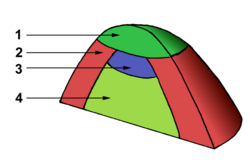
Structurally, the SAM is organized into distinct zones. The central zone acts as a reservoir of undifferentiated stem cells, while the peripheral zone is where new organs are generated. The medullary meristem contributes to the development of vascular tissues. In some plants, the layers are organized into a tunica (the outermost layer) and a corpus (the inner layers).
![Tunica-corpus model of the apical meristem (growing tip). The epidermal (L1) and subepidermal (L2) layers form the outer layers called the tunica. The corpus (L3) will form the vascular and stem tissues. Cells in the outer layers divide in a sideways fashion relative to each other, which keeps these layers distinct, whereas the lower layer divides in a more random fashion in all directions.[1]](/images/89/38/89386747b0635e29d049408fa3767ac904f1e46230e6a2396754596bac51c0a5.png)
The SAM's activity is regulated by complex genetic signaling. In the model organism Arabidopsis thaliana, the CLAVATA (CLV) gene family and the WUSCHEL (WUS) gene work together in a feedback loop to maintain the correct number of stem cells. While WUS promotes stem cell identity, CLV signaling helps prevent the stem cell pool from growing too large.
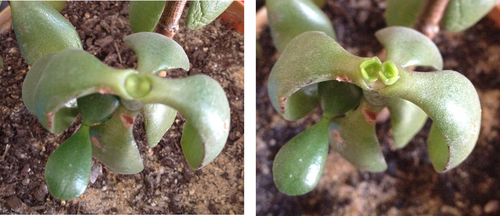
The rapid proliferation of cells in the SAM allows for the development of various structures, such as the leaves of Crassula ovata.
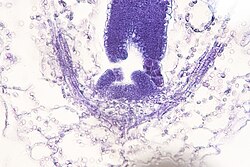
As cells move away from the SAM, they begin to form leaf or flower primordia.
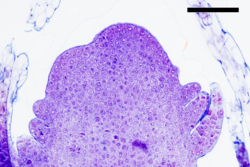
The maintenance of these stem cell populations involves highly organized cell groups, including the stem cells themselves, their immediate daughter cells, an organizing center, and founder cells that initiate organ formation.
The Root Apical Meristem (RAM)
While the SAM focuses on upward and outward growth, the RAM drives the root system downward. The RAM contains an organizing center called the quiescent center (QC). The QC consists of cells with low division rates that help maintain the surrounding stem cells and prevent them from differentiating too early. To protect the growing tip, the RAM is covered by a root cap, which guides the root through the soil. As the root grows, cells from the outer surface of the root cap are continuously sloughed off.
Secondary Growth and Lateral Meristems
While primary growth makes a plant taller, secondary growth makes it thicker. This is achieved through lateral meristems, primarily found in woody, or arboraceous, plants.
Vascular and Cork Cambium
The vascular cambium produces secondary xylem (which becomes wood) and secondary phloem. This process can continue throughout the life of the plant. In contrast, the cork cambium creates a protective outer layer called the periderm. This layer includes the phellem (cork) and phelloderm (bark). The cork cells are often coated in suberin, a substance that makes them impermeable to water and gases, providing a sturdy protective barrier.
Specialized Meristems: Flowers and Regrowth
When a plant transitions from vegetative growth to flowering, the SAM transforms into a floral meristem. Unlike the SAM, floral meristems are determinate, meaning their growth is limited to the specific size and form of the flower. This transition is controlled by identity genes like AGAMOUS (AG) and LEAFY (LFY), which ensure the correct development of sepals, petals, stamens, and carpels.
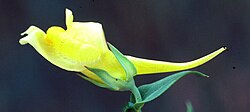
In certain plants, such as grasses, intercalary meristems located at the base of nodes or leaves allow for rapid regrowth after the plant has been grazed by animals or damaged by fire.
Additionally, some plants can induce meristems through environmental interactions. For example, legumes like soybeans and peas develop root nodules after being infected by Rhizobia bacteria. This process is triggered by chemical signals known as Nod factors.
Evolutionary and Horticultural Significance
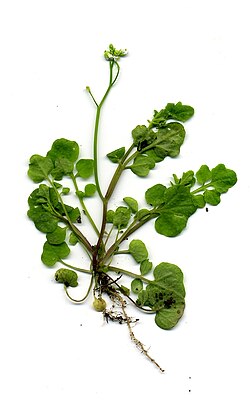
Meristems play a massive role in plant evolution and human industry. The KNOX gene family is a key player in determining leaf complexity; for instance, the expression of these genes can differentiate the simple leaves of Arabidopsis from the complex leaves of Cardamine hirsuta.
In horticulture, the ability of shoot meristems to develop into entirely new plants is used for cloning (or mericloning). This asexual reproduction allows for the mass production of desirable plant genotypes and can even help eliminate viruses from a plant lineage.
Summary of Meristem Types
| Meristem Type | Location | Primary Function |
|---|---|---|
| Apical | Tips of roots and shoots | Primary growth (increase in length/height) |
| Intercalary | Base of nodes or leaves | Rapid regrowth and elongation |
| Lateral | Sides of stems and roots | Secondary growth (increase in diameter) |
Frequently Asked Questions
What is the difference between primary and secondary growth?
Primary growth refers to the increase in a plant's length or height, driven by apical meristems at the tips of roots and shoots. Secondary growth refers to the increase in the plant's thickness or diameter, driven by lateral meristems like the vascular cambium.
How does apical dominance work?
Apical dominance is a phenomenon where the main central stem grows more strongly than side branches. This is regulated by hormones like auxins and strigolactones produced in the apical meristem, which inhibit the growth of lateral buds.
Can plants be cloned using meristems?
Yes. Through a process called mericloning, shoot meristems can be used to grow complete, new plants. This is a common practice in horticulture for mass-producing plants with specific desirable traits and can even help in producing virus-free plants.
What are totipotent cells?
Totipotent cells are cells that have the ability to differentiate into any other type of cell in the organism. Meristematic cells are totipotent, allowing them to serve as the foundation for all specialized plant tissues and organs.
Why do some plants have complex leaves while others have simple leaves?
Leaf shape is often influenced by the expression of KNOX genes. In plants with simple leaves, these genes are typically turned off in the leaves, whereas in plants with complex leaves, their continued expression helps generate more intricate structures.