Planetary Boundary Layer: The Dynamics of Earth's Lowest Atmosphere
The planetary boundary layer (PBL), also referred to as the atmospheric boundary layer (ABL) or peplosphere, is the lowest portion of the atmosphere. Its defining characteristic is that its behavior is directly influenced by its contact with the planetary surface. On Earth, this layer is highly dynamic, often responding to changes in surface radiative forcing within an hour or less.
Within the PBL, physical quantities such as temperature, moisture, and flow velocity experience rapid fluctuations known as turbulence, which facilitates strong vertical mixing. This stands in stark contrast to the "free atmosphere" located above the PBL, where winds are approximately geostrophic—meaning they flow parallel to the isobars. Inside the PBL, however, surface drag forces the wind to turn across the isobars.
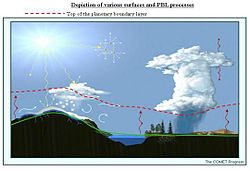
Key Facts
- Definition: The lowest part of the atmosphere directly influenced by the Earth's surface.
- Wind Behavior: Wind speed increases with height due to surface drag, creating a wind gradient.
- Composition: Consists of the surface layer, the PBL core, and the entrainment (capping) layer.
- Variability: Depth can range from 50 meters in the Arctic winter to over 4,000 meters over deserts in the late afternoon.
- Types: Primarily categorized into Convective (CBL) and Stably Stratified (SBL) layers.
The Cause of Surface Wind Gradients
Due to aerodynamic drag, a wind gradient exists approximately 100 meters above the Earth's surface. Because of the no-slip condition, wind speed starts at zero at the ground and increases with altitude. Obstacles on the surface reduce wind speed and introduce random vertical and horizontal velocity components, creating turbulence. This turbulence is critical for the dispersion of pollutants and the process of soil erosion.
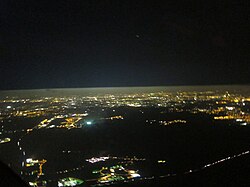
The intensity of this velocity reduction depends on surface roughness. Rough, irregular terrain or man-made structures can reduce geostrophic wind speed by 40% to 50%, whereas open water or ice may only cause a 20% to 30% reduction. These variations are essential considerations when siting wind turbines.
Modeling Wind Speed
For engineering, the wind gradient is often modeled using a power law with a constant exponential coefficient based on terrain. The height at which surface friction becomes negligible is known as the gradient height. Typical gradient heights include:
- Large cities: 457 m
- Suburbs: 366 m
- Open terrain: 274 m
- Open sea: 213 m
While the power law is convenient, a logarithmic fit is theoretically more accurate when the temperature profile is adiabatic. Additionally, the wind often changes direction as it rises, a phenomenon related to the Ekman spiral. The angle of this diversion ranges from 10° over open water to 50° over land at night.
Diurnal and Nocturnal Cycles
The PBL undergoes a daily cycle driven by solar heating. During the day, the turbulent rise of heated air breaks up the inversion layers formed overnight. This process is fastest on sunny days, driven by convective cells 200–500 meters in diameter. Conversely, the boundary layer stabilizes shortly before sunset.
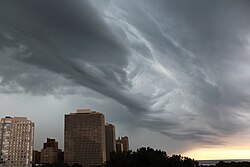
At night, radiative cooling increases atmospheric stability, which constrains turbulent eddies and increases the wind gradient. This effect is more pronounced over the sea, where there is less diurnal variation in boundary layer height compared to land. In a convective boundary layer, strong mixing typically diminishes the vertical wind gradient.
Constituent Layers and Depth
The PBL is structured into three primary zones based on the production and dissipation of turbulent kinetic energy:
- Surface Layer: The lowest 10% of the PBL where the largest velocity gradients occur.
- PBL Core: The region between 0.1 and 0.7 of the total PBL depth.
- Entrainment Layer: Also called the capping inversion layer, located between 0.7 and 1 of the PBL depth.
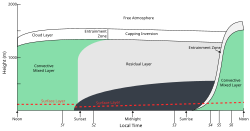
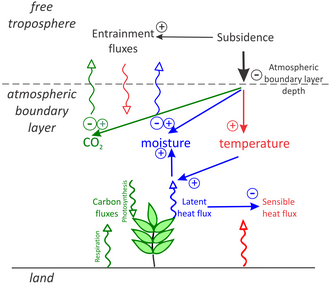
The total depth of the PBL is determined by the free atmosphere wind speed, surface heat (buoyancy) balance, density stratification, and vertical wind shear. Depth varies wildly by region and season: a nocturnal PBL in mid-latitudes is typically 300 m, while a tropical PBL in the trade-wind zone can reach 2,000 m.
Principal Types of Boundary Layers
Convective Planetary Boundary Layer (CBL)
A CBL occurs when positive buoyancy flux at the surface creates thermal instability, generating significant turbulence. This is common in tropical and mid-latitude regions during the day. In some cases, solar heating and water vapor condensation can create turbulence so strong that the convective layer extends through the entire troposphere, reaching the tropopause (10 km to 18 km in the Intertropical Convergence Zone).
Stably Stratified Planetary Boundary Layer (SBL)
An SBL occurs when negative buoyancy flux at the surface damps turbulence. Because it is driven solely by wind shear, an SBL cannot exist without free atmosphere wind. This type is typical at night or in regions where the surface is colder than the air above, such as the Arctic, where sea-ice surfaces significantly suppress turbulent motions.
Correctly representing these layers in atmospheric models is vital for predicting the transport of pollutants and moisture (evapotranspiration), as well as understanding the hydrological cycle and energy exchange.
| Feature | Convective PBL (CBL) | Stably Stratified PBL (SBL) |
|---|---|---|
| Primary Driver | Positive buoyancy flux (Thermal) | Wind shear turbulence |
| Typical Timing | Daytime | Nighttime |
| Turbulence Level | High (Strong vertical mixing) | Low (Damped turbulence) |
| Common Locations | Tropics, mid-latitudes (day) | Arctic, high latitudes, night |
Frequently Asked Questions
What is the difference between the PBL and the free atmosphere?
The PBL is the lowest layer of the atmosphere directly influenced by the Earth's surface, characterized by turbulence and wind that turns across isobars. The free atmosphere lies above the PBL, where wind is primarily geostrophic and flows parallel to isobars.
How does surface roughness affect wind speed?
Surface roughness creates aerodynamic drag. Rough terrain or buildings can reduce wind speeds by 40% to 50%, while smooth surfaces like open water or ice only reduce speeds by 20% to 30%.
What is the "no-slip condition"?
The no-slip condition is the physical principle that the velocity of the air immediately at the planetary surface is zero, which leads to the creation of the wind gradient as height increases.
What factors determine the depth of the planetary boundary layer?
The depth is determined by four main external factors: the wind speed of the free atmosphere, the surface heat/buoyancy balance, the density stratification of the free atmosphere, and the vertical wind shear (baroclinicity).
Why is the PBL important for environmental science?
The PBL is critical because it governs the turbulent transport of moisture and air pollutants. It also influences the formation of clouds, trade winds, and the overall exchange of energy between the land and the atmosphere.