Plague: Causes, Symptoms, and Modern Medical Management
Plague is a severe infectious disease caused by the bacterium Yersinia pestis. While most famously associated with the devastating Black Death pandemic of the 14th century, plague remains a present, though rare, health threat in several parts of the world today. Modern medicine has transformed the prognosis of the disease, shifting it from a nearly certain death sentence to a treatable condition provided it is diagnosed early.
Key Facts
- Causative Agent: The bacterium Yersinia pestis.
- Primary Vector: The Oriental rat flea (Xenopsylla cheopis).
- Global Incidence: Approximately 600 reported cases per year.
- Treatment: Highly responsive to antibiotics such as gentamicin and fluoroquinolones.
- Mortality: Roughly 10% with treatment, compared to approximately 70% without.
Types of Plague and Their Symptoms
Depending on how the bacteria enter the body and spread, plague manifests in three primary forms: bubonic, septicemic, and pneumonic.
Bubonic Plague
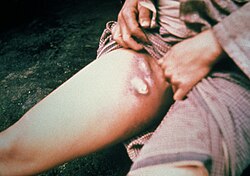
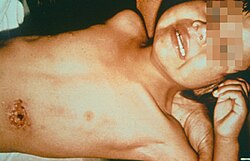
The most common form, bubonic plague, occurs when bacteria enter the skin through a flea bite or a break in the skin. It is characterized by the sudden onset of fever, headache, and weakness, along with the development of buboes—painfully swollen lymph nodes, typically in the groin, armpit, or neck.
Septicemic Plague
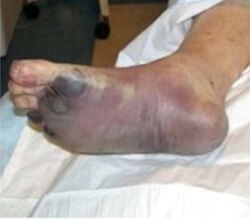
Septicemic plague occurs when Y. pestis multiplies in the bloodstream. This can happen as a primary infection or as a complication of bubonic or pneumonic plague. It can lead to disseminated intravascular coagulation, causing tissue necrosis (death of body tissue), particularly in the extremities.
Pneumonic Plague
Pneumonic plague is the most severe form, resulting from an infection of the lungs. It is the only form that can be transmitted from person to person via airborne droplets produced by coughing. The incubation period is very short, ranging from a few hours to four days. Symptoms include headache, weakness, and the coughing up of blood. Without treatment within a few hours of symptom onset, mortality is nearly 100%.
Causes and Transmission
The transmission of Yersinia pestis involves a complex cycle between animal reservoirs and vectors. The bacteria primarily circulate among rodents in tropical, sub-tropical, and warm temperate latitudes between 55° N and 40° S on all continents except Australia.
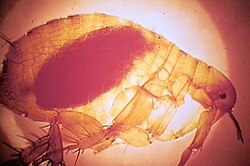
The primary vector is the Oriental rat flea (Xenopsylla cheopis). When a flea feeds on an infected rodent, the bacteria multiply and form a physical plug in the flea's stomach. This prevents the flea from consuming blood, leaving it starving. In a desperate attempt to feed, the flea bites a new host and vomits the bacteria-laden blood into the wound.
While flea bites are the most common route, humans can also be infected through:
- Droplet contact: Inhaling droplets from an infected person coughing or sneezing.
- Direct physical contact: Touching an infected person or animal.
- Indirect contact: Touching contaminated soil or surfaces.
- Fecal-oral transmission: Consuming contaminated food or water.
Diagnosis and Treatment
Diagnosis is typically achieved by identifying the bacterium in a patient's blood, sputum, or lymph node aspirate. A rapid diagnostic test (F1RDT) that detects the F1 capsule antigen has been developed for suspected pneumonic and bubonic cases. While highly sensitive, F1RDT results must be confirmed due to a risk of false positives.
Treatment consists of antibiotics and supportive care. Effective medications include streptomycin, chloramphenicol, tetracycline, and newer options like gentamicin and doxycycline. A combination of gentamicin and a fluoroquinolone is typically used. Prompt administration is critical; the risk of death drops from 70% to about 10% when treated.
Prevention and Vaccination
The first plague vaccine was developed by Waldemar Haffkine in 1897. Today, routine vaccination is not recommended for the general public or most travelers. Vaccination is reserved for high-risk individuals, including:
- Laboratory and field personnel working with antimicrobial-resistant Y. pestis.
- Individuals conducting aerosol experiments with the bacteria.
- Personnel in field operations within enzootic areas (regions where the disease occurs at regular, predictable rates in animal populations) where exposure cannot be avoided.
Epidemiology and History
Historically, the most devastating outbreak was the Black Death in the 14th century, which killed over 50 million people in Europe. Recent research suggests the modern strains of Y. pestis may have originated in Kyrgyzstan, with DNA evidence found in graves dating to 1338 and 1339.
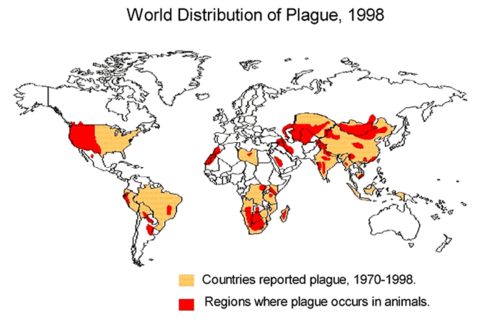
In the modern era, plague is sporadic. In 2017, the highest case numbers were reported in Madagascar, the Democratic Republic of the Congo, and Peru. In the United States, cases occasionally appear in rural areas where the bacteria circulate among local rodent populations.
| Type | Primary Site of Infection | Key Symptom | Transmission Route |
|---|---|---|---|
| Bubonic | Lymph nodes | Buboes (swollen glands) | Flea bites / Skin breaks |
| Septicemic | Bloodstream | Tissue necrosis | Flea bites / Progression from other types |
| Pneumonic | Lungs | Coughing blood | Airborne droplets / Progression from other types |
Frequently Asked Questions
Can plague be transmitted between humans?
Yes, but only in the pneumonic form. Pneumonic plague can spread through airborne droplets when an infected person coughs or sneezes. Bubonic and septicemic plague are not typically transmitted between humans.
Is the plague still a threat today?
Yes, though it is rare. Approximately 600 cases are reported globally each year, with endemic pockets in countries like Madagascar and the Democratic Republic of the Congo, as well as rural areas of the United States.
How is plague treated in modern medicine?
Plague is treated with a course of antibiotics, often a combination of gentamicin and a fluoroquinolone. Early diagnosis and treatment are essential to prevent death.
Do I need a vaccine if I am traveling?
Routine vaccination is not recommended for most travelers, even those visiting countries with reported cases, especially if they stay in urban areas with modern accommodations.
What is the difference between the Black Death and modern plague?
The Black Death was a massive 14th-century pandemic caused by Yersinia pestis. Modern plague is caused by the same bacterium, but it occurs in sporadic cases or small outbreaks and is now treatable with antibiotics.