Pío Collivadino: The Post-Impressionist Master of Argentine Art
Pío Collivadino was a pivotal figure in the evolution of Argentine art, bridging the gap between traditional European training and the modern sensibilities of Post-Impressionism—an art movement that emerged as a reaction against Impressionism, emphasizing emotional expression and structured form over the fleeting effects of light.
Born in Buenos Aires on August 20, 1869, Collivadino dedicated his life to capturing the essence of his homeland and the changing urban landscape of his city. His journey took him from the cultural hubs of Italy back to the heart of Argentina, where he would eventually lead the nation's most prestigious art institutions.
Key Facts
- Born: August 20, 1869, Buenos Aires, Argentina.
- Died: August 26, 1945, Buenos Aires, Argentina.
- Artistic Movement: Post-Impressionist.
- Notable Works: La hora del almuerzo (1903) and Usinas (1914).
- Major Awards: Gold medal at the 1904 Universal Exposition and the Order of the Crown of Italy (1905).
- Key Roles: Director of the Academy of Fine Arts and Director of the Prilidiano Pueyrredón School of Fine Arts.
Early Education and Italian Influence
Collivadino's artistic foundation began at the Societá Nazionale de Buenos Aires, the Italian Argentine cultural society. Seeking deeper mastery, he traveled to Rome in 1889. By 1891, he was accepted into the Accademia di San Luca, the National Academy of Fine Arts, where he studied under the mentorship of Cesare Mariani. During this period, he contributed to the creation of decorative frescoes within the Constitutional Court of Italy.
Upon returning to Argentina in 1896, he initially gained recognition for his romanticist lithographs, a form of printmaking that allowed for soft, tonal gradations.
Rise to International Fame and the Nexus Group
Between 1903 and 1907, Collivadino attended three international festivals in Venice. It was here that his work La hora del reposo (Workday Break, 1903), also known as La hora del almuerzo (Lunch break time), earned him a gold medal.
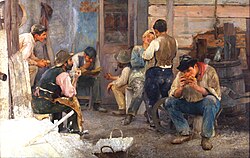
His success continued at the 1904 Louisiana Purchase Exposition in St. Louis, where he was awarded both a silver and a gold medal. These accolades provided the momentum for Collivadino to embrace Post-Impressionism. At the time, this style was not yet popular among Argentine patrons. To champion this new direction, he joined the Nexus Group in 1907, alongside painters Fernando Fader and Martín Malharro, and sculptor Rogelio Yrurtia. Together, they overcame initial social ostracism to popularize the genre in Argentina.
Leadership in the Arts and Later Career
Collivadino's prestige grew steadily. In 1905, he was honored with the Order of the Crown of Italy and became an honorary member of the Accademia di Brera in Milan. By 1908, he was appointed Director of the Academy of Fine Arts, and he played a prominent role in the 1910 Centennial International Exposition in Buenos Aires.
During this prolific era, he produced some of his most enduring works, including Usinas (Power Plants, 1914). Beyond painting, he served as the director of scenography at the world-renowned Colón Theatre and continued teaching at the Academy of Fine Arts until his retirement in 1935.
Institutional Contributions
In his final years, Collivadino focused on institutional growth, helping to organize the Prilidiano Pueyrredón School of Fine Arts in 1939 and the Ernesto de la Cárcova Museum in 1941.
| Period/Year | Achievement/Role | Significance |
|---|---|---|
| 1891 | Accademia di San Luca | Formal training in Rome under Cesare Mariani |
| 1903 | Gold Medal (Venice) | Recognition for La hora del almuerzo |
| 1907 | Nexus Group Member | Popularized Post-Impressionism in Argentina |
| 1908 | Director, Academy of Fine Arts | Led the nation's primary art education center |
| 1914 | Painting of Usinas | Creation of one of his most famous works |
Political Conflict and Final Years
Collivadino's tenure as director of the Pueyrredón School ended abruptly in 1944. He was forced into retirement by the military regime of General Pedro Pablo Ramírez. The dictatorship's cultural policy was hostile toward European influences, favoring what they termed "criollo virtues" (native Argentine values).
Geno Díaz, a former student and famed artist, later described this period as a tragedy, noting that the "illustrious elderly master died of sadness" following his cruel replacement by the regime. Pío Collivadino passed away in Buenos Aires on August 26, 1945, at the age of 76.
Frequently Asked Questions
What is Pío Collivadino most famous for?
He is most famous as a leading Argentine Post-Impressionist painter and for his notable works such as La hora del almuerzo and Usinas.
Where did Collivadino study his art?
He began his studies at the Societá Nazionale de Buenos Aires and later attended the Accademia di San Luca in Rome, Italy.
What was the Nexus Group?
The Nexus Group was a collective of artists, including Collivadino, Fernando Fader, Martín Malharro, and Rogelio Yrurtia, who worked to popularize Post-Impressionism in Argentina despite initial resistance from patrons.
Why was Collivadino forced to retire in 1944?
He was removed from his position at the Prilidiano Pueyrredón School by the military regime of General Pedro Pablo Ramírez, which opposed European cultural influences in favor of "criollo virtues."
Which international awards did he receive?
Collivadino earned a gold medal at the Venice festivals for La hora del reposo, a gold and silver medal at the 1904 Louisiana Purchase Exposition in St. Louis, and the Order of the Crown of Italy in 1905.