Pig Biology, Domestication, and Global Economic Impact
The domestic pig, scientifically known as Sus domesticus, is a highly intelligent and versatile mammal that has played a central role in human civilization for millennia. From its evolutionary roots as a descendant of wild boars to its current status as a cornerstone of global agriculture, the pig is a complex animal with significant biological, economic, and cultural importance.
![The initial emergence of wild pigs, followed by the genetic divergence between boars and pigs and the domestication of pigs [20]](/images/dc/8e/dc8edbb64aa319d3df02487ba98aca6dd4ef949e71d8038011a2ac0d85ef66a4.png)
Evolutionary History and Taxonomy

Taxonomically, pigs belong to the kingdom Animalia, the phylum Chordata, and the class Mammalia. They are part of the order Artiodactyla (even-toed ungulates) and the family Suidae. The journey from wild ancestors to the domesticated species we recognize today began during the Neolithic period, marking a significant shift in human history.
From Wild Boars to Domesticated Swine
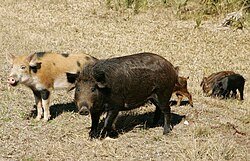
The domestication process involved a genetic divergence from wild boars. As humans transitioned to settled agricultural lifestyles, pigs were integrated into human societies, eventually spreading globally through events like the Columbian Exchange. In some regions, descendants of these domestic animals have reverted to a wild state, becoming known as feral pigs.
Biology and Physiology

Pigs possess unique physiological traits that support their survival and reproductive success. Their sensory capabilities, particularly their highly sensitive sense of smell, are among the most advanced in the animal kingdom.
Reproduction and Nursing
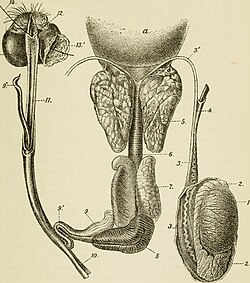
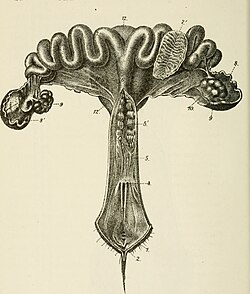
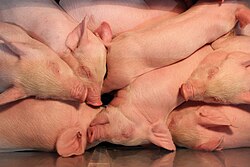
The reproductive systems of boars (males) and sows (females) are specialized for high productivity. Sows are known for their ability to nurse large litters, typically possessing between 12 and 14 nipples to support suckling piglets.
Intelligence and Senses
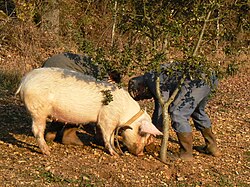
Research has consistently highlighted the high level of intelligence in pigs. They have demonstrated the ability to perform complex tasks, such as using a specifically designed joystick to interact with digital interfaces. Their keen sense of smell is also utilized in specialized roles, such as assisting in the search for wild truffles.
![A pig using a specifically designed joystick[71]](/images/60/01/600129d5a2df65ee0cc64e1c22b0732d4819f31026528f684f242e83aa37be13.jpg)
Agriculture and Global Economy
Pigs are a major global commodity. The scale of pig production is immense, with the world total pig stock reaching over 850 million in 2019. China remains the largest producer, followed by the European Union and the United States.
Global Pig Stock Distribution (2019)
| Rank | Country/Region | Stock (Millions) | Percentage of World Total |
|---|---|---|---|
| 1 | China (Mainland) | 310.4 | 36.5% |
| 2 | European Union | 143.1 | 16.83% |
| 3 | United States | 78.7 | 9.26% |
| 4 | Brazil | 40.6 | 4.77% |
| 5 | Russia | 23.7 | 2.79% |
| 6 | Myanmar | 21.6 | 2.54% |
| 7 | Vietnam | 19.6 | 2.31% |
| 8 | Mexico | 18.4 | 2.16% |
| 9 | Canada | 14.1 | 1.66% |
| 10 | Philippines | 12.7 | 1.49% |
Production and Welfare
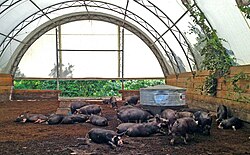
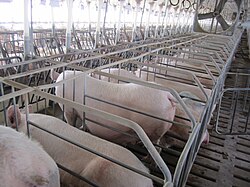
Modern pig farming encompasses various methods, from intensive indoor systems to free-range setups. As the industry evolves, there is increasing focus on animal welfare, including management practices regarding gestation and housing to prevent issues like crushing or tail biting.

Medical and Cultural Significance
Beyond food production, pigs are vital in medical research. Due to physiological similarities to humans, they are used in studies involving organ systems and even xenotransplantation (the transplantation of living cells, tissues, or organs from one species to another).
![The growth in publication of medical research papers using pigs and miniature pigs, and the research done on miniature pigs by organ system[106]](/images/08/81/0881496644fb30de1d473b344c6da9b6648fcfd51a282f851f5f48598bbad3f2.jpg)
Culturally, pigs appear frequently in art, literature, and history, ranging from ancient bronze sculptures to modern depictions in folklore.
Key Facts
- Scientific Name: Sus domesticus.
- Global Population: Approximately 850.3 million (2019 data).
- Leading Producer: China holds the largest share of global pig stock at 36.5%.
- Intelligence: Pigs are capable of learning complex tasks using tools like joysticks.
- Medical Use: Pigs are essential in medical research and organ system studies.
Frequently Asked Questions
What is the difference between a pig and a boar?
While the terms are often used interchangeably, a boar typically refers to an uncastrated male pig, whereas a pig is a general term for the species.
How intelligent are pigs?
Pigs are highly intelligent animals capable of complex problem-solving and can even be trained to use joysticks for digital tasks.
What are the main uses of pigs?
Pigs are primarily used for food products like pork chops, bacon, and salami, but they also serve roles in medical research and as pets.
Can pigs be used in medical science?
Yes, pigs are used extensively in medical research due to their physiological similarities to humans, including studies on organ systems.
What are feral pigs?
Feral pigs are domestic pigs that have escaped into the wild and reverted to a wild lifestyle.