Pickerelweed (Pontederia cordata): An Essential Guide to This Aquatic Beauty
Commonly known as pickerelweed in the United States and pickerel weed in the United Kingdom, Pontederia cordata is a striking monocotyledonous aquatic plant. Native to the Americas, this resilient species is a staple of wetland ecosystems, adding both beauty and ecological value to the environments it inhabits.
Ecology and Natural Habitat
Pickerelweed is an emergent plant, meaning it grows in flooded conditions with its upper parts extending above the water surface. To survive in these saturated environments, the plant relies on aerenchyma—specialized tissue within the stem that facilitates the transport of oxygen down to the roots. This adaptation, combined with a metabolism that tolerates low soil oxygen, allows the species to thrive where other plants might struggle.
This species is typically found in a variety of wetlands, such as the margins of ponds and lakes. Its range is remarkably vast, stretching from eastern Canada all the way south to Argentina. You can find it in diverse settings, including northern rivers, the Louisiana wetlands, and the Everglades. Pickerelweed often thrives in areas with naturally fluctuating water levels, such as during spring flooding and summer emergence. It also shows a preference for fertile areas, such as the nutrient-rich bays of large lakes.
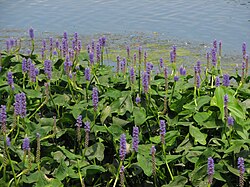
While hardy, pickerelweed is not without its challenges. It is negatively impacted by high salinity, grazing, and competition from other wetland plants. Interestingly, the species shares a complex relationship with other aquatic life; for example, a 36-year study in a sinkhole pond revealed an inverse relationship with the American Lotus (Nelumbo lutea). In years when American Lotus abundance was high, pickerelweed populations tended to decline, and vice versa.
Botanical Characteristics and Reproduction
The Beauty of the Flowers
In the late summer, pickerelweed produces beautiful purple flowers adorned with yellow markings. These markings serve a vital purpose: attracting pollinators. Specifically, two species known to pollinate these flowers are Melissodes apicatus and Dufourea novaeangliae. Botanically, the flowers are described as tristylous, meaning the styles of individual plants occur in three different morphs, with most populations containing all three types.
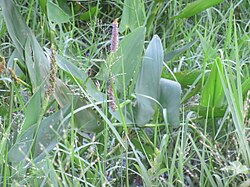
Beyond sexual reproduction through flowers, the plant can also reproduce asexually. It uses branching rhizomes—underground stems—to spread, which allows it to form large, dense clonal stands. While the leaf shape of the plant can vary significantly between different populations or even within a single individual, these variations have historically led to many different taxonomic names for the species.
Seed Development and Germination
As the plant moves into its seeding stage, the stem supporting the flower cluster (the inflorescence) bends to submerge the fruits and seeds beneath the water. The resulting seed pods are small, green, and have a warty texture. When these pods are ripe, they release the seeds into the water. To ensure successful growth, the seeds undergo a period of dormancy and require stratification—a period of specific environmental conditions, such as cold or moisture—for 6 to 8 weeks before they will germinate.
Cultivation and Human Uses
Because of its aesthetic appeal, pickerelweed is a popular choice for ornamental garden ponds. Its reliability and beauty have earned it the Royal Horticultural Society's Award of Garden Merit.
Beyond its use in landscaping, the plant has practical uses for foraging. The young leafstalks are edible and can be consumed either raw (provided the unripe fruits are removed) or cooked. Additionally, the seeds are edible in their raw state and can be ground into grain for consumption.
Key Facts
- Common Names: Pickerelweed (USA) or pickerel weed (UK).
- Conservation Status: Secure.
- Native Range: The Americas, from eastern Canada to Argentina.
- Pollinators: Primarily Melissodes apicatus and Dufourea novaeangliae.
- Edible Parts: Young leafstalks and seeds.
- Growth Habit: Forms large clonal stands via rhizomes.
Summary Profile
| Rank | Classification |
|---|---|
| Kingdom | Plantae |
| Clade | Embryophytes, Tracheophytes, Angiosperms, Monocots, Commelinids |
| Order | Commelinales |
| Family | Pontederiaceae |
| Genus | Pontederia |
| Species | P. cordata |
Frequently Asked Questions
Where does pickerelweed naturally grow?
Pickerelweed grows in various wetland environments, including the margins of lakes, ponds, and rivers. Its natural range extends from eastern Canada southward to Argentina.
How does the plant survive in underwater conditions?
The plant uses specialized tissue called aerenchyma in its stems to transport oxygen down to its roots, allowing it to thrive in flooded, low-oxygen soil.
Can I grow pickerelweed in my garden?
Yes, it is frequently cultivated as an ornamental plant for garden ponds and has received the Royal Horticultural Society's Award of Garden Merit.
Is pickerelweed edible?
Yes, the young leafstalks can be eaten raw or cooked, and the seeds are edible raw and can also be ground into grain.
How do the seeds germinate?
The seeds are dormant when released and require a period of stratification lasting 6 to 8 weeks before they are able to germinate.