Philosophical Transactions of the Royal Society B: A Legacy of Biological Science
The Philosophical Transactions of the Royal Society B: Biological Sciences stands as a cornerstone of scientific communication. Published by the Royal Society in the United Kingdom, this biweekly, peer-reviewed journal is dedicated to the advancement of the biological sciences. Under the leadership of Editor-in-Chief Richard Dixon, the publication continues to serve as a vital platform for authoritative research and synthesis.
Key Facts
- Established: 1665 (as the original Philosophical Transactions), making it the oldest scientific journal in the English-speaking world.
- Frequency: Published biweekly.
- Impact Factor: 4.7 (2024).
- Access Model: Hybrid open access, with articles becoming freely available one year after publication.
- Focus: Themed issues providing original syntheses across biological disciplines.
Editorial Scope and Structure
Unlike journals that publish disparate research papers, each issue of Philosophical Transactions B focuses on a specific area of the biological sciences. The goal is to create an authoritative synthesis—a comprehensive integration of existing knowledge—that bridges traditional disciplines. These issues are designed to showcase current developments and provide a foundation for future policy decisions, applications, and research.
To ensure the highest level of expertise, each issue is managed by one or more expert guest editors. The thematic content generally falls into one of four primary categories:
- Cell and Development
- Health and Disease
- Environment and Evolution
- Neuroscience and Cognition
A History of Scientific Excellence
The journal's origins date back to 1665, when it was founded by the Royal Society. Henry Oldenburg, the society's first joint secretary, served as the journal's first editor. For over two centuries, it operated as a single publication before expanding in 1887 to better serve the growing complexity of science.
In 1887, the publication split into two distinct journals: Philosophical Transactions of the Royal Society A, focusing on mathematical, physical, and engineering sciences, and Philosophical Transactions of the Royal Society B, focusing on the life sciences. Today, while these journals handle themed and discussion meeting issues, individual research articles are published in their sister journal, Proceedings of the Royal Society.
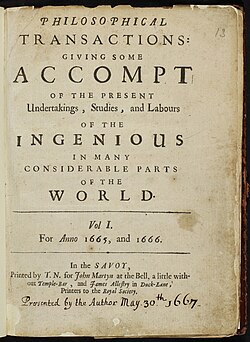
In 2015, the journal celebrated its 350th anniversary. To mark this milestone, it published a special collection of commentaries on landmark papers from its extensive archives, featuring contributions from legendary scientists such as Alan Turing, Hans Sloane, and Antonie van Leeuwenhoek.
Journal Specifications
| Attribute | Detail |
|---|---|
| ISO 4 Abbreviation | Philos. Trans. R. Soc. B |
| ISSN (Print/Web) | 0962-8436 / 1471-2970 |
| CODEN | PTRBAE |
| LCCN | 86645785 |
| OCLC Number | 01403239 |
Frequently Asked Questions
How often is the journal published?
The journal is published on a biweekly basis.
Is the journal open access?
It operates on a hybrid open access model, meaning that all articles become freely accessible to the public one year after their initial publication date.
Who is the current editor-in-chief?
The editor-in-chief is Richard Dixon of the University of North Texas (UNT).
What is the difference between Philosophical Transactions B and Proceedings of the Royal Society?
Philosophical Transactions B focuses on themed issues and authoritative syntheses, whereas the sister journal, Proceedings of the Royal Society, publishes individual research articles.
What is the historical significance of this journal?
Established in 1665, it is the oldest scientific journal in the English-speaking world, providing a continuous record of scientific discovery for over 350 years.