Phase Angle in Observational Astronomy
In the study of the cosmos, the way we perceive the brightness and shape of celestial bodies depends heavily on geometry. One of the most critical measurements in this regard is the phase angle. This angle determines how much of an illuminated side of an object is visible to an observer, directly influencing the observed "phase" of a planet or moon.
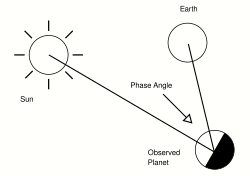
Technically, the phase angle is defined as the angle between the light incident upon an observed object and the light reflected from that object toward the observer. In most astronomical contexts, this is measured as the angle formed by the Sun, the object, and the observer.
The Geometry of Observation
For observers on the ground, the "Sun–object–Earth" angle is typically used. While this is nearly identical to the "Sun–object–observer" angle, a small difference exists due to parallax—the displacement in the apparent position of an object viewed along two different lines of sight. For example, when observing the Moon, this difference can be as significant as 1°, which is equivalent to two full Moon diameters.
With the advent of space travel and the theoretical study of observations from various points in the universe, the concept of the phase angle has evolved to be independent of the specific positions of the Sun and Earth, applying instead to any illuminator and observer.
Understanding Phase Angle Values
The phase angle ranges from 0° to 180°, with each value representing a specific geometric alignment:
- 0°: The illuminator, observer, and object are collinear, with the illuminator and observer on the same side of the object.
- 180°: The object is positioned directly between the illuminator and the observer, a position known as inferior conjunction.
- Less than 90°: This range represents backscattering, where light is reflected back toward the source.
- Greater than 90°: This range represents forward scattering, where light is deflected away from the source.
Planetary Variations and the Phase Curve
Not all celestial bodies exhibit the same range of phase angles as seen from Earth. The Moon, Venus, and Mercury can cover the full spectrum from 0° to 180°. In contrast, the superior planets (those further from the Sun than Earth) have much more limited ranges. For instance, Mars reaches a maximum phase angle of approximately 45°, while Jupiter and Saturn are limited to 11.1° and 6°, respectively.
The relationship between an object's brightness and its phase angle is known as the phase curve. While this relationship is generally smooth, some objects exhibit an opposition spike—a sharp increase in brightness near 0°. This phenomenon is not observed in gas giants or bodies with thick atmospheres. As the phase angle approaches 180°, the object typically becomes fainter.
| Object | Maximum Phase Angle |
|---|---|
| Moon | 180° |
| Venus | 180° |
| Mercury | 180° |
| Mars | ~45° |
| Jupiter | 11.1° |
| Saturn | 6° |
Key Facts
- The phase angle is the angle between incident light and reflected light (Sun-object-observer).
- A 0° angle means the observer and light source are on the same side of the object.
- A 180° angle occurs during inferior conjunction, where the object is between the source and observer.
- The phase curve describes how an object's brightness changes relative to its phase angle.
- The opposition spike is a brightness increase near 0° not found in gas giants.
Frequently Asked Questions
What is the difference between backscattering and forward scattering?
Backscattering occurs when the phase angle is less than 90°, meaning light is reflected back toward the direction of the light source. Forward scattering occurs when the phase angle is greater than 90°, meaning light is deflected further away from the source.
Why do superior planets have smaller maximum phase angles?
Because superior planets orbit further from the Sun than Earth does, the geometric angle formed between the Sun, the planet, and Earth cannot reach the wide extremes (up to 180°) that are possible for inner planets like Venus or Mercury.
What is an opposition spike?
An opposition spike is a non-smooth increase in an object's brightness that occurs when the phase angle is very close to 0°. This effect is absent in bodies with pronounced atmospheres or gas giants.
How does parallax affect phase angle measurements?
Parallax is the difference in the apparent position of an object based on the observer's location. For terrestrial observations of the Moon, this can cause a difference of up to 1° between the Sun-object-Earth angle and the Sun-object-observer angle.