Peruvian Seaside Cinclodes: The Unique Surf-Dwelling Bird of Peru
Along the rugged coastlines of Peru lives a remarkable avian specialist: the Peruvian seaside cinclodes (Cinclodes taczanowskii), also known as the surf cinclodes. A member of the ovenbird family (Furnariidae), this bird has carved out a highly specific niche, spending its life at the very edge of the Pacific Ocean.
Unlike most songbirds, the Peruvian seaside cinclodes is a master of the intertidal zone—the area that is above water at low tide and under water at high tide. Its existence is a testament to evolutionary adaptation, allowing it to thrive in a harsh, salty environment where few other passerines (perching birds) can survive.
Key Facts
- Endemic Status: Found exclusively in Peru.
- Habitat: Strictly coastal, favoring rocky intertidal zones.
- Diet: Aquatic invertebrates, including crabs, snails, and isopods.
- Conservation: Listed as Least Concern by the IUCN.
- Unique Behavior: One of the only passerines to forage directly at the ocean's surf line.
Taxonomy and Classification
The Peruvian seaside cinclodes is a monotypic species, meaning there are no recognized subspecies. It belongs to the subfamily Furnariinae within the family Furnariidae.
Taxonomists have long debated the relationship between the Peruvian seaside cinclodes and its close relative, the Chilean seaside cinclodes (C. nigrofumosus). While they have been viewed as both separate and identical species at different times, 21st-century genetic studies reveal they are very weakly differentiated. As of 2023, they are classified as sister species, and both are closely related to the dark-bellied cinclodes (C. patagonicus). The American Ornithological Society's South American Classification Committee is currently considering a proposal to merge the Peruvian and Chilean species.
Physical Description
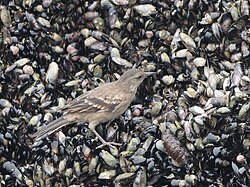
This is a relatively large cinclodes, measuring approximately 21 cm (8.3 in) in length and weighing around 63 g (2.2 oz). It is characterized by a straight bill and a plumage that provides effective camouflage against coastal rocks.
Both males and females share the same appearance. Their crowns are a dark sepia brown, blending into dark brown upperparts. The face features an indistinct buffy brown supercilium (the stripe of feathers above the eye). Their wings and tail are primarily dusky brown, though the primaries often show cinnamon buff or pale rufous bases, and the outer tail feathers have pale rufous tips. The underparts transition from a dirty white throat with dusky spots to a brown breast with short pale streaks and a plain brown belly.
Distribution and Habitat
The species is endemic to Peru, with a distribution stretching from the Department of Ancash in the north down to the Department of Tacna near the Chilean border. They are also found on several islands located near the shore.
Their habitat is strictly limited to the coastline. While they primarily favor rocky shores, they will occasionally venture onto adjacent sandy areas. They are year-round residents and almost never leave the immediate vicinity of the water's edge.
Behavior and Ecology
Feeding Habits
The Peruvian seaside cinclodes exhibits a rare behavior among passerines: foraging directly at the ocean's surf line. Working alone or in pairs, they hunt for aquatic invertebrates. Their diet consists of small crabs, other crustaceans, isopods, beetles, and small bivalves and snails.
Breeding and Vocalization
Information regarding their breeding habits is limited, as only one nest has been formally described. This nest, active in February, consisted of a cup made of algae, plant fibers, and feathers, tucked securely into a rock crevice.
In terms of communication, the bird's song is described as a trill, while its standard call is an abrupt "chec" sound.
Conservation Status
The IUCN Red List categorizes the Peruvian seaside cinclodes as Least Concern. Although its geographic range is limited and the exact population size is unknown, the population is believed to be stable. There are currently no immediate threats identified, and the species is considered common and largely unaffected by human activity.
| Feature | Details |
|---|---|
| Scientific Name | Cinclodes taczanowskii |
| Family | Furnariidae (Ovenbirds) |
| Length | ~21 cm (8.3 in) |
| Weight | ~63 g (2.2 oz) |
| Range | Coastal Peru (Ancash to Tacna) |
| IUCN Status | Least Concern |
Frequently Asked Questions
Where can the Peruvian seaside cinclodes be found?
It is endemic to the coast of Peru, ranging from the Department of Ancash south to the Department of Tacna, as well as on several nearshore islands.
What makes this bird's feeding behavior unique?
Along with its Chilean relative, it is one of the only passerines (perching birds) in the world that forages directly at the ocean's surf line.
What do Peruvian seaside cinclodes eat?
They feed on aquatic invertebrates, specifically small crabs, crustaceans, isopods, beetles, snails, and small bivalves.
Is the Peruvian seaside cinclodes an endangered species?
No, it is classified as Least Concern by the IUCN. The population is believed to be stable and is not significantly impacted by human activity.
How does it differ from the Chilean seaside cinclodes?
While they are treated as sister species, genetic studies show they are very weakly differentiated, leading some ornithologists to propose that they be merged into a single species.