Persimmons: A Comprehensive Look at the Diospyros Genus
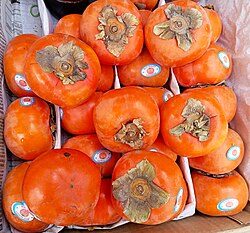
The persimmon is the edible fruit of several tree species within the genus Diospyros. While many varieties exist, the most widely cultivated is the Oriental persimmon, known scientifically as Diospyros kaki. This fruit is a staple in many East Asian cultures and has expanded globally, with China producing 80% of the world's supply as of 2023.
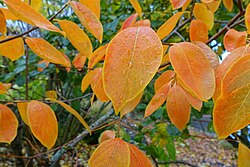
Botanically, the persimmon is classified as a berry because it is a single fleshy fruit derived from the ovary of a single flower, similar to the morphology of a tomato. The Diospyros kaki tree typically grows between 4.5 and 18 metres (15 to 60 feet) with a round top. Its deciduous leaves are bluish-green, leathery, and glossy on top, turning vibrant shades of yellow, orange, or red during the autumn months.
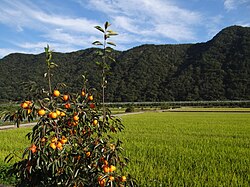
Key Facts
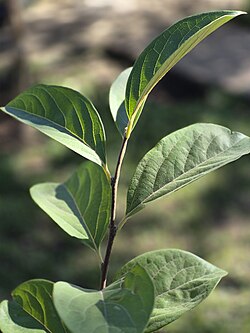
- Primary Species: Diospyros kaki is the most commercially significant species.
- Global Leader: China is the dominant producer, accounting for 80% of global output.
- Botanical Type: Classified as a berry.
- Nutritional Highlight: A moderate source of manganese (15% DV per 100g).
- Main Categories: Divided into astringent and non-astringent varieties.
The Oriental Persimmon (Diospyros kaki)
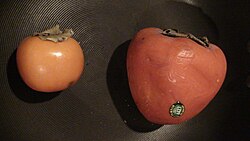
Native to China, Northeast India, and northern Indochina, the Oriental persimmon has a cultivation history spanning over 2,000 years. It reached Japan in the 7th century and Korea in the 14th century. In these regions, it is known as shì (Chinese), kaki (Japanese), and gam (Korean). In Nepal, it is called haluwabed and remains a popular seasonal fruit.
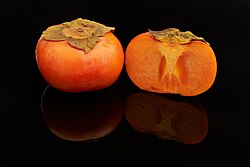
The fruit is characterized by a sweet, slightly tangy flavor and a texture that ranges from soft to occasionally fibrous. It was introduced to Southern Europe and California in the 1800s, and later to Brazil in the 1890s via Japanese immigrants.
Astringent Varieties
Astringent persimmons contain tannins that cause a drying sensation in the mouth if eaten before they are fully ripe. Notable varieties include:
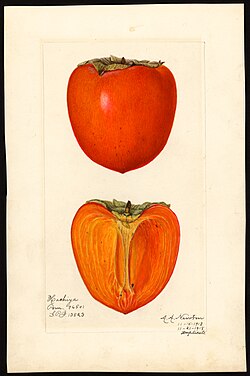
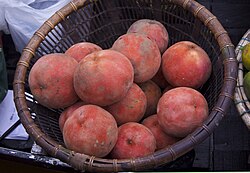
- Hachiya: Cone-shaped and bright orange.
- Rojo Brillante: A primary variety produced in Spain.
- Sharon Fruit: The primary variety grown in Israel.
- Other notable types: Fuji, Saijō, and the Italian Cioccolatino.
Non-Astringent Varieties
These varieties can be eaten while still firm and do not possess the same level of astringency. Popular examples include:
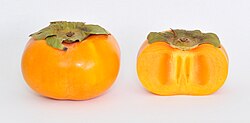
- Fuyu: A medium-sized, flattened orange fruit common in California and Japan.
- Jiro: A medium to large fruit known for its eating quality.
- Vainiglia: A traditional Italian variety with a vanilla-like taste.
Other Notable Species and Hybrids
Beyond D. kaki, several other species are recognized for their fruit or ecological value:
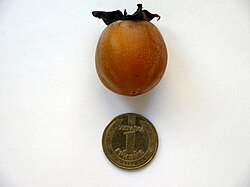
- Diospyros virginiana: The American persimmon, which has various cultivars like 'Prok' and 'Claypool'.
- Diospyros lotus: Known as the date-plum.
- Diospyros blancoi: The velvet persimmon.
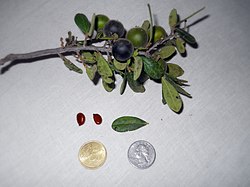
- Diospyros texana: The Texas persimmon.
To combine the cold-tolerance of the American persimmon with the larger fruit size of the Oriental persimmon, hybrid breeding began at the Nikitsky Botanical Garden in Crimea in 1948. Some of these hybrids, such as 'Nikita's Gift', can withstand temperatures as low as –24 °C.
Global Production and Yields
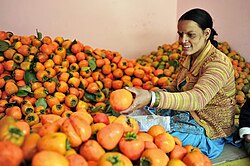
Production is concentrated in East Asia, but significant commercial activity exists in the Mediterranean and the Americas. While China leads in total volume, Israel and Uzbekistan have shown the highest yields per hectare.
| Country | Production (Million Tonnes) |
|---|---|
| China | 4.06 |
| South Korea | 0.24 |
| Japan | 0.19 |
| Azerbaijan | 0.19 |
| Brazil | 0.17 |
| World Total | 5.07 |
Nutrition and Culinary Uses
A raw Japanese persimmon consists of approximately 80% water and 19% carbohydrates. It is low in protein and fat, providing about 70 calories per 100 grams.
Nutritional Value (per 100g)
- Energy: 70 kcal
- Carbohydrates: 18.59 g (including 12.53 g sugars)
- Dietary Fiber: 3.6 g
- Manganese: 15% DV
- Vitamin C: 8% DV
Culinary Preparations
Persimmons are consumed fresh, dried, or processed. In Taiwan, astringent varieties are sometimes sealed in jars with limewater for 5 to 7 days to remove bitterness, creating "crisp persimmons." In Japan, Hoshigaki refers to the traditional method of drying the fruit.
Frequently Asked Questions
What is the difference between astringent and non-astringent persimmons?
Astringent varieties contain high levels of tannins that create a puckering sensation in the mouth unless the fruit is fully ripe (soft). Non-astringent varieties, such as the Fuyu, can be eaten while still firm without this effect.
Which country produces the most persimmons?
China is the world's leading producer, accounting for approximately 80% of global persimmon production as of 2023.
Are persimmons healthy?
Yes, they are a good source of dietary fiber and provide a significant amount of manganese (15% of the Daily Value per 100g), along with vitamins C and E.
What is a hybrid persimmon?
A hybrid persimmon is a cross between Diospyros virginiana (American persimmon) and Diospyros kaki (Oriental persimmon), designed to create a tree that has both large fruit and high cold-tolerance.
How are persimmons used in Asian cuisine?
They are eaten fresh, dried (such as Japanese Hoshigaki), or treated with limewater in Taiwan to remove astringency and create a crisp texture.