Peristalsis: The Biological Mechanism of Wave-Like Propulsion
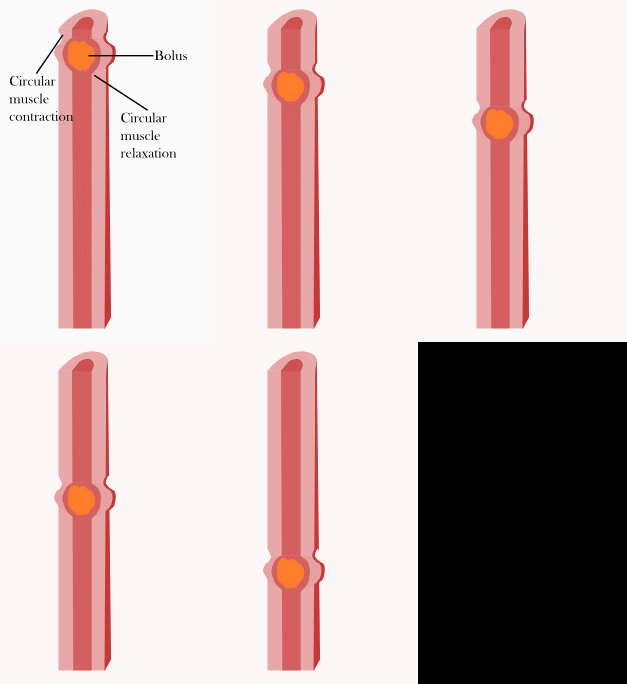
Peristalsis is a fundamental type of gut motility characterized by the radially symmetrical contraction and relaxation of muscles. These movements propagate in a wave-like motion down a tube in an anterograde (forward) direction. Derived from the Greek word peristellein, meaning "to wrap around," this process is essential for moving materials through the body, from the digestion of food to the circulation of lymph.
At its core, peristalsis involves the coordinated contraction of involuntary circular muscles. This is preceded by a simultaneous contraction of the longitudinal muscle and the relaxation of the circular muscle in the lining of the gut. In the human digestive tract, this sequence propels a food bolus (a ball of chewed food) forward until it is transformed into chyme (a semi-fluid mass of partly digested food) in the stomach.
Key Facts
- Direction: Moves materials in an anterograde (forward) direction.
- Mechanism: Coordinated waves of circular and longitudinal muscle contractions.
- Control: Managed by the myenteric plexus and the medulla oblongata.
- Scope: Occurs in the esophagus, stomach, intestines, lymphatic system, and vasa deferentia.
- Non-Human Examples: Used by earthworms for locomotion and imitated in industrial peristaltic pumps.
The Physiology of Human Peristalsis
The coordination of these waves is managed by the myenteric plexus, an interconnected network of neurons spanning the gastrointestinal (GI) tract from the esophagus to the rectum. When a food bolus stretches the smooth muscle of the gut, serotonin is secreted, activating sensory neurons.
These sensory neurons trigger the myenteric plexus, which splits into two distinct cholinergic pathways:
- Retrograde Pathway: Releases substance P and acetylcholine to contract the smooth muscle behind the bolus.
- Anterograde Pathway: Releases nitric oxide and vasoactive intestinal polypeptide to relax the smooth muscle ahead (caudal) of the bolus.
This dual action effectively pushes the bolus forward, a process also known as the myenteric reflex.
Peristalsis Across the Digestive Tract
The Esophagus
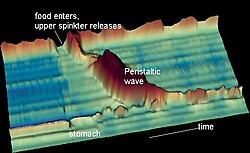
Once food is swallowed, the esophagus uses rhythmic, unidirectional waves to force the bolus into the stomach. This is supported by the migrating motor complex (MMC), which helps trigger these waves and clears remaining particles from the stomach and small bowel.
There are three types of esophageal peristalsis:
- Primary: Triggered by swallowing, lasting about 8–9 seconds.
- Secondary: Triggered by stretch receptors if a bolus becomes stuck or moves too slowly.
- Tertiary: Dysfunctional, irregular contractions that can result in a "corkscrew esophagus" appearance during a barium swallow.
The Stomach and Small Intestine
At the end of the esophagus, the cardiac sphincter (gastroesophageal sphincter) opens to allow the bolus into the stomach. Here, the muscularis layer is at its thickest, and maximum peristalsis occurs to blend food with acidic gastric juice. The pyloric sphincter then releases the resulting chyme into the small intestine in installments.
In the small intestine, peristaltic waves are shorter and slower, traveling only a few centimeters per second. Their primary role here is mixing rather than propulsion. This differs from segmentation contractions, which churn and mix materials without pushing them forward.
The Large Intestine
While the large intestine utilizes standard peristalsis, its primary propulsion comes from mass action contractions. These occur one to three times per day, often triggered by the gastrocolic reflex when food enters the stomach or duodenum, propelling feces toward the rectum.
Beyond Digestion: Other Applications of Peristalsis
Lymphatic and Reproductive Systems
Because the human lymphatic system lacks a central pump, lymph circulates via peristalsis in capillaries and valves, aided by arterial pulsation and skeletal muscle contraction. Similarly, during ejaculation, the vasa deferentia use peristaltic contractions to propel sperm from the testicles to the urethra.
Animal Locomotion
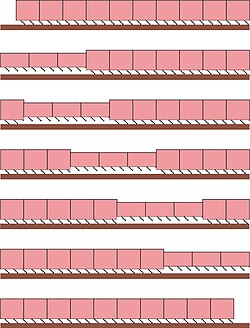
Earthworms utilize a hydrostatic skeleton—a fluid-filled body cavity surrounded by an extensible wall—to move. By radially constricting the anterior portion of their body, they increase length via hydrostatic pressure. This wave propagates posteriorly, extending the worm forward while hair-like setae prevent backward slipping.
Mechanical Engineering
The biological design of peristalsis is mirrored in peristaltic pumps. These positive-displacement pumps use a motor to pinch a flexible tube, propelling fluid while keeping it isolated from the machinery. This is critical for handling abrasive or sterile fluids. Additionally, soft robotics have been developed to mimic earthworm locomotion.
| Location/System | Primary Purpose | Key Characteristic |
|---|---|---|
| Esophagus | Transport | Primary and secondary waves |
| Stomach | Churning/Mixing | Thickest muscularis layer |
| Small Intestine | Mixing/Absorption | Short, slow waves |
| Large Intestine | Mass Propulsion | Mass action contractions |
| Lymphatic System | Circulation | Valve-assisted movement |
| Earthworm | Locomotion | Hydrostatic skeleton pressure |
Frequently Asked Questions
What is the difference between peristalsis and segmentation?
Peristalsis is a wave-like contraction that propels contents forward along a tube. Segmentation consists of localized contractions that churn and mix materials without moving them significantly forward.
Does peristalsis reverse during vomiting?
No. During vomiting, the propulsion of food back up the esophagus is caused by the contraction of abdominal muscles, not by the reversal of peristaltic waves.
What happens when peristalsis fails?
A lack of propulsion is known as aperistalsis, which can result from achalasia. A disruption of the normal propulsive ability of the GI tract is called ileus.
How is esophageal peristalsis medically evaluated?
It is typically assessed through an esophageal motility study or a barium swallow, the latter of which can identify dysfunctional tertiary peristalsis.
What controls the peristaltic reflex?
The process is controlled by the medulla oblongata and the myenteric plexus, which coordinates the release of neurotransmitters like acetylcholine and nitric oxide to manage muscle contraction and relaxation.