Discovering Penstemon: The Vibrant Beardtongues of North America
With their striking colors and unique floral structures, Penstemon—commonly known as beardtongues—are among the most captivating flowering plants native to the Americas. Ranging from delicate perennials to hardy shrubs, this expansive genus is celebrated by botanists and gardeners alike for its incredible diversity and resilience. From the alpine zones of Canada to the tropical reaches of Central America, these plants have adapted to some of the most challenging environments on the continent.
What is Penstemon?
Penstemon is a large genus consisting of approximately 280 species of flowering plants. It holds the distinction of being the largest genus of flowering plants endemic to North America. While they were historically classified within the Scrophulariaceae (figwort) family, modern genetic research has moved them into the expanded Plantaginaceae (plantain) family.
These plants exhibit a wide variety of growth forms. Many develop a caudex—a durable, woody stem—and maintain persistent basal leaves. Others are fully deciduous perennials, while some grow as shrubs or subshrubs. Their height is equally variable, ranging from a modest 10 centimeters to as tall as 3 meters.
The Anatomy of a Beardtongue
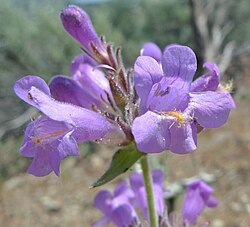
The most defining characteristic of the genus is the staminode, which is an infertile stamen. In many species, this staminode is long and densely hairy, protruding from the flower like a fuzzy tongue—a feature that inspired the common name "beardtongue."
The flowers themselves are bilabiate (two-lipped) and shaped like a funnel or tube. The petals are fused into a five-lobed tube that opens into a throat. The lower lip is typically larger with three lobes, while the upper lip is smaller with two lobes. Leaves also vary significantly between species, ranging from broad and rounded to needle-like, and can be either hairy or glabrous (hairless).
Distribution and Ecology
Penstemons are primarily a Nearctic genus (native to North America), though a few species extend into the Neotropics. Their range is vast: Penstemon gormanii is found in the Northwest Territories of Canada, while Penstemon gentianoides reaches as far south as Guatemala. The state of Utah serves as the center of diversity for the genus, hosting 70 different species.
According to expert Robert Nold, the defining evolutionary trait of Penstemon is its adaptation to drought, which explains why they are so prevalent in the interior west of North America. They can be found in habitats as diverse as open deserts, moist forests, and high alpine zones.
Pollination Strategies
Penstemons have evolved two primary pollination syndromes to ensure reproduction:
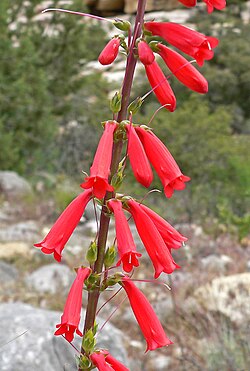
- Hummingbird Adaptation: These species typically feature red or magenta flowers with narrow tubes. They produce larger quantities of nectar located deep within the corolla throat to attract birds.
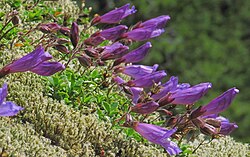
- Bee Adaptation: This is the ancestral trait of the genus. Bee-adapted species usually have blue or purple flowers, wider tubes, and a longer lower lip that serves as a landing platform. They generally produce less nectar than hummingbird-pollinated species.
Taxonomy and Scientific History
The scientific naming of Penstemon has a complex history. The first description was published by John Mitchell in 1748, though botanical priority is given to Casimir Schmidel, who published a description in 1763. The name is derived from the Greek "penta-" (five), referring to the unusual fifth stamen.
Taxonomically, the genus is divided into six subgenera based on anther dehiscence (the way the pollen-bearing part of the stamen opens). These include Cryptostemon, Dissecti, Penstemon, Habroanthus, Saccanthera, and Dasanthera. While some of these groupings are natural, genetic analysis suggests others are more confused.
Horticulture and Cultivars
While native to the Americas, much of the hybridization of Penstemon occurred in Europe during the 19th century. Growers in France, Germany, and Britain developed hundreds of varieties. For example, the Scottish firm John Forbes offered 550 varieties by 1900.
In modern landscaping, penstemons are frequently used in xeriscaping—a gardening method that reduces or eliminates the need for supplemental water—because many species are naturally hardy and drought-tolerant. The American Penstemon Society, formed in 1946, now serves as the International Cultivar Registration Authority for the genus.
Key Facts
- Endemic Status: The largest genus of flowering plants endemic to North America.
- Species Count: At least 281 valid species according to WFO and POWO as of 2024.
- Defining Feature: The staminode (an infertile stamen), often hairy.
- Diversity Hub: Utah is the center of diversity with 70 species.
- Color Palette: Most commonly blue, but also found in red, purple, pink, white, and rarely yellow.
- Pollinators: Primarily adapted for either bees or hummingbirds.
Penstemon Summary Table
| Feature | Details |
|---|---|
| Scientific Family | Plantaginaceae |
| Common Name | Beardtongue |
| Native Range | North America (Canada to Central America) |
| Flower Structure | Bilabiate, fused petals, 5-lobed tube |
| Growth Forms | Perennials, shrubs, subshrubs |
| Primary Pollinators | Bees and Hummingbirds |
Frequently Asked Questions
Why are they called "beardtongues"?
The name comes from the staminode, an infertile stamen that is often long and covered in hairs, resembling a fuzzy tongue protruding from the flower's mouth.
Are penstemons toxic?
There are no widespread reports of poisonings, and relatively little is known about their overall toxicity. However, some species, such as the dusky penstemon (Penstemon whippleanus), are known to contain several alkaloids.
What colors do penstemon flowers come in?
Shades of blue are the most frequent. They are also commonly white, violet, purple, pink, magenta, and red. Pale cream or ivory yellow is very rare.
How do hummingbird-pollinated species differ from bee-pollinated ones?
Hummingbird-pollinated species typically have red or magenta flowers with narrow tubes and deep nectar reserves. Bee-pollinated species usually have blue or purple flowers with wider tubes and a prominent lower lip for landing.
Where is the best place to find the highest variety of Penstemons?
The state of Utah is considered the center of diversity for the genus, hosting 70 different species.