Pawnee Bill's Wild West Shows and Legacy
The era of the American frontier was not only defined by settlers and scouts but also by the spectacular entertainment that brought the myth of the West to the masses. At the center of this phenomenon was Gordon Lillie, better known as Pawnee Bill, whose vision for Wild West shows blended athletic skill, cultural diversity, and theatrical flair.
The Partnership of Gordon and May Lillie
Behind the success of Pawnee Bill was a partnership built on both love and business. In 1886, Gordon Lillie married May Manning, a Smith College graduate and the daughter of a wealthy Philadelphia physician. Despite initial objections from her parents—who were hesitant to see their refined daughter marry a cowboy—the union was eventually blessed.
May was far more than a supportive spouse; she became a central attraction in her own right. In their performances, she took the stage as the "Champion Girl Horseback Shot of the West," showcasing the skill and bravery associated with frontier life.
The Evolution of the Wild West Show
In 1888, the couple launched their first venture, Pawnee Bill’s Historic Wild West. While the initial season proved to be a financial disaster, the Lillies demonstrated resilience by reorganizing into a smaller, more focused operation: "Pawnee Bill’s Historical Wild West Indian Museum and Encampment Show." This iteration found both popularity and financial stability.
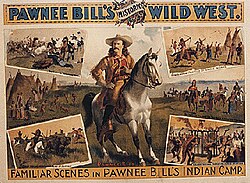
Expanding the Cast and Vision
As the show grew, Lillie expanded his roster to include diverse talents. He added Jose Barrera, who became a crowd favorite performing under the name "Mexican Joe." Between 1901 and 1905, Mamie Francis also performed with the troupe.
By 1907, Lillie shifted his focus toward a more global spectacle. He hired a multicultural ensemble that included Mexican cowboys, Pawnee people, Japanese performers, and Arab jugglers. This diverse cast debuted under the title "Pawnee Bill’s Great Far East Show."
The "Two Bills" Collaboration
In 1908, a landmark collaboration occurred when Pawnee Bill joined forces with the legendary Buffalo Bill to create the "Two Bills' show." Despite the combined star power of the two most famous figures in Wild West entertainment, the venture ended in financial hardship, eventually facing foreclosure while playing in Denver, Colorado.
Life Beyond the Stage
While Gordon Lillie traveled on tour, May managed the family's buffalo ranch, now recognized as the Pawnee Bill Ranch. The couple's personal life mirrored their success in the arts; in 1910, they completed the construction of their Arts-and-Crafts style home located on Blue Hawk Peak.
Key Facts
- Founding: The first show launched in 1888.
- Key Performers: May Manning (Champion Girl Horseback Shot), Jose Barrera (Mexican Joe), and Mamie Francis.
- Global Reach: The "Great Far East Show" featured performers from Japan, Mexico, and Arab regions.
- Major Collaboration: The "Two Bills' show" combined the talents of Pawnee Bill and Buffalo Bill.
- Home Base: The couple resided in an Arts-and-Crafts home on Blue Hawk Peak and operated the Pawnee Bill Ranch.
| Year | Show/Event Name | Outcome/Note |
|---|---|---|
| 1888 | Pawnee Bill’s Historic Wild West | Initial financial failure |
| Post-1888 | Historical Wild West Indian Museum and Encampment Show | Financial success |
| 1907 | Pawnee Bill’s Great Far East Show | Featured international performers |
| 1908 | Two Bills' show | Foreclosed in Denver, Colorado |
| 1910 | Blue Hawk Peak Home | Completion of Arts-and-Crafts residence |
Frequently Asked Questions
Who was May Manning?
May Manning was the wife of Gordon Lillie (Pawnee Bill). A Smith College graduate from a wealthy Philadelphia family, she was a skilled performer known as the "Champion Girl Horseback Shot of the West" and managed the Pawnee Bill Ranch.
What happened to the "Two Bills' show"?
Despite the combined fame of Pawnee Bill and Buffalo Bill, the show suffered financial difficulties and was foreclosed upon while performing in Denver, Colorado.
How did the "Great Far East Show" differ from previous shows?
Unlike the earlier frontier-focused shows, the Great Far East Show was a multicultural production featuring Japanese performers, Arab jugglers, Mexican cowboys, and Pawnee people.
What was the first successful version of Pawnee Bill's show?
After the initial failure of "Pawnee Bill’s Historic Wild West," the couple found success with the "Pawnee Bill’s Historical Wild West Indian Museum and Encampment Show."
Where did Pawnee Bill and his wife live?
The Lillies lived in an Arts-and-Crafts style home on Blue Hawk Peak, which they completed in 1910.