Pauly–Wissowa: The Definitive Encyclopedia of Classical Antiquity
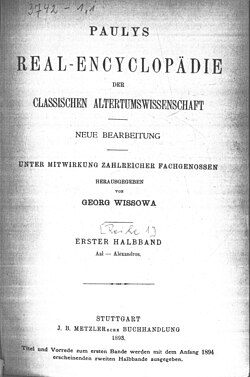
The Pauly–Wissowa, formally known as Paulys Real-Encyclopädie der Classischen Altertumswissenschaft (Pauly's Practical Encyclopedia of the Study of Classical Ancient History), stands as one of the most ambitious scholarly undertakings in the field of classical studies. Commonly abbreviated as RE, this monumental work serves as a comprehensive reference for the history, culture, and language of the ancient world.
The project was initiated in 1890 by Georg Wissowa, who sought to create a more expansive edition than previous efforts. While the original goal was to complete the work by 1900, the sheer scale of the project meant that it far outlasted its founding editor. The leadership of the series eventually passed to Wilhelm Kroll, Kurt Witte, Karl Mittelhaus, and Konrat Ziegler.
Key Facts
- Full Title: Paulys Real-Encyclopädie der Classischen Altertumswissenschaft.
- Timeline: Work began in 1890 and the main series was completed in 1972.
- Final Additions: Supplements were added until 1978, with the final index published in 1980.
- Authorship: Every article was penned by a recognized specialist in the specific field of study.
- Scope: Spans three generations of scholarship, reflecting the evolving academic assumptions of the 19th and 20th centuries.
- Notable Contributors: Early biographies were authored by scholars such as Elimar Klebs, Paul von Rohden, Friedrich Münzer, and Otto Seeck.
Structure and Publication History
The RE is organized into two primary series based on alphabetical ranges, supplemented by a series of additive volumes. Because the work was produced over several decades, it is divided into Bände (volumes) and Halbbände (half-volumes).
First Series (A–Q)
The first series covers the alphabetical range from A to Q. It began with Band I (Halbbände 1–2) in 1894, covering entries from Aal to Apollokrates, and concluded with Band XXIV (Halbband 47) in 1963, ending with Quosenus.
Second Series (R–Z)
The second series addresses the remaining alphabet from R to Z. This series began in 1914 with Band IA (Halbband 1) and reached its conclusion in 1972 with Band XA (Halbband 19), covering entries from Zenobia to Zythos.
Supplements and Indices
To keep the encyclopedia current, a series of Supplementbände (supplementary volumes) were published. These began in 1903 with Supplementband I and continued through 1978 with Supplementband XV. The entire project was finalized with the publication of the index in 1980.
Publication Summary
| Section | Alphabetical Range | Start Year | End Year |
|---|---|---|---|
| First Series | A–Q | 1894 | 1963 |
| Second Series | R–Z | 1914 | 1972 |
| Supplements | Various | 1903 | 1978 |
| Final Index | N/A | N/A | 1980 |
Frequently Asked Questions
What is the Pauly–Wissowa?
It is a comprehensive encyclopedia of classical antiquity, formally titled Paulys Real-Encyclopädie der Classischen Altertumswissenschaft, designed to provide detailed scholarly information on the ancient world.
Who were the primary editors of the RE?
The work was started by Georg Wissowa and continued by Wilhelm Kroll, Kurt Witte, Karl Mittelhaus, and Konrat Ziegler.
How long did it take to complete the encyclopedia?
The process spanned nearly a century, starting in 1890 and concluding with the final index in 1980.
Why do the articles in the RE vary in perspective?
Because the work was written over three generations, the underlying academic assumptions and methodologies vary depending on the age of the specific article.
How is the work organized?
The encyclopedia is divided into two main alphabetical series (A–Q and R–Z), further subdivided into volumes (Bände) and half-volumes (Halbbände), with additional supplementary volumes.