Papworth's Ordinary: A Landmark in British Heraldic Reference
In the world of heraldry, identifying a coat of arms often requires a specialized tool known as an ordinary—a reference work where arms are arranged by their design rather than by the family name. While such rolls have existed since the Middle Ages, they were historically limited in scope. This changed with the publication of An Alphabetical Dictionary of Coats of Arms belonging to Families in Great Britain and Ireland, more commonly known as Papworth's Ordinary.
This monumental work introduced an entirely new plan for organizing British armorials, transforming how researchers and historians track heraldic designs across the British Isles.
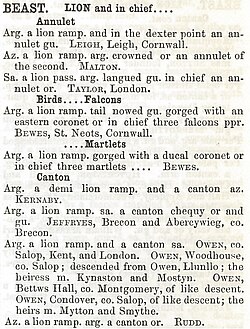
The Development and Publication Process
The creation of the Ordinary was a lifelong endeavor for Papworth, who began the arduous task of compilation in 1847. To build his database, he relied heavily on Burke's General Armory (first published in 1842), a collection of arms arranged alphabetically by surname. Papworth meticulously copied entries from the third edition and its supplement onto slips of paper, which he then rearranged according to his own systematic scheme of blazon—the formal technical description of a coat of arms.
The path to publication was gradual. After issuing a prospectus in 1857, Papworth released the work in installments. By 1863, nine parts had been published, and by the time of his death in 1870, fourteen parts had appeared, reaching page 696.
The project was brought to fruition by Alfred William Morant (1828–1881), who edited the remaining 429 pages using Papworth's original materials. The final volume was overseen by Wyatt Papworth and published in 1874, containing approximately 50,000 entries.
Key Facts
- Full Title: An Alphabetical Dictionary of Coats of Arms belonging to Families in Great Britain and Ireland.
- Total Entries: Approximately 50,000.
- Publication Date: Completed in 1874.
- Primary Source: Heavily based on Burke's General Armory.
- Legacy: Its classification system remains the basis for most modern ordinaries.
- Reprint History: Reprinted in 1961, 1977, and 1985.
Analysis of the System: Strengths and Weaknesses
The Rigor of Classification
The enduring legacy of Papworth's Ordinary is its rigorous system of classification by blazon. By organizing arms by their visual components rather than names, Papworth created a functional tool for identification. This methodology was so effective that, with only minor modifications, it continues to serve as the foundation for heraldic ordinaries published today.
Dependence and Distribution
Despite its structural brilliance, the work had notable drawbacks. Because it relied on secondary sources like Burke's General Armory, it inherited the errors and omissions present in those earlier texts.
Additionally, the book is known for an unbalanced alphabetical distribution. Because Papworth grouped all animal charges under the heading "Beast" and all birds under "Bird," the sections from A to F contain roughly 80% of the entire book. This quirk was so pronounced that Papworth had to personally reassure subscribers who were concerned about the uneven progress of the installments.
| Milestone | Year/Detail |
|---|---|
| Work Commenced | 1847 |
| Prospectus Published | 1857 |
| Death of Papworth | 1870 (at page 696) |
| Final Completion | 1874 (by A.W. Morant and Wyatt Papworth) |
| Total Volume Size | ~1,125 pages / 50,000 entries |
Frequently Asked Questions
What is a heraldic ordinary?
An ordinary is a reference book or roll of coats of arms that are arranged by their design (blazon) rather than by the name of the family to whom they belong.
How did Papworth compile his dictionary?
Papworth used Burke's General Armory as a primary source, copying entries onto slips of paper and rearranging them according to a systematic classification of heraldic designs.
Who finished the work after Papworth's death?
Alfred William Morant edited the final 429 pages from Papworth's materials, and Wyatt Papworth saw the complete volume through the press.
Why is the book's alphabetical distribution unbalanced?
The distribution is skewed because Papworth categorized all birds under "Bird" and all animals under "Beast," resulting in the A–F sections containing about 80% of the content.
Is Papworth's Ordinary still relevant today?
Yes, it established itself as a standard reference work and its system of classification by blazon remains the basis for most ordinaries published since its inception.