Papal Conclave: The History and Process of Electing the Pope
A conclave is the formal gathering of the College of Cardinals convened to appoint the pope of the Catholic Church. In Catholic theology, the pope is regarded as the earthly head of the Church and the apostolic successor of Saint Peter. The process of selecting this leader has evolved over nearly two millennia, transforming from local acclamation to a highly regulated, secluded electoral process.
Key Facts
- Location: Modern conclaves are held in the Sistine Chapel within the Apostolic Palace in Vatican City.
- Electors: Only cardinals under the age of 80 are eligible to vote.
- Requirement: A two-thirds majority is traditionally required to elect a new pope.
- Seclusion: The term "conclave" comes from the Latin cum clave, meaning "with a key," referring to the locking of electors in seclusion.
- Signaling: Black smoke indicates no pope has been elected; white smoke signals a successful election.
Historical Development of the Election
From the Apostolic Age until 1059, the pope was chosen by the consensus of the local clergy (priests and deacons) and the laity of the diocese. This changed in 1059 when the College of Cardinals was designated as the sole body of electors.
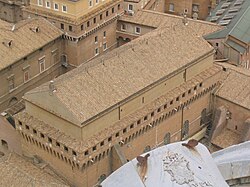
Political interference often plagued early elections. Following a prolonged interregnum from 1268 to 1271, Pope Gregory X issued a decree during the Second Council of Lyons in 1274. He mandated that cardinal electors be locked in seclusion and forbidden from leaving until a new pope was chosen to prevent outside influence.
Evolution of the Electorate
During the Middle Ages and Renaissance, the number of cardinals was often very small—sometimes as few as seven. This small group made familial and political allegiances powerful, often leading to conclaves that lasted months or years. To speed up the process, Gregory X's 1274 decree included rationing food for cardinals if a decision was not reached by the fourth and ninth days.
The composition of the College has also shifted. Until 1899, some lay members (nobility or non-priest monks) were included, provided they were celibate. By 1917, the Code of Canon Law required all cardinals to be priests. Since 1962, almost all cardinals have been bishops. In 1970, Pope Paul VI introduced the age limit, ruling that cardinals 80 or older cannot participate in the election.
The Election Process
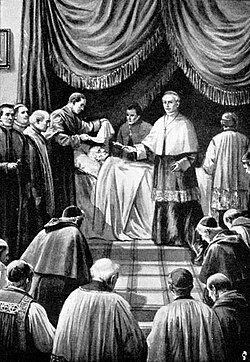
The process begins after the death or resignation of a pope. A vacancy may occur through death or, more rarely, resignation, as seen with Benedict XVI in 2013. The camerlengo is the official responsible for proclaiming the papal death.
Preparation and Seclusion
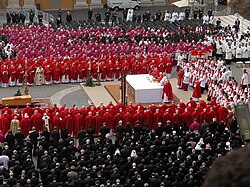
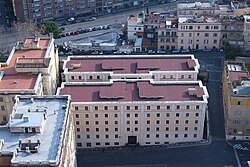
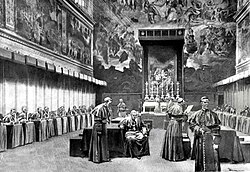
Before the Sistine Chapel is sealed, cardinals attend two sermons designed to reflect on the state of the Church and the qualities needed in a future leader. Once the conclave begins, the electors reside in the Domus Sanctae Marthae.
Voting and Scrutiny
The current method of election is scrutiny (secret balloting). While methods like acclamation and compromise were used in the past, they were formally abolished in 1996 by the constitution Universi Dominici gregis. Electors use simple cards printed with the Latin phrase "I elect as Supreme Pontiff."
![Cardinals formerly used these intricate ballot papers, one of which is shown folded above. The text Latin reads "Name" and "Signature" at bottom, with the middle text translating to, "I choose as Supreme Pontiff my most reverend lord, the Lord Cardinal [name]." Currently, the ballots are simple cards, folded once, like a note card, with the words "I elect as Supreme Pontiff" printed in Latin on them.](/images/06/07/0607a427801502981e017f85bda1d69d80aa3139853758fbaa207613563dec30.jpg)
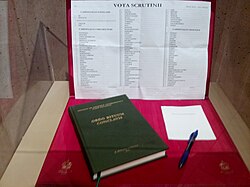
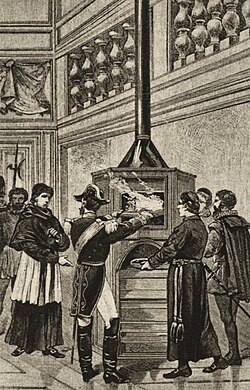
The voting process involves multiple rounds. If a candidate receives the necessary two-thirds majority, they are elected. Historically, ballots were burned to maintain secrecy, and the resulting smoke was used to communicate the outcome to the public.
The Smoke Signals (Fumata)
The world watches the chimney of the Sistine Chapel for the fumata. Black smoke indicates that the voting has not yet resulted in a two-thirds majority.
![Black smoke in the Sistine Chapel, indicating there has been no two-thirds majority necessary for a papal election[100]](/images/82/28/8228d4bfa90e2f42b3f6459ca1806af78c98d54d31d9c3459014de9f406788e6.jpg)
White smoke indicates that a new pope has been elected by the College of Cardinals.
![White smoke in the Sistine Chapel, indicating that a pope has been elected by the College of Cardinals.[100]](/images/db/a0/dba0ffe1c723c8ad3cc1f911af7c61086c76ee6d2343e86ac794dce3ccd4e0fe.jpg)
Acceptance and Proclamation
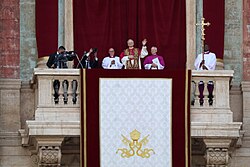
Once elected, the new pope is asked if he accepts the appointment and chooses a papal name. He then makes his first public appearance, typically waving from the central loggia of St. Peter's Basilica.
The Secretary Tradition
A long-standing tradition allows the new pope to give his cardinalitial zucchetto (skull cap) to the secretary of the conclave. This gesture indicates that the secretary will be made a cardinal at the next consistory. This occurred in 1958 with Pope John XXIII and in 2013 with Pope Francis.
Summary of Papal Election Evolution
| Period/Year | Key Change | Authority/Event |
|---|---|---|
| Pre-1059 | Chosen by clergy and laity consensus | Apostolic Age |
| 1059 | College of Cardinals becomes sole electors | In nomine Domini |
| 1274 | Introduction of locked seclusion (conclave) | Pope Gregory X |
| 1970 | Electors limited to those under 80 years old | Pope Paul VI |
| 1996 | Abolition of acclamation and compromise | Universi Dominici gregis |
| 2007 | Reinstatement of strict two-thirds majority | Pope Benedict XVI |
Frequently Asked Questions
Who is eligible to be elected pope?
While the pope is the bishop of Rome, he does not need to be Italian. Historically, candidates were drawn from the College of Cardinals, though the Church does not strictly require the pope to be a cardinal. However, because the Church holds that women cannot be ordained, women are not eligible for the papacy.
What happens if the cardinals cannot agree on a candidate?
If a deadlock occurs, the cardinals continue voting in rounds of scrutiny. In the past, local authorities sometimes forced seclusion or restricted food to speed up the process. Today, the process continues until a two-thirds majority is reached.
What is the significance of the smoke colors?
The smoke is a signal to the public. Black smoke means no pope has been elected yet. White smoke means a candidate has reached the required majority and a new pope has been chosen.
Can a pope resign?
Yes. While rare, a pope can resign. This happened in 1415 with Gregory XII and in 2013 with Benedict XVI. The procedures for a vacancy caused by resignation are the same as those for a vacancy caused by death.
How many cardinals can vote in a conclave?
Pope Paul VI set a theoretical limit of 120 cardinal electors in 1975, though this has been exceeded at times. For example, the 2025 papal conclave saw 133 cardinal-electors participate.