Panther Store: A Hub of Community and Commerce in Washington Township
In the heart of Washington Township, where the border meets Colfax Township along what is now Iowa Highway 44, once stood a cornerstone of rural life: the Panther Store. Originally situated along a route known as the Panora Speedway, this establishment evolved from a cooperative venture into a vital center for trade, communication, and social interaction for local farmers and their families.
The Origins of the Panther Co-operative Association
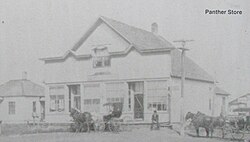
Before 1900, a group of local farmers took the initiative to establish a formal business structure. By forming a board and selling shares, they created the Panther Co-operative Association. This cooperative built the Panther Store on the northwest corner of the intersection of Highway 44 and J Avenue. Under the operation of Isarel Bever, the store began handling a wide array of essential commodities for the surrounding agricultural community.
The area surrounding the store quickly grew into a small commercial cluster. To the northeast, a blacksmith shop was established to service livestock and machinery. Meanwhile, on the southwest corner within Colfax Township, Will Bazor opened a "tin shop," specializing in the construction and repair of windmills, which were critical for farm operations at the time.
Expansion and the Sheaffer Era
The ownership of the store shifted around 1934 when John and Mart Sheaffer purchased the entirety of the Co-operative Association. Under their full ownership, the store continued to serve as a primary resource for the region. The building was designed for utility, featuring living quarters for the manager located in the rooms above the main storefront.
The store became a bustling social hub, particularly on rainy days and Saturday afternoons. During these times, the hitching racks were filled with horse-drawn teams as farmers gathered to stock up on a vast inventory of goods, including:
- Dry goods and apparel: Men's overalls, shirts, shoes, and mittens.
- Household essentials: Groceries, canned goods, kerosene, and tobacco.
- Hardware and tools: Ammunition and shucking pegs.
- Treats: A variety of candies.
Trade and Logistics
Beyond selling retail goods, the Panther Store acted as a produce buyer, purchasing butter, cream, eggs, and poultry from local producers. It also functioned as an ordering agent for larger items such as furniture, fencing materials, farm machinery, wagons, and buggies. These larger orders were typically shipped to Dallas Center before being hauled to the store by teams.
As technology advanced, the reliance on horse-drawn wagons faded. The introduction of cars and trucks allowed for more direct supply runs from Des Moines and necessitated the installation of a gasoline pump to accommodate motorized travel.
A Center for Communication and Recreation
The Panther Store served as more than just a place of business; it was the community's primary communication link. For a period, a post office operated within the store. Mail was held there for pickup, and neighbors often assisted one another by fetching mail for those living nearby. Robert Bentall recalls a system of pigeon-holed racks used to hold mail for friends to collect at his home.
The store also functioned as a recreational center for the men of the community. It was a venue for friendly competition and physical contests, including boxing, wrestling, ball games, and "pulling square holds."
Key Facts
- Location: Northwest corner of Highway 44 and J Avenue, Washington Township.
- Founding: Established before 1900 as the Panther Co-operative Association.
- Ownership: Purchased by John and Mart Sheaffer around 1934.
- Services: Retail store, produce buyer, post office, and gasoline station.
- Neighboring Businesses: A blacksmith shop and Will Bazor's windmill tin shop.
| Category | Details |
|---|---|
| Retail Goods | Groceries, clothing, kerosene, ammunition, and candy. |
| Purchased Produce | Poultry, eggs, cream, and butter. |
| Special Orders | Farm machinery, wagons, buggies, and furniture. |
| Community Roles | Post office and recreational center for sports. |
Frequently Asked Questions
What was the Panther Co-operative Association?
It was a business entity formed before 1900 by a group of farmers who sold shares to fund the construction and operation of the Panther Store.
Who owned the store in the 1930s?
Around 1934, John and Mart Sheaffer bought out the Co-operative Association to become the full owners of the store.
How did the store handle large equipment orders?
Orders for machinery, furniture, and wagons were shipped to Dallas Center and then transported to the store via horse-drawn teams.
What role did the store play in local communication?
The store housed a post office for a short time, serving as a central point where neighbors could pick up their mail.
What recreational activities took place at the store?
The store was a social hub where local men engaged in wrestling, boxing, ball games, and pulling square holds.