Palmerston Boulevard: A Historic Residential Gem in Toronto
Nestled in the heart of Toronto, Ontario, Palmerston Boulevard stands as a testament to early 20th-century urban elegance. Located two blocks west of Bathurst Street, this residential stretch bridges the vibrant neighborhoods of Koreatown and Little Italy, offering a serene escape defined by its distinct architectural character and lush greenery.
The boulevard is physically demarcated by stone and iron gates at both Bloor Street and College Street, creating a sense of enclosure and prestige. Its aesthetic appeal is further enhanced by symmetrically placed cast-iron lamps and a canopy of mature silver maple trees that provide a timeless atmosphere for residents and visitors alike.
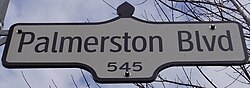
Key Facts
- Location: Toronto, Ontario, between Bloor Street and College Street.
- Construction Era: Most homes were built between 1903 and 1910.
- Defining Features: Cast-iron lamps, silver maple trees, and stone/iron gates.
- Notable Residents: George Weston, Horatio Hocken, and Samuel McBride.
- Former Name: Muter Street.
History and Evolution
Before it became the boulevard known today, the street was named Muter Street, in honor of Lieutenant-Colonel Robert Muter of the Royal Canadian Rifle Regiment. At the turn of the 20th century, as the area underwent significant development, the name was changed to Palmerston. This new name honored Lord Palmerston, the Prime Minister of the United Kingdom, a choice likely intended to promote Victorian ideals to the city's growing population.
While the boulevard is a distinct segment, the name Palmerston continues as Palmerston Avenue, extending north from Bloor Street to the Canadian Pacific Railway tracks and south from College Street to Queen Street.
Architectural Significance
The architectural integrity of the street is well-documented. In 1982, Brown and Storey Architects published Palmerston Boulevard: An Evaluation of a Unique Residential Street. This analysis examined the street's evolution, built form, and landscape, specifically evaluating renovations and key elements like porches and gates.
The study compared Palmerston to other contemporary Toronto streets, including Indian Road, St. George Street, and High Park Boulevard. A central conclusion of the analysis was that the silver maple trees and cast-iron lamps are not merely decorative, but effectively define the space of the boulevard as a passage.
Notable Residences
The street has hosted several prominent figures in Canadian business and politics. The most imposing structure is the George Weston Mansion (#469), which was built across 1.5 lots; George Weston passed away in this residence on April 6, 1924. Additionally, former Toronto mayors Horatio Hocken and Samuel McBride resided at #340 and #351, respectively.
Social Transformation
The demographic makeup of Palmerston Boulevard has shifted significantly over the last century. Initially established as a wealthy Anglo-Saxon enclave, the street transitioned between the 1920s and 1950s to become a primary residence for middle- and upper-middle-class Jewish families, who were frequently excluded from elite WASP (White Anglo-Saxon Protestant) neighborhoods.
By the 1960s, the street's utility shifted again, with some of the grand houses being subdivided into rooming houses to accommodate university students.
| Feature | Details |
|---|---|
| Primary Construction Period | 1903–1910 |
| Key Flora | Silver Maple Trees |
| Boundary Markers | Stone and iron gates |
| Former Name | Muter Street |
| Notable Landmark | George Weston Mansion (#469) |
Frequently Asked Questions
Who was Palmerston Boulevard named after?
The street was named after Lord Palmerston, the Prime Minister of the United Kingdom, to reflect Victorian ideals during the street's development at the turn of the 20th century.
What was the street called before it was renamed Palmerston?
It was originally called Muter Street, named in honor of Lieutenant-Colonel Robert Muter of the Royal Canadian Rifle Regiment.
Which famous figures lived on Palmerston Boulevard?
Notable residents include George Weston (of the George Weston Mansion), and former Toronto mayors Horatio Hocken and Samuel McBride.
What makes the architecture of Palmerston Boulevard unique?
The street is characterized by homes built between 1903 and 1910, symmetrically placed cast-iron lamps, and a canopy of silver maple trees that define the boulevard as a passage.
How did the demographics of the street change over time?
It began as a wealthy Anglo-Saxon enclave, became a hub for middle- and upper-middle-class Jewish residents from the 1920s to the 1950s, and saw some homes converted into student rooming houses in the 1960s.