Palmchat: The Unique Social Bird of Hispaniola
The palmchat (Dulus dominicus) is a medium-sized passerine bird found exclusively on the Caribbean island of Hispaniola, which is shared by the Dominican Republic and Haiti. As the sole representative of both its genus (Dulus) and its family (Dulidae), this bird is a biological anomaly with a lifestyle deeply intertwined with the palm trees of its homeland.
From its distinctive appearance to its extraordinary communal nesting habits, the palmchat is one of the most recognizable avian species in the region. It is so culturally significant that it serves as the national bird of the Dominican Republic.
Key Facts
- Endemic Range: Found only on Hispaniola and the adjacent Saona and Gonâve Islands.
- Unique Status: The only species in the family Dulidae.
- Social Structure: Highly sociable, living in flocks and building massive communal nests.
- Diet: Primarily frugivorous, feeding on fruits, berries, and occasionally insects.
- Conservation: Classified as Least Concern by the IUCN.
Taxonomy and Scientific History
The scientific classification of the palmchat has evolved significantly since the 18th century. It was first described in 1760 by French zoologist Mathurin Jacques Brisson, though it was Carl Linnaeus who provided the recognized binomial name Tanagra dominica in 1766. Initially grouped with tanagers, researchers later discovered that the palmchat is more closely related to waxwings (Bombycillidae) and silky-flycatchers (Ptiliogonatidae).
By 1862, P.L. Sclater moved the species to the subfamily Dulinae, and by 1904, Robert Ridgway elevated it to its own full family, Dulidae. While some scientists have debated whether these related groups should be merged into a single family, the palmchat remains the only species in the genus Dulus. Although a subspecies was proposed for birds on the Gonâve Islands in 1929, most scientists consider the species monotypic, meaning it has no recognized subspecies.
Physical Description
Palmchats are medium-sized birds, typically measuring 18–20 cm (7–8 in) in length and weighing between 41 and 52 g (1.4–1.8 oz). They possess a somewhat unusual appearance, characterized by relatively small heads, long necks, and short, deeply-curved yellow-horn bills.
Their plumage is primarily olive-brown on top and heavily streaked with brown on the underside. The rump and uppertail-coverts are a dark greenish-olive, while the primary feathers exhibit a yellow-green hue. Unlike their relatives, the waxwings, they lack silky plumage. While males and females look nearly identical, males generally have slightly larger wings. Immature birds can be distinguished by their buff-colored rumps and darker throats.
Distribution and Habitat
The palmchat is widespread across Hispaniola, inhabiting elevations from sea level up to 1,800 m (5,900 ft). While they are most common in open savannas where royal palms thrive, they are also found in semi-open areas, broadleaf forests, and pine forests. They are only absent from dense closed forests and the highest mountain peaks.
These birds have adapted remarkably well to human-modified environments, including city parks, gardens, and farmland, provided their preferred food trees are available. They are non-migratory and poor dispersers, which explains why they are not found on neighboring islands, despite a single uncorroborated report from Jamaica.
Social Behavior and Communication
Palmchats are exceptionally sociable. They are frequently seen in small flocks consisting of several pairs and are known to roost in such close proximity that their bodies touch.
Their communication is constant and noisy, consisting of a wide repertoire of gurgling, cheeping, whistling, and cawing. While they do not have a structured song, their sustained chattering is often compared to a simplified version of the common starling's call. One of their most critical vocalizations is a specific alarm call—a "cheer cheer cheer" whistle that drops in pitch—which signals the presence of a predator and prompts the flock to dive into cover.
Breeding and Communal Nesting
The most striking feature of the palmchat's life cycle is its nesting habit. They build massive, conspicuous communal nests made of twigs that can reach up to 2 meters (6.6 ft) in width. These structures are not a single nest but a colony of adjoining nests, where each pair maintains its own separate chamber and entrance.
Typically, these colonies house four to ten pairs, though some have been recorded with up to 50 pairs. Their preferred nesting sites are the Puerto Rico royal palm (Roystonea borinquena) and Hispaniolan silver thatch palms (Coccothrinax argentea), though they will occasionally use coconut palms, cana, or even telephone poles.
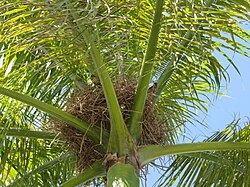
These nests are maintained year-round and serve as roosts outside the breeding season. The breeding season occurs from March to June, with females laying between 2 and 7 eggs. In a rare trait for passerine birds, the chicks hatch completely without feathers, possessing only dark grey skin. Both parents share the responsibility of feeding the chicks, which fledge after approximately 32 days.
Diet and Ecology
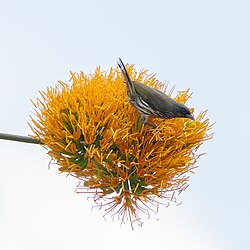
The palmchat's diet consists primarily of plant matter, specifically fruits and berries. Royal palm fruit is a staple, though they also consume the fruit of the gumbo-limbo (Bursera simaruba) and other palms. While they occasionally eat leaves, flowers, and insects, insects are a minor part of their intake and are usually caught in the air or gleaned from trees.
Ecologically, their large nests provide opportunities for other species. The mourning dove, Ridgway's hawk, white-necked crow, and ashy-faced owl have all been known to use palmchat nests. However, the species is also targeted by the shiny cowbird, a brood parasite that lays its eggs in the nests of other birds.
Summary Table: Palmchat Profile
| Feature | Details |
|---|---|
| Scientific Name | Dulus dominicus |
| Family | Dulidae |
| Range | Hispaniola (Dominican Republic & Haiti) |
| Average Length | 18–20 cm |
| Primary Diet | Fruits and berries (especially royal palms) |
| Nesting Style | Communal twig domes |
| Conservation Status | Least Concern |
Frequently Asked Questions
Why is the palmchat unique among birds?
The palmchat is unique because it is the only species in its entire family (Dulidae) and genus (Dulus). It is also noted for its rare communal nesting behavior and the fact that its chicks hatch without any feathers.
Where can the palmchat be found?
It is endemic to the island of Hispaniola, including the Dominican Republic, Haiti, and the nearby Saona and Gonâve Islands.
What do palmchats eat?
Their diet is predominantly plant-based, consisting mainly of fruits and berries from royal palms and gumbo-limbo trees, supplemented occasionally by flowers, leaves, and insects.
How do palmchats build their nests?
They build large, dome-shaped communal structures from twigs. Multiple pairs (sometimes up to 50) build adjoining chambers within one massive structure, typically located in palm trees.
Is the palmchat an endangered species?
No, the palmchat is classified as Least Concern by the IUCN. It has adapted well to human-modified habitats and remains one of the most common birds on Hispaniola.