Palais Garnier: The Architectural Splendor of the Paris Opera
The Palais Garnier stands as a monumental testament to 19th-century opulence and artistic ambition. Designed by architect Charles Garnier (1825–1898), the opera house was constructed in the Napoleon III style, a highly eclectic approach that blended elements of Baroque, Renaissance architecture, and the classicism of Palladio. While its aesthetic looks to the past, the building utilized cutting-edge modern techniques of its time, including an iron framework similar to that used in the Bibliothèque Nationale and Les Halles markets.
Key Facts
- Architectural Style: Napoleon III style, characterized by eclecticism and axial symmetry.
- Capacity: The auditorium seats 1,979 people and features one of Europe's largest stages.
- Artistic Collaboration: The exterior ornamentation involved 14 painters, mosaicists, and 73 sculptors.
- Notable Features: A seven-ton bronze and crystal chandelier and a removable ceiling painted by Marc Chagall.
- Historical Influence: The 1896 chandelier counterweight accident inspired Gaston Leroux's The Phantom of the Opera.
The Exterior: A Masterpiece of Ornamentation
The principal façade faces south, terminating the perspective of the Avenue de l'Opéra. The building's exterior is a dense gallery of sculpture and symbolism. At the highest points of the façade's avant-corps sit two gilt copper electrotype groups by Charles Gumery: L'Harmonie (Harmony) and La Poésie (Poetry).
Below these, the pediments feature sculpted reliefs. The west pediment, by Jean Claude Petit, depicts Architecture and Industry, while the east pediment, by Théodore Gruyère, represents Painting and Sculpture. The base of the avant-corps is further adorned with four major multi-figure groups, including Jean-Baptiste Carpeaux's The Dance, which was famously criticized for its indecency at the time of installation.
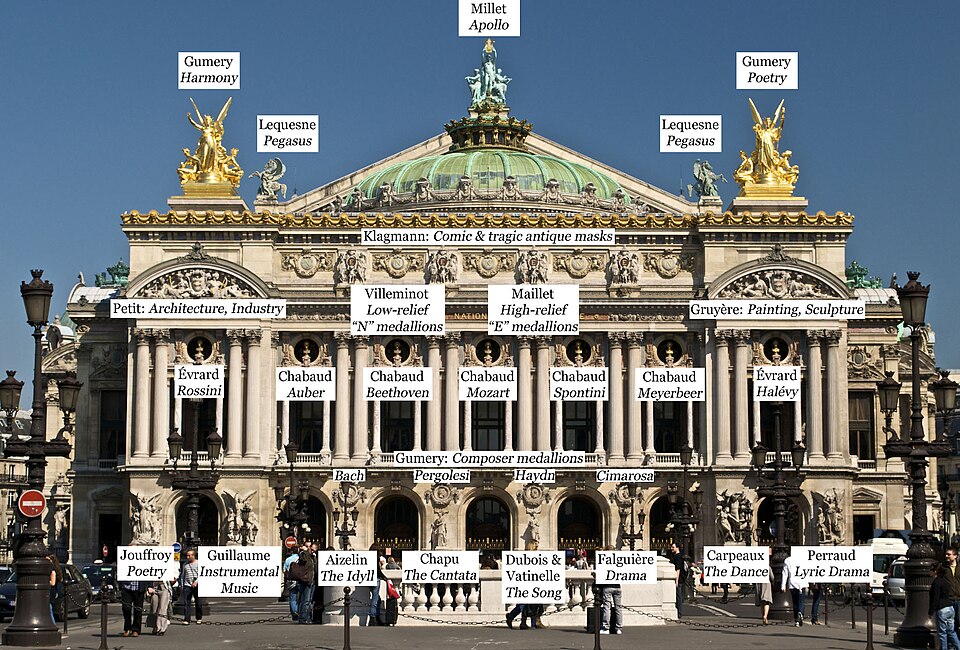
The façade also honors the history of music through gilded galvanoplastic bronze busts of legendary composers, including Beethoven, Mozart, and Rossini, as well as prominent librettists like Eugène Scribe and Philippe Quinault. The attic storey further emphasizes the imperial connection with the monogram "N" and "E" (Napoléon Empereur) integrated into high and low reliefs.
Specialized Pavilions
The building features two distinct side pavilions. The Pavillon de l'Empereur (or Rotonde de l'Empereur) on the west was designed for the Emperor's secure access. Though left unfinished after the fall of the Empire, it now houses the Bibliothèque-Musée de l'Opéra de Paris, containing nearly 600,000 documents. Conversely, the Pavillon des Abonnés on the east provided subscribers direct access from their carriages and is crowned by a 13.5-meter diameter dome.
The Interior: Grandeur and Symbolism
Entering the Palais Garnier leads to the Grand Staircase, a ceremonial marvel of white, red, and green marble. Inspired by the Théâtre de Bordeaux, the staircase is topped by a ceiling painted by Isidore Pils, depicting themes such as The Triumph of Apollo. At the foot of these stairs lies the Cave of Pythia, featuring a statue of the priestess Pythia by Adèle d'Affry, designed to resemble a "gypsy" or Indian fortune teller with snakes curled around her forehead.
The Foyer of Mosaics and Grand Foyer
The Avant Foyer, or "Foyer of Mosaics," serves as a transition to the Grand Foyer. It is decorated with Greek uncial inscriptions and mosaic panels depicting mythological couples, alternating themes of love and death (such as Orpheus and Eurydice). This area also contains gilt bronze medallions representing the musical instruments of Egypt, Greece, Italy, and France.
The Grand Foyer was designed as a social drawing room for Parisian society. Its massive ceiling, painted by Paul-Jacques-Aimé Baudry, illustrates the history of music. The space is further enriched by eight canvases representing the Muses, though Polyhymnia was omitted from the main series due to space constraints, leading to a contemporary artistic protest by Victorin de Joncières.
The Auditorium and the Famous Chandelier
The auditorium follows a traditional Italian horseshoe shape. While the stage is vast enough to hold 450 artists, the ceiling is perhaps its most discussed feature. In 1964, a removable ceiling painted by Marc Chagall was installed over the original work by Jules-Eugène Lenepveu, depicting scenes from operas by 14 different composers.
The center of the room is dominated by a seven-ton bronze and crystal chandelier. Despite criticisms that it obstructed views from the upper boxes, Garnier defended the piece as a source of "joyous life." The chandelier is historically notorious for a 1896 accident where a counterweight fell, killing a concierge—an event that served as the inspiration for a key scene in The Phantom of the Opera.
Summary of Key Architectural Elements
| Section | Key Feature | Notable Artist/Detail |
|---|---|---|
| Main Façade | Gilt Copper Groups | Charles Gumery (Harmony & Poetry) |
| Grand Staircase | Ceiling Paintings | Isidore Pils |
| Avant Foyer | Greek Mosaics | Themes of Love and Death |
| Auditorium | Modern Ceiling | Marc Chagall (1964) |
| Chandelier | 7-Ton Bronze/Crystal | Designed by Charles Garnier |
Frequently Asked Questions
What is the "Napoleon III style"?
The Napoleon III style is a highly eclectic architectural approach that blends various historical influences, including Baroque, Renaissance, and Palladian classicism, often combined with modern materials like iron frameworks.
Who painted the current ceiling of the auditorium?
The current ceiling was painted by Marc Chagall in 1964. It is a removable frame installed over the original ceiling painted by Jules-Eugène Lenepveu.
What is the significance of the chandelier in popular culture?
A real-life accident in 1896, where a counterweight from the chandelier fell into the auditorium, inspired the famous crashing chandelier scene in Gaston Leroux's novel The Phantom of the Opera.
What happened to the original grand organ?
The grand organ, built by Aristide Cavaillé-Coll, fell into poor condition and was out of service for decades. In August 2026, it began being moved to storage at the Opéra Bastille for future relocation.
Is there a restaurant inside the Palais Garnier?
Yes, L'Opéra Restaurant opened in 2011 on the eastern side of the building. Designed by Odile Decq, it is accessible to the general public.