Palace of Versailles: The Pinnacle of French Royal Power and Architecture
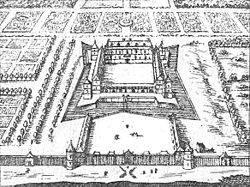
The Palace of Versailles, originally a modest hunting lodge, evolved into one of the most opulent symbols of absolute monarchy in human history. Located in Versailles, France, this masterpiece of French classicism—an architectural style characterized by symmetry, order, and grandeur—served as the seat of the French government and the center of royal life for over a century.
From its expansion under Louis XIV to its current status as a UNESCO World Heritage Site, Versailles represents a visual timeline of French art, politics, and architectural evolution from the 1630s through the 1780s.
Key Facts
- Construction Start: 1661.
- Architectural Style: French classicism.
- UNESCO Status: Inscribed in 1979.
- Total Area: 800 hectares (approximately 2,000 acres).
- Primary Purpose: Centralization of royal power and a showcase of French culture.
- Key Figures: Louis XIV, Jules Hardouin-Mansart, and Louis Le Vau.
The Political Engine of the Sun King
For Louis XIV, Versailles was more than a residence; it was a political tool. By moving the court to Versailles in 1682, the "Sun King" effectively centralized royal power. He required the French nobility to reside at the palace to seek prestige and royal patronage, a strategy that eroded their traditional power bases in the provinces through a strict system of court etiquette.
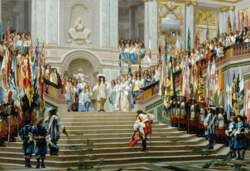
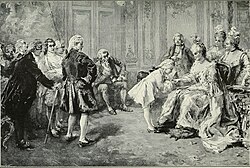
The palace became a global stage for diplomacy. Louis XIV hosted high-profile delegations, including the Doge of Genoa in 1685, an embassy from the Ayutthaya Kingdom in 1686, and an embassy from Safavid Iran in 1715.
Architectural Evolution and Design
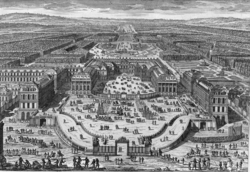
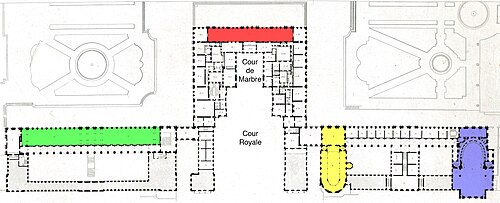
The palace's structure reflects the changing tastes of the French monarchy. The earliest section, the corps de logis (the main residential block), was built for Louis XIII using brick, marble, and slate. In the 1660s, architect Louis Le Vau surrounded this with the Enveloppe, inspired by Italian Renaissance villas.
Later expansions in the 1680s by Jules Hardouin-Mansart followed the model of the Enveloppe, while the 1770s saw the addition of neoclassical elements by Ange-Jacques Gabriel during the remodeling of the Ministers' Wings.
The Ambassador's Staircase
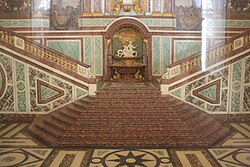
Between 1674 and 1680, François d'Orbay constructed the Ambassador's Staircase. Designed to overawe visitors, the staircase featured a tall, open space lit by a skylight, which stood in stark contrast to the cramped, dark vestibule that preceded it. This grand entrance was later demolished in 1752 by Louis XV to make room for private apartments.
The Hall of Mirrors and State Apartments
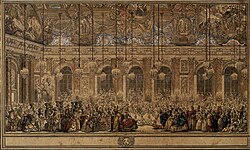
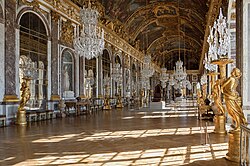
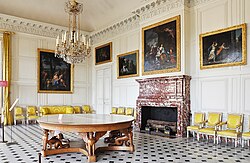
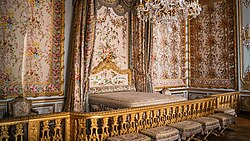
The Hall of Mirrors remains the palace's most iconic room, serving as a gallery of light and power. The State Apartments of the King were designed to reflect the royal image through a series of themed salons, including the Salon of Hercules, the Salon of Apollo, and the Salon of Diana.
The Royal Chapel and Opera
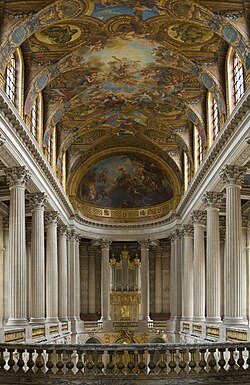
The Royal Chapel, commissioned in 1683–84 by Hardouin-Mansart and Le Brun, was the final major project of Louis XIV's reign, completed in 1710. It underwent a comprehensive restoration between 2017 and 2021. Similarly, the Royal Opera served as a venue for grand celebrations, such as the marriage of Louis XVI and Marie-Antoinette in 1770.
The Estate and Gardens
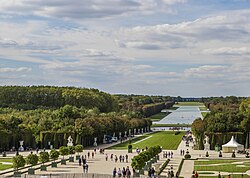
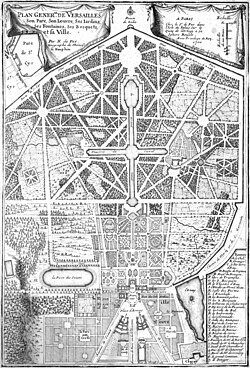
The Versailles estate was vast, once comprising the Grand Parc (a 15,000-hectare hunting ground) and the Petit Parc (the 1,700-hectare gardens). The entire estate was enclosed by a 40-kilometer-long wall with 24 gateways.
Subsidiary Structures
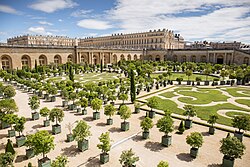
- The Orangery: Built by Le Vau in 1663 and later doubled in size by Mansart.
- The Menagerie: An early zoo built between 1662 and 1664, though it was demolished in 1801.
- Château de Marly: A Palladian-style retreat located 8 kilometers from the main palace.
- The Trianons: The Grand Trianon and Petit Trianon provided more intimate escapes for the royal family, along with the Queen's Hamlet and Theatre.
Versailles Through the Ages
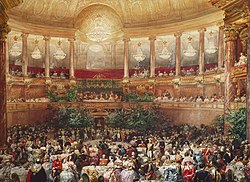
Following the death of Louis XIV in 1715, the palace's cultural dominance wavered. Under Louis XVI, courtiers increasingly preferred the leisure of Paris. In the 19th century, Louis Philippe transformed parts of the palace into the Museum of the History of France, including the Galerie des Batailles (Hall of Battles).
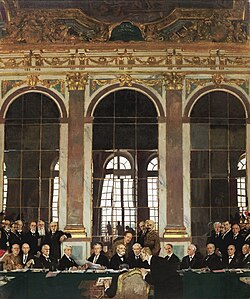
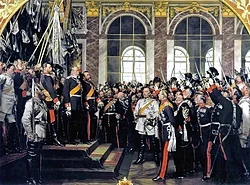
In the 20th and 21st centuries, Versailles transitioned into a site of global diplomacy and national ceremony. It hosted the signing of the Treaty of Versailles in 1919 and continues to host state banquets and presidential addresses, such as those by Nicolas Sarkozy and François Hollande.
| Feature | Details |
|---|---|
| Architectural Style | French Classicism / Neoclassical |
| Key Architects | Louis Le Vau, Jules Hardouin-Mansart, Ange-Jacques Gabriel |
| UNESCO Inscription | 1979 |
| Estate Components | Main Palace, Grand Parc, Petit Parc, Trianons, Orangery |
| Modern Use | Museum, State Ceremonies, Olympic Venue (2024) |
Frequently Asked Questions
![Plan of the main floor in the central part of the palace (c. 1742),[139] showing the grand appartement du roi in dark blue, the appartement du roi in medium blue, the petit appartement du roi in light blue, the grand appartement de la reine in yellow, and the petit appartement de la reine in red](/images/ec/67/ec673fc1d1da5875368b7798ecb1b85b038119515986f3858b0cf6845c533398.jpg)
Why did Louis XIV move the court to Versailles?
Louis XIV moved the court to Versailles to centralize royal power and keep the nobility under his direct supervision. By requiring them to live at the palace, he reduced their ability to maintain independent power bases in their home provinces.
What is the significance of the Hall of Mirrors?
The Hall of Mirrors is a symbol of French artistic achievement and royal prestige. Beyond its architectural beauty, it has been the site of major historical events, most notably the signing of the Peace Treaty ending World War I in 1919.
What are the Trianons?
The Trianons (Grand Trianon and Petit Trianon) were smaller palaces on the estate that allowed the royal family to escape the rigid etiquette and crowds of the main court for more private, intimate gatherings.
Is Versailles still used for political purposes?
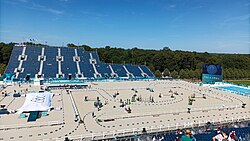
Yes. While it is primarily a museum, it is still used for state visits, banquets, and rare joint sessions of the French Parliament, as well as hosting events for the 2024 Summer Olympics.