Paekche: The Golden Age of the Southwestern Korean Kingdom
Spanning from 18 BCE to 660 CE, Paekche (also known as Baekje) was one of the three major powers that defined the ancient history of the Korean peninsula. Situated in the southwestern region, this kingdom was not only a military contender alongside Goguryeo and Silla but also a sophisticated cultural powerhouse that exerted significant influence across East Asia.
With a population reaching approximately 3,800,000 by the 7th century, Paekche maintained a demographic scale comparable to Goguryeo and far exceeding that of Silla. This human resource fueled its expansion, its complex social structures, and its vibrant artistic traditions.

Key Facts
- Era: 18 BCE – 660 CE (Ancient Period)
- Status: One of the Three Kingdoms of Korea
- Major Capitals: Wirye, Ungjin (Gongju), and Sabi (Buyeo)
- Official Religion: Buddhism (established as state religion in 528 CE)
- Cultural Legacy: UNESCO World Heritage status for Baekje Historic Areas
The Rise and Expansion of Paekche
The kingdom's journey toward becoming a centralized state began during the reign of King Goi (234–286), who consolidated the Mahan confederacy. By 249, records suggest Paekche's influence had reached the Gaya confederacy in the Nakdong River valley.
The kingdom reached its zenith under King Geunchogo (346–375). During his reign, Paekche expanded its territory northward through conflicts with Goguryeo—notably defeating them at Pyongyang in 371—and annexed the remaining Mahan societies in the south. This era established Paekche as a dominant force controlling much of the western Korean peninsula.
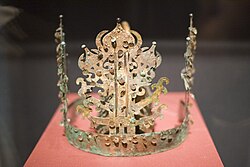
The Ungjin and Sabi Periods
The 5th century brought challenges as Goguryeo exerted southward military pressure, leading to the loss of the Seoul region in 475. Consequently, the capital was moved to Ungjin (modern-day Gongju), marking the start of the Ungjin period. This era was characterized by a period of retreat and reorganization.
In 538, King Seong moved the capital again to Sabi (modern-day Buyeo County), initiating the Sabi period. King Seong even briefly renamed the nation Nambuyeo ("Southern Buyeo") to honor the kingdom's ancestral roots. This period is remembered as a cultural flowering, characterized by the rapid growth of Buddhism and refined artistic expression.
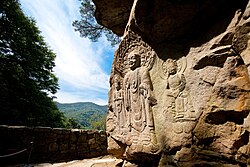
Culture, Religion, and Art
Paekche was a melting pot of ideas, synthesizing Chinese influences with indigenous traditions to create a unique aesthetic. Buddhism, introduced around 384 and formalized as the state religion in 528, became the cornerstone of Paekche's spiritual and artistic life.
The kingdom's art is often noted for the "Baekje smile"—a warm, beatific expression found on many Buddhist sculptures. This warmth is a hallmark of their religious iconography. Beyond Buddhism, Taoism and Shamanism also played roles in the cultural fabric, while the influence of the Chinese Liang dynasty contributed to the sophisticated craftsmanship seen in the Sabi period.
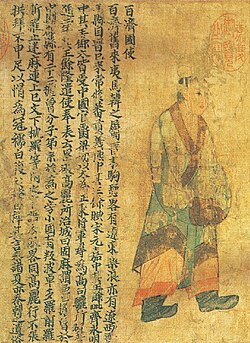
Archaeological Treasures
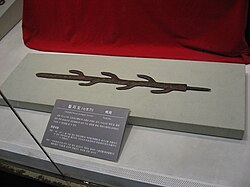
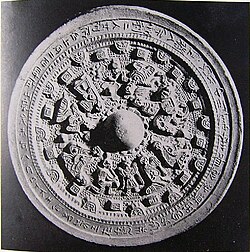
The Tomb of King Muryeong (501–523) serves as a vital archaeological window into the Ungjin period. While the tomb architecture reflects Chinese brick-tomb styles, the funerary objects—including gold crowns, belts, and earrings—are distinctly Paekche in tradition. These artifacts demonstrate the high level of metallurgy and craftsmanship achieved by the kingdom's artisans.
Foreign Relations and the Fall of the Kingdom
Paekche maintained active diplomatic and trade relations with China and Japan. They sent envoys to the Jin and Liang dynasties to acquire technology and cultural goods. In Japan, the cultural impact of Paekche is evident in various archaeological finds, though historical interpretations of specific interactions, such as those mentioned in the Gwanggaeto Stele, remain a subject of scholarly debate.
The kingdom's end came in 660 CE when it was defeated by a joint force of Tang China and Silla. Despite a desperate attempt at revival involving Japanese military support and the Battle of Baekgang in 663, the movement failed. The prince Buyeo Pung escaped to Goguryeo, and Paekche was ultimately absorbed into Unified Silla.
![Guze Kannon is a buddhist statue made in the image of King Seong[note 1] in the Korean style.[37] The statue, originally come from Paekche,[38] is kept in the Dream Hall at the Japanese temple Hōryū-ji.](/images/c0/5d/c05d00ae18e39a1d46660f463658dfcf8de7907c752a1eaab977672a719a1e3b.jpg)
Legacy and Modern Recognition
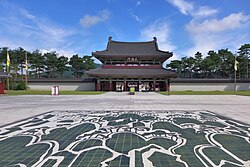
The spirit of Paekche saw a brief resurgence in 892 when General Kyŏn Hwŏn established Later Paekche, though it eventually fell to the Goryeo dynasty in 936. Today, the legacy of the kingdom is preserved through the Baekje Historic Areas, which were designated as a UNESCO World Heritage site in 2015. Visitors can also explore the Baekje Cultural Land, a theme park dedicated to preserving the architecture and culture of this ancient era.
| Period | Capital Location | Key Characteristics |
|---|---|---|
| Early Period | Wirye (18 BCE – 475 CE) | Founding and expansion under King Geunchogo. |
| Ungjin Period | Gomnaru/Ungjin (476–538 CE) | Period of retreat and reorganization after Goguryeo pressure. |
| Sabi Period | Sabi/Soburi (538–660 CE) | Cultural flowering and official establishment of Buddhism. |
Frequently Asked Questions
What were the three kingdoms of Korea?
The three kingdoms were Paekche, Goguryeo, and Silla, which competed for dominance on the Korean peninsula during the ancient period.
When was Buddhism officially adopted in Paekche?
While Buddhism was introduced around 384 CE, it was not officially established as the state religion until 528 CE under King Seong.
Why did the capital move from Wirye to Ungjin?
The capital was moved to Ungjin in 475 CE due to military threats and the loss of the Seoul region to the kingdom of Goguryeo.
What caused the fall of Paekche?
Paekche fell in 660 CE following a military defeat by the combined forces of the Tang dynasty of China and the kingdom of Silla.
How is Paekche culture preserved today?
Paekche's legacy is preserved through UNESCO World Heritage sites known as the Baekje Historic Areas and through cultural sites like the Baekje Cultural Land.