Oxford Dictionary of National Biography
The Oxford Dictionary of National Biography (ODNB) stands as one of the most ambitious biographical projects in history. Published by Oxford University Press, it serves as a definitive record of the individuals who have shaped the British world, blending the rigorous scholarship of the late nineteenth century with the expanded perspectives of the modern era.
The Evolution of the New DNB
In the early 1990s, Oxford University Press began a massive overhaul of the original Dictionary of National Biography (DNB). Starting in 1992, the project—initially called the New Dictionary of National Biography—was led by Colin Matthew, a professor of modern history at the University of Oxford. Matthew's vision was inclusive; he ensured that no subjects from the original dictionary were excluded, regardless of how insignificant they might seem to a modern audience.
While some shorter articles from the original work were retained in revised forms, the vast majority were completely rewritten. To modernize the scope, the editors sought to add approximately 14,000 new subjects. These additions were identified through questionnaires distributed to universities and libraries, and later via online submissions. The selection process involved a rigorous assessment by the editor, 12 external consultant editors, and hundreds of associate editors and staff. The technical process of digitization was handled by the Alliance Photosetting Company in Pondicherry, India.
Scope and Collaborative Research
The ODNB covers British history in a broad sense. This definition includes subjects from Roman Britain, the United States prior to its independence, and individuals from former colonies, provided they were functionally part of the Empire rather than part of an indigenous culture. The dictionary covers figures up to December 31, 2000.
This was a massive collaborative effort, coordinating nearly 10,000 international contributors. While the work remains selective—for instance, it does not list every single member of parliament—it aims to capture significant, influential, or notorious figures across the entire spectrum of life in the United Kingdom and its former colonies. By merging nineteenth-century selections with twentieth-century scholarship, the project sought to create a resource more useful for the future than either era could produce alone.
A Vision for Data Internationalism
Colin Matthew was a strong advocate for the digitization of the ODNB, a philosophy Christopher Warren described as "data internationalism." In 1996, Matthew predicted that national reference works in Europe would eventually aggregate into larger, shared resources, mirroring how the computer was collapsing national library catalogues into worldwide series.
Publication and Digital Access
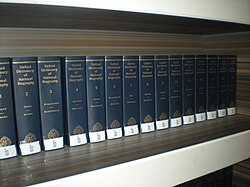
Following Colin Matthew's death in October 1999, Brian Harrison took over as editor in January 2000. The final work, renamed the Oxford Dictionary of National Biography, was published on September 23, 2004. It was released in two formats: a 60-volume print set (originally priced at £7,500) and a subscription-based online edition. Today, most UK library card holders can access the digital version for free.
At the time of its 2004 launch, the ODNB contained 50,113 biographical articles covering 54,922 lives. It preserved all subjects from the original DNB, and users can still access the original entries via a link to the "DNB Archive." Following Harrison, Lawrence Goldman became editor in October 2004, overseeing the first online updates in early 2005. These updates included individuals who died in 2001 and 2002, as well as figures who became notable to historians after the original DNB was published, such as William Eyre (fl. 1634–1675).
The online edition features an advanced search facility that allows users to filter by religion, area of interest, and specific life events, dates, or places through a specialized electronic index.
Reception and Leadership
The reception of the ODNB has been largely positive, highlighted by the American Library Association awarding it the prestigious Dartmouth Medal in 2005. While some newspapers reported factual inaccuracies shortly after publication, the scale was minimal: only 23 of the 50,113 articles were publicly queried, resulting in fewer than 100 substantiated amendments. The online edition continues to be updated as corrections and additions are approved.
The leadership of the ODNB has transitioned through several distinguished historians. Sir David Cannadine assumed the editorship in October 2014, and William Whyte is scheduled to succeed him as general editor in August 2026.
Key Facts
- Total Articles: 50,113 articles covering 54,922 lives at the 2004 launch.
- Print Format: Published in 60 volumes.
- Scope: British history (broadly defined) up to December 31, 2000.
- Contributors: Nearly 10,000 international contributors.
- Award: Recipient of the 2005 Dartmouth Medal from the American Library Association.
- Access: Available in print and via a subscription-based online edition (free for most UK library card holders).
| Editor | Term Start | Key Milestone |
|---|---|---|
| Colin Matthew | 1992 | Initiated the overhaul and digitization process |
| Brian Harrison | January 2000 | Oversaw the 2004 official publication |
| Lawrence Goldman | October 2004 | Managed early online updates and expansions |
| Sir David Cannadine | October 2014 | Continued editorial leadership |
| William Whyte | August 2026 (Expected) | Future General Editor |
Frequently Asked Questions
What is the difference between the DNB and the ODNB?
The DNB refers to the original Dictionary of National Biography, while the ODNB is the updated, expanded, and digitized version published by Oxford University Press in 2004. The ODNB includes all subjects from the original but adds thousands of new entries and updated scholarship.
Who is included in the Oxford Dictionary of National Biography?
The dictionary includes significant, influential, or notorious figures from the United Kingdom and its former colonies, as well as subjects from Roman Britain and the pre-independence United States, provided they were functionally part of the British Empire.
How can I access the ODNB for free?
Most individuals who hold a current library card in the United Kingdom can access the online edition of the ODNB free of charge.
How does the ODNB handle factual errors?
The editors maintain an ongoing program to assess proposed corrections. When a factual amendment is substantiated and approved, it is incorporated into the online edition of the dictionary.
Does the ODNB include people who died after 2000?
Yes. While the initial scope was up to December 31, 2000, the online edition has been updated with subjects who died in subsequent years, such as those who passed away in 2001 and 2002.